

E1C09 09/14/2010
15:5:2 Page 421
up to 2 m. Engineer A suggests very small 2-mm-diameter tubing to reduce air volume so as to
increase response time. Engineer B disagrees and suggests 5-mm tubing to balance air friction with
air volume to increase response time. Offer your opinion and its basis. (Hint: Look at length-todiameter effects.)
9.31 Show that Equation 9.23 can be reduced to the fundamental form of Equation 9.22 in terms of system
inertance, resistance, and compliance.
9.32 Apply a circuit analysis to an RLC analog of Figure 9.22 showing the steps to achieve Equations 9.21
through 9.23. Use the direct analogy equating E a ; E m with p a ; p m , respectively.
9.33 Determine the resolution of a manometer required to measure the velocity of air from 5 to 50 m/s
using a pitot-static tube and a manometer fluid of mercury (S ¼ 13.57) to achieve a zero-order
uncertainty of 5% and 1%.
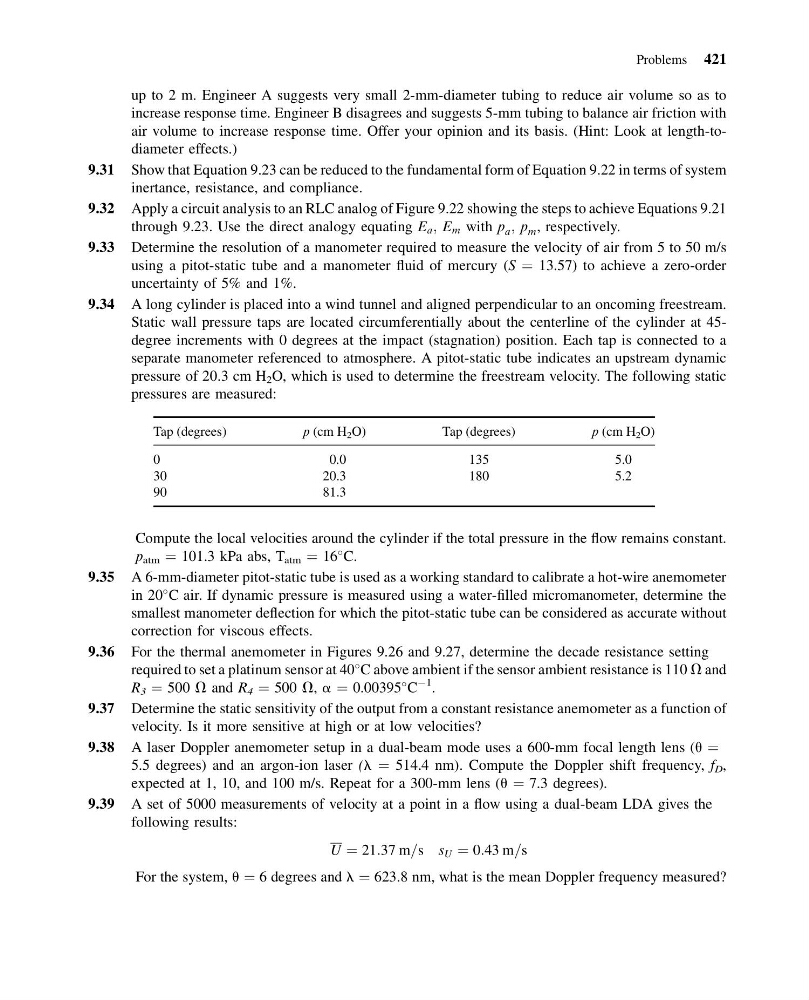
9.34 A long cylinder is placed into a wind tunnel and aligned perpendicular to an oncoming freestream.
Static wall pressure taps are located circumferentially about the centerline of the cylinder at 45degree increments with 0 degrees at the impact (stagnation) position. Each tap is connected to a
separate manometer referenced to atmosphere. A pitot-static tube indicates an upstream dynamic
pressure of 20.3 cm H 2 O, which is used to determine the freestream velocity. The following static
pressures are measured:
Tap (degrees)
p (cm H 2 O)
Tap (degrees)
p (cm H 2 O)
0
0.0
135
5.0
30
20.3
180
5.2
90
81.3
Compute the local velocities around the cylinder if the total pressure in the flow remains constant.
p atm ¼ 101.3 kPa abs, T atm ¼ 16
C.
9.35 A 6-mm-diameter pitot-static tube is used as a working standard to calibrate a hot-wire anemometer
in 20
C air. If dynamic pressure is measured using a water-filled micromanometer, determine the
smallest manometer deflection for which the pitot-static tube can be considered as accurate without
correction for viscous effects.
9.36 For the thermal anemometer in Figures 9.26 and 9.27, determine the decade resistance setting
required to set a platinum sensor at 40
C above ambient if the sensor ambient resistance is 110 V and
R 3 ¼ 500 V and R 4 ¼ 500 V, a ¼ 0.00395
C
À1 .
9.37 Determine the static sensitivity of the output from a constant resistance anemometer as a function of
velocity. Is it more sensitive at high or at low velocities?
9.38 A laser Doppler anemometer setup in a dual-beam mode uses a 600-mm focal length lens (u ¼
5.5 degrees) and an argon-ion laser (l ¼ 514.4 nm). Compute the Doppler shift frequency, f D ,
expected at 1, 10, and 100 m/s. Repeat for a 300-mm lens (u ¼ 7.3 degrees).
9.39 A set of 5000 measurements of velocity at a point in a flow using a dual-beam LDA gives the
following results:
U ¼ 21:37 m=s s U ¼ 0:43 m=s
For the system, u ¼ 6 degrees and l ¼ 623.8 nm, what is the mean Doppler frequency measured?
Problems 421
15:5:2 Page 421
up to 2 m. Engineer A suggests very small 2-mm-diameter tubing to reduce air volume so as to
increase response time. Engineer B disagrees and suggests 5-mm tubing to balance air friction with
air volume to increase response time. Offer your opinion and its basis. (Hint: Look at length-todiameter effects.)
9.31 Show that Equation 9.23 can be reduced to the fundamental form of Equation 9.22 in terms of system
inertance, resistance, and compliance.
9.32 Apply a circuit analysis to an RLC analog of Figure 9.22 showing the steps to achieve Equations 9.21
through 9.23. Use the direct analogy equating E a ; E m with p a ; p m , respectively.
9.33 Determine the resolution of a manometer required to measure the velocity of air from 5 to 50 m/s
using a pitot-static tube and a manometer fluid of mercury (S ¼ 13.57) to achieve a zero-order
uncertainty of 5% and 1%.
9.34 A long cylinder is placed into a wind tunnel and aligned perpendicular to an oncoming freestream.
Static wall pressure taps are located circumferentially about the centerline of the cylinder at 45degree increments with 0 degrees at the impact (stagnation) position. Each tap is connected to a
separate manometer referenced to atmosphere. A pitot-static tube indicates an upstream dynamic
pressure of 20.3 cm H 2 O, which is used to determine the freestream velocity. The following static
pressures are measured:
Tap (degrees)
p (cm H 2 O)
Tap (degrees)
p (cm H 2 O)
0
0.0
135
5.0
30
20.3
180
5.2
90
81.3
Compute the local velocities around the cylinder if the total pressure in the flow remains constant.
p atm ¼ 101.3 kPa abs, T atm ¼ 16
C.
9.35 A 6-mm-diameter pitot-static tube is used as a working standard to calibrate a hot-wire anemometer
in 20
C air. If dynamic pressure is measured using a water-filled micromanometer, determine the
smallest manometer deflection for which the pitot-static tube can be considered as accurate without
correction for viscous effects.
9.36 For the thermal anemometer in Figures 9.26 and 9.27, determine the decade resistance setting
required to set a platinum sensor at 40
C above ambient if the sensor ambient resistance is 110 V and
R 3 ¼ 500 V and R 4 ¼ 500 V, a ¼ 0.00395
C
À1 .
9.37 Determine the static sensitivity of the output from a constant resistance anemometer as a function of
velocity. Is it more sensitive at high or at low velocities?
9.38 A laser Doppler anemometer setup in a dual-beam mode uses a 600-mm focal length lens (u ¼
5.5 degrees) and an argon-ion laser (l ¼ 514.4 nm). Compute the Doppler shift frequency, f D ,
expected at 1, 10, and 100 m/s. Repeat for a 300-mm lens (u ¼ 7.3 degrees).
9.39 A set of 5000 measurements of velocity at a point in a flow using a dual-beam LDA gives the
following results:
U ¼ 21:37 m=s s U ¼ 0:43 m=s
For the system, u ¼ 6 degrees and l ¼ 623.8 nm, what is the mean Doppler frequency measured?
Problems 421