

E1C09 09/14/2010
15:5:2 Page 420
9.25 A 1.5-mm i.d., 1-m-long catheter filled with saline is attached to a diaphragm pressure transducer.
The system has a compliance of 2 Â 10
À4 mL/mm Hg. Estimate the natural frequency and damping
ratio of the system. Use water for your calculations.
9.26 Compare the inertance of water in a 0.2-m-long tube to that of a 1-m-long tube each of 25-mm and
then of 12.5-mm diameter.
9.27 The output from a resting healthy human adult heart is about 5 L/min. We can estimate that the mean
systemic pressure is 95 mm Hg with a mean atrial pressure of 4 mm Hg. The mean pulmonary
pressure is 15 mm Hg with an atrial pressure of 2 mm Hg. Compare the vascular resistance of the left
(systemic) circulation to that of the right (pulmonary) circulation. Assume that the flow remains
laminar.
9.28 The left ventricle of a healthy man ejects 80 mL of blood into the aorta each heart beat. The
pressure of the corresponding circulation varies between 120 and 80 mm Hg during each beat,
known as the blood pressure, for a change of 40 mm Hg. Estimate the average compliance of the
left circulation.
9.29 A system similar to that described in Example 9.8 is used to measure surface pressures on a car
during a wind tunnel test. Estimate the overall uncertainty of the measurements using the 12-bit
A/D converter. Typical wind tunnel measurements of a stock race car at 180 km/hr based on N ¼ 100
are:
Pressure (cm H 2 O)
Position
jp avr j
s p
Hood
0.8
0.025
Roof
3.3
0.0025
Rear deck
8.0
0.05
9.30 Wall pressure taps (e.g., Figs. 9.19 and 9.21) are often used to sense surface pressure and are
connected to transducers by connecting tubing. Two race engineers discuss the preferred diameter of
the tubing to measure pressure changes on a car as it moves along a track. The tubing length may be
d
ρ∀ x ⋅⋅
p a
π
4
d
2
8πμL x ⋅
π 2 Emd 4
16∀
x
x
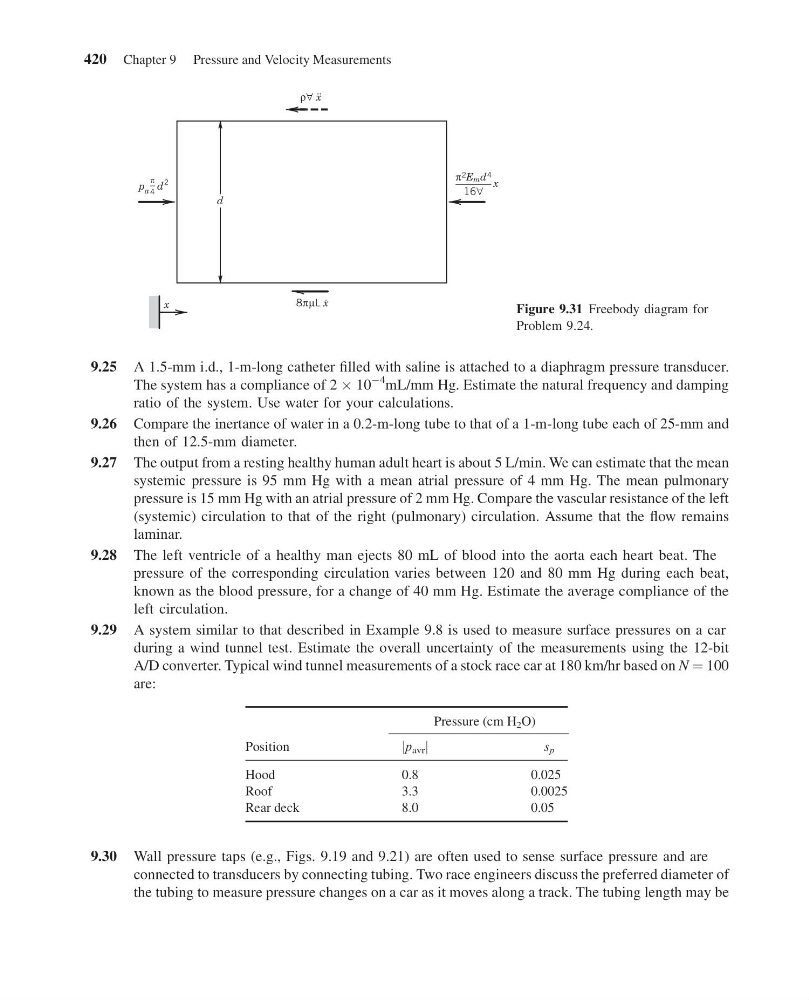
Figure 9.31 Freebody diagram for
Problem 9.24.
420 Chapter 9 Pressure and Velocity Measurements
15:5:2 Page 420
9.25 A 1.5-mm i.d., 1-m-long catheter filled with saline is attached to a diaphragm pressure transducer.
The system has a compliance of 2 Â 10
À4 mL/mm Hg. Estimate the natural frequency and damping
ratio of the system. Use water for your calculations.
9.26 Compare the inertance of water in a 0.2-m-long tube to that of a 1-m-long tube each of 25-mm and
then of 12.5-mm diameter.
9.27 The output from a resting healthy human adult heart is about 5 L/min. We can estimate that the mean
systemic pressure is 95 mm Hg with a mean atrial pressure of 4 mm Hg. The mean pulmonary
pressure is 15 mm Hg with an atrial pressure of 2 mm Hg. Compare the vascular resistance of the left
(systemic) circulation to that of the right (pulmonary) circulation. Assume that the flow remains
laminar.
9.28 The left ventricle of a healthy man ejects 80 mL of blood into the aorta each heart beat. The
pressure of the corresponding circulation varies between 120 and 80 mm Hg during each beat,
known as the blood pressure, for a change of 40 mm Hg. Estimate the average compliance of the
left circulation.
9.29 A system similar to that described in Example 9.8 is used to measure surface pressures on a car
during a wind tunnel test. Estimate the overall uncertainty of the measurements using the 12-bit
A/D converter. Typical wind tunnel measurements of a stock race car at 180 km/hr based on N ¼ 100
are:
Pressure (cm H 2 O)
Position
jp avr j
s p
Hood
0.8
0.025
Roof
3.3
0.0025
Rear deck
8.0
0.05
9.30 Wall pressure taps (e.g., Figs. 9.19 and 9.21) are often used to sense surface pressure and are
connected to transducers by connecting tubing. Two race engineers discuss the preferred diameter of
the tubing to measure pressure changes on a car as it moves along a track. The tubing length may be
d
ρ∀ x ⋅⋅
p a
π
4
d
2
8πμL x ⋅
π 2 Emd 4
16∀
x
x
Figure 9.31 Freebody diagram for
Problem 9.24.
420 Chapter 9 Pressure and Velocity Measurements