

E1C09 09/14/2010
15:4:56 Page 414
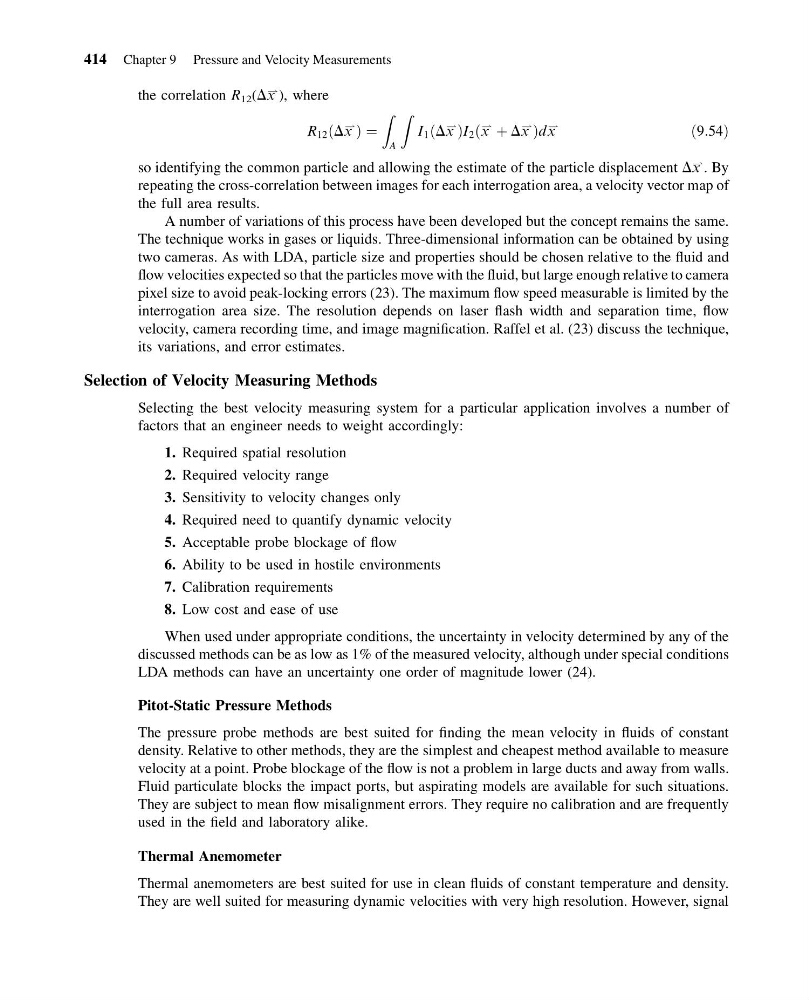
the correlation R 12 (Dx
* ), where
R 12 Dx
*
ð Þ ¼
Z
A
Z
I 1 Dx
*
ð ÞI 2 x
*
þ Dx
*
ð
Þ dx
*
ð9:54Þ
so identifying the common particle and allowing the estimate of the particle displacement Dx
* . By
repeating the cross-correlation between images for each interrogation area, a velocity vector map of
the full area results.
A number of variations of this process have been developed but the concept remains the same.
The technique works in gases or liquids. Three-dimensional information can be obtained by using
two cameras. As with LDA, particle size and properties should be chosen relative to the fluid and
flow velocities expected so that the particles move with the fluid, but large enough relative to camera
pixel size to avoid peak-locking errors (23). The maximum flow speed measurable is limited by the
interrogation area size. The resolution depends on laser flash width and separation time, flow
velocity, camera recording time, and image magnification. Raffel et al. (23) discuss the technique,
its variations, and error estimates.
Selection of Velocity Measuring Methods
Selecting the best velocity measuring system for a particular application involves a number of
factors that an engineer needs to weight accordingly:
1. Required spatial resolution
2. Required velocity range
3. Sensitivity to velocity changes only
4. Required need to quantify dynamic velocity
5. Acceptable probe blockage of flow
6. Ability to be used in hostile environments
7. Calibration requirements
8. Low cost and ease of use
When used under appropriate conditions, the uncertainty in velocity determined by any of the
discussed methods can be as low as 1% of the measured velocity, although under special conditions
LDA methods can have an uncertainty one order of magnitude lower (24).
Pitot-Static Pressure Methods
The pressure probe methods are best suited for finding the mean velocity in fluids of constant
density. Relative to other methods, they are the simplest and cheapest method available to measure
velocity at a point. Probe blockage of the flow is not a problem in large ducts and away from walls.
Fluid particulate blocks the impact ports, but aspirating models are available for such situations.
They are subject to mean flow misalignment errors. They require no calibration and are frequently
used in the field and laboratory alike.
Thermal Anemometer
Thermal anemometers are best suited for use in clean fluids of constant temperature and density.
They are well suited for measuring dynamic velocities with very high resolution. However, signal
414 Chapter 9 Pressure and Velocity Measurements
15:4:56 Page 414
the correlation R 12 (Dx
* ), where
R 12 Dx
*
ð Þ ¼
Z
A
Z
I 1 Dx
*
ð ÞI 2 x
*
þ Dx
*
ð
Þ dx
*
ð9:54Þ
so identifying the common particle and allowing the estimate of the particle displacement Dx
* . By
repeating the cross-correlation between images for each interrogation area, a velocity vector map of
the full area results.
A number of variations of this process have been developed but the concept remains the same.
The technique works in gases or liquids. Three-dimensional information can be obtained by using
two cameras. As with LDA, particle size and properties should be chosen relative to the fluid and
flow velocities expected so that the particles move with the fluid, but large enough relative to camera
pixel size to avoid peak-locking errors (23). The maximum flow speed measurable is limited by the
interrogation area size. The resolution depends on laser flash width and separation time, flow
velocity, camera recording time, and image magnification. Raffel et al. (23) discuss the technique,
its variations, and error estimates.
Selection of Velocity Measuring Methods
Selecting the best velocity measuring system for a particular application involves a number of
factors that an engineer needs to weight accordingly:
1. Required spatial resolution
2. Required velocity range
3. Sensitivity to velocity changes only
4. Required need to quantify dynamic velocity
5. Acceptable probe blockage of flow
6. Ability to be used in hostile environments
7. Calibration requirements
8. Low cost and ease of use
When used under appropriate conditions, the uncertainty in velocity determined by any of the
discussed methods can be as low as 1% of the measured velocity, although under special conditions
LDA methods can have an uncertainty one order of magnitude lower (24).
Pitot-Static Pressure Methods
The pressure probe methods are best suited for finding the mean velocity in fluids of constant
density. Relative to other methods, they are the simplest and cheapest method available to measure
velocity at a point. Probe blockage of the flow is not a problem in large ducts and away from walls.
Fluid particulate blocks the impact ports, but aspirating models are available for such situations.
They are subject to mean flow misalignment errors. They require no calibration and are frequently
used in the field and laboratory alike.
Thermal Anemometer
Thermal anemometers are best suited for use in clean fluids of constant temperature and density.
They are well suited for measuring dynamic velocities with very high resolution. However, signal
414 Chapter 9 Pressure and Velocity Measurements