

E1C09 09/14/2010
15:4:56 Page 410
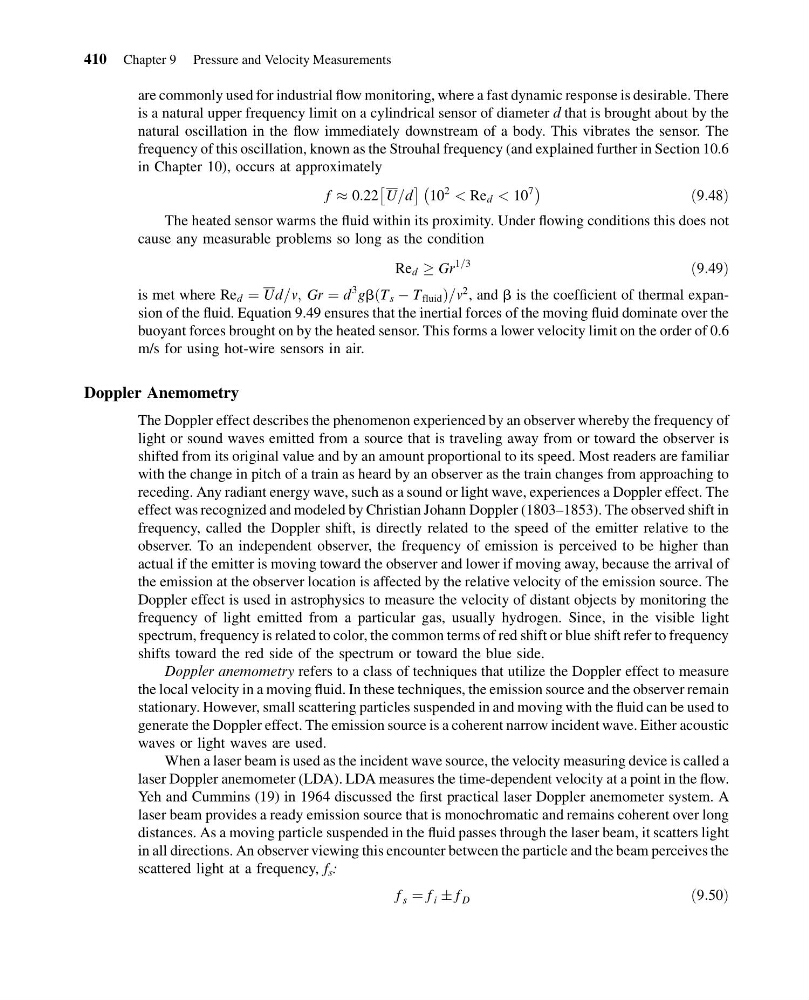
are commonly used for industrial flow monitoring, where a fast dynamic response is desirable. There
is a natural upper frequency limit on a cylindrical sensor of diameter d that is brought about by the
natural oscillation in the flow immediately downstream of a body. This vibrates the sensor. The
frequency of this oscillation, known as the Strouhal frequency (and explained further in Section 10.6
in Chapter 10), occurs at approximately
f % 0:22 U=d
Â
Ã
10
2
< Re d < 10
7
À
Á
ð9:48Þ
The heated sensor warms the fluid within its proximity. Under flowing conditions this does not
cause any measurable problems so long as the condition
Re d ! Gr
1=3
ð9:49Þ
is met where Re d ¼ Ud=v; Gr ¼ d
3
gb T s À T fluid
ð
Þ =v
2 , and b is the coefficient of thermal expansion of the fluid. Equation 9.49 ensures that the inertial forces of the moving fluid dominate over the
buoyant forces brought on by the heated sensor. This forms a lower velocity limit on the order of 0.6
m/s for using hot-wire sensors in air.
Doppler Anemometry
The Doppler effect describes the phenomenon experienced by an observer whereby the frequency of
light or sound waves emitted from a source that is traveling away from or toward the observer is
shifted from its original value and by an amount proportional to its speed. Most readers are familiar
with the change in pitch of a train as heard by an observer as the train changes from approaching to
receding. Any radiant energy wave, such as a sound or light wave, experiences a Doppler effect. The
effect was recognized and modeled by Christian Johann Doppler (1803–1853). The observed shift in
frequency, called the Doppler shift, is directly related to the speed of the emitter relative to the
observer. To an independent observer, the frequency of emission is perceived to be higher than
actual if the emitter is moving toward the observer and lower if moving away, because the arrival of
the emission at the observer location is affected by the relative velocity of the emission source. The
Doppler effect is used in astrophysics to measure the velocity of distant objects by monitoring the
frequency of light emitted from a particular gas, usually hydrogen. Since, in the visible light
spectrum, frequency is related to color, the common terms of red shift or blue shift refer to frequency
shifts toward the red side of the spectrum or toward the blue side.
Doppler anemometry refers to a class of techniques that utilize the Doppler effect to measure
the local velocity in a moving fluid. In these techniques, the emission source and the observer remain
stationary. However, small scattering particles suspended in and moving with the fluid can be used to
generate the Doppler effect. The emission source is a coherent narrow incident wave. Either acoustic
waves or light waves are used.
When a laser beam is used as the incident wave source, the velocity measuring device is called a
laser Doppler anemometer (LDA). LDA measures the time-dependent velocity at a point in the flow.
Yeh and Cummins (19) in 1964 discussed the first practical laser Doppler anemometer system. A
laser beam provides a ready emission source that is monochromatic and remains coherent over long
distances. As a moving particle suspended in the fluid passes through the laser beam, it scatters light
in all directions. An observer viewing this encounter between the particle and the beam perceives the
scattered light at a frequency, f s :
f s ¼ f i Æ f D
ð9:50Þ
410 Chapter 9 Pressure and Velocity Measurements
15:4:56 Page 410
are commonly used for industrial flow monitoring, where a fast dynamic response is desirable. There
is a natural upper frequency limit on a cylindrical sensor of diameter d that is brought about by the
natural oscillation in the flow immediately downstream of a body. This vibrates the sensor. The
frequency of this oscillation, known as the Strouhal frequency (and explained further in Section 10.6
in Chapter 10), occurs at approximately
f % 0:22 U=d
Â
Ã
10
2
< Re d < 10
7
À
Á
ð9:48Þ
The heated sensor warms the fluid within its proximity. Under flowing conditions this does not
cause any measurable problems so long as the condition
Re d ! Gr
1=3
ð9:49Þ
is met where Re d ¼ Ud=v; Gr ¼ d
3
gb T s À T fluid
ð
Þ =v
2 , and b is the coefficient of thermal expansion of the fluid. Equation 9.49 ensures that the inertial forces of the moving fluid dominate over the
buoyant forces brought on by the heated sensor. This forms a lower velocity limit on the order of 0.6
m/s for using hot-wire sensors in air.
Doppler Anemometry
The Doppler effect describes the phenomenon experienced by an observer whereby the frequency of
light or sound waves emitted from a source that is traveling away from or toward the observer is
shifted from its original value and by an amount proportional to its speed. Most readers are familiar
with the change in pitch of a train as heard by an observer as the train changes from approaching to
receding. Any radiant energy wave, such as a sound or light wave, experiences a Doppler effect. The
effect was recognized and modeled by Christian Johann Doppler (1803–1853). The observed shift in
frequency, called the Doppler shift, is directly related to the speed of the emitter relative to the
observer. To an independent observer, the frequency of emission is perceived to be higher than
actual if the emitter is moving toward the observer and lower if moving away, because the arrival of
the emission at the observer location is affected by the relative velocity of the emission source. The
Doppler effect is used in astrophysics to measure the velocity of distant objects by monitoring the
frequency of light emitted from a particular gas, usually hydrogen. Since, in the visible light
spectrum, frequency is related to color, the common terms of red shift or blue shift refer to frequency
shifts toward the red side of the spectrum or toward the blue side.
Doppler anemometry refers to a class of techniques that utilize the Doppler effect to measure
the local velocity in a moving fluid. In these techniques, the emission source and the observer remain
stationary. However, small scattering particles suspended in and moving with the fluid can be used to
generate the Doppler effect. The emission source is a coherent narrow incident wave. Either acoustic
waves or light waves are used.
When a laser beam is used as the incident wave source, the velocity measuring device is called a
laser Doppler anemometer (LDA). LDA measures the time-dependent velocity at a point in the flow.
Yeh and Cummins (19) in 1964 discussed the first practical laser Doppler anemometer system. A
laser beam provides a ready emission source that is monochromatic and remains coherent over long
distances. As a moving particle suspended in the fluid passes through the laser beam, it scatters light
in all directions. An observer viewing this encounter between the particle and the beam perceives the
scattered light at a frequency, f s :
f s ¼ f i Æ f D
ð9:50Þ
410 Chapter 9 Pressure and Velocity Measurements