

E1C09 09/14/2010
15:4:55 Page 404
compliance, the tubing is removed at the wall tap, filled with water, and purged of any residual air.
The transducer output is noted. Using a syringe, 1 mL of water is then added to the system and the
corresponding measured pressure increases by 100 mm Hg. Find the compliance.
SOLUTION Using Equation 9.20, the compliance of the transducer-tubing system is
C vp ¼ D8=Dp ¼ 1 mL=100 mm Hg ¼ 0:01 mL=mm Hg
Example 9.10
A pressure transducer with a natural frequency of 100 kHz is connected to a 0.10-in. static wall
pressure tap using a 0.10-in. i.d. rigid tube that is 5 in. long. The transducer dead volume is 1 in.
3
Determine the system frequency response to fluctuating pressures of air at 72
F if the pressure
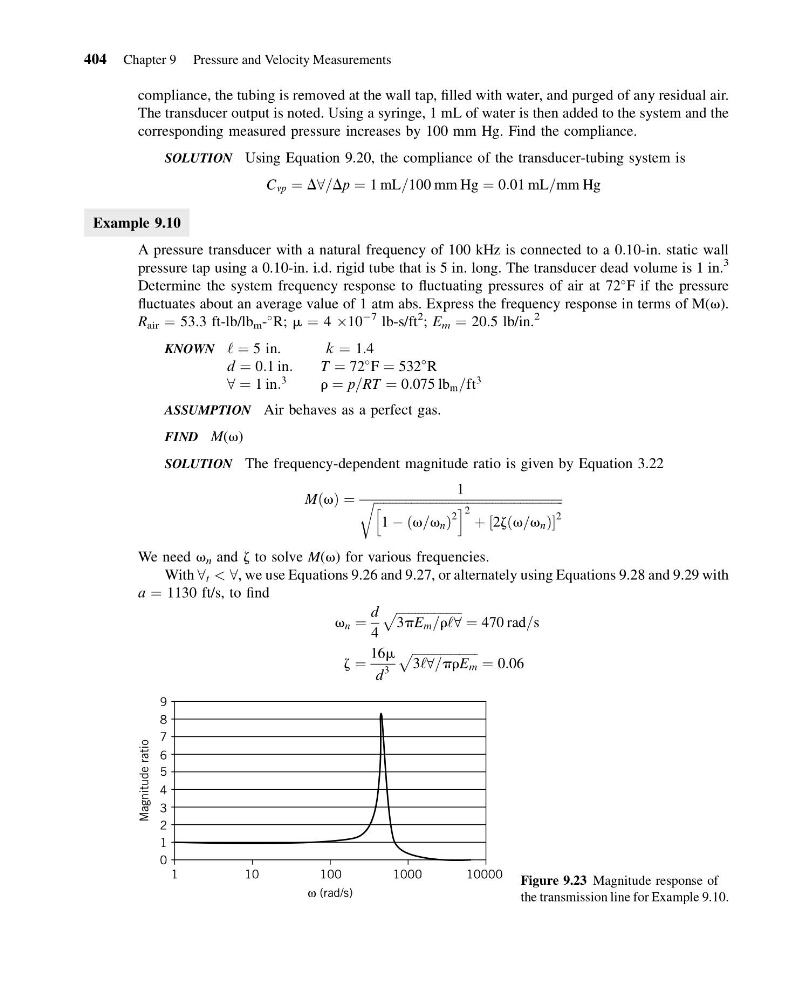
fluctuates about an average value of 1 atm abs. Express the frequency response in terms of M(v).
R air ¼ 53.3 ft-lb/lb m -
R; m ¼ 4 Â10
À7 lb-s/ft
2 ; E m ¼ 20.5 lb/in.
2
KNOWN ‘ ¼ 5 in.
k ¼ 1.4
d ¼ 0:1 in:
T ¼ 72
F ¼ 532
R
8 ¼ 1 in:
3
r ¼ p=RT ¼ 0:075 lb m =ft
3
ASSUMPTION Air behaves as a perfect gas.
FIND M(v)
SOLUTION The frequency-dependent magnitude ratio is given by Equation 3.22
MðvÞ ¼
1
ffiffiffiffiffiffiffiffiffiffiffiffiffiffiffiffiffiffiffiffiffiffiffiffiffiffiffiffiffiffiffiffiffiffiffiffiffiffiffiffiffiffiffiffiffiffiffiffiffiffiffiffiffiffiffiffiffiffiffiffi ffi
1 À v=v n
ð
Þ
2
h
i 2 þ 2z v=v n
ð
Þ
½
2
r
We need v n and z to solve M(v) for various frequencies.
With 8 t < 8, we use Equations 9.26 and 9.27, or alternately using Equations 9.28 and 9.29 with
a ¼ 1130 ft/s, to find
v n ¼
d
4
ffiffiffiffiffiffiffiffiffiffiffiffiffiffiffiffiffiffiffiffiffi
3pE m =r‘8
p
¼ 470 rad=s
z ¼
16m
d
3
ffiffiffiffiffiffiffiffiffiffiffiffiffiffiffiffiffiffiffiffiffi
3‘8=prE m
p
¼ 0:06
9
8
7
6
5
4
3
2
1
0
1
1 0
Magnitude ratio
100
1000
10000
ω (rad/s)
Figure 9.23 Magnitude response of
the transmission line for Example 9.10.
404 Chapter 9 Pressure and Velocity Measurements
15:4:55 Page 404
compliance, the tubing is removed at the wall tap, filled with water, and purged of any residual air.
The transducer output is noted. Using a syringe, 1 mL of water is then added to the system and the
corresponding measured pressure increases by 100 mm Hg. Find the compliance.
SOLUTION Using Equation 9.20, the compliance of the transducer-tubing system is
C vp ¼ D8=Dp ¼ 1 mL=100 mm Hg ¼ 0:01 mL=mm Hg
Example 9.10
A pressure transducer with a natural frequency of 100 kHz is connected to a 0.10-in. static wall
pressure tap using a 0.10-in. i.d. rigid tube that is 5 in. long. The transducer dead volume is 1 in.
3
Determine the system frequency response to fluctuating pressures of air at 72
F if the pressure
fluctuates about an average value of 1 atm abs. Express the frequency response in terms of M(v).
R air ¼ 53.3 ft-lb/lb m -
R; m ¼ 4 Â10
À7 lb-s/ft
2 ; E m ¼ 20.5 lb/in.
2
KNOWN ‘ ¼ 5 in.
k ¼ 1.4
d ¼ 0:1 in:
T ¼ 72
F ¼ 532
R
8 ¼ 1 in:
3
r ¼ p=RT ¼ 0:075 lb m =ft
3
ASSUMPTION Air behaves as a perfect gas.
FIND M(v)
SOLUTION The frequency-dependent magnitude ratio is given by Equation 3.22
MðvÞ ¼
1
ffiffiffiffiffiffiffiffiffiffiffiffiffiffiffiffiffiffiffiffiffiffiffiffiffiffiffiffiffiffiffiffiffiffiffiffiffiffiffiffiffiffiffiffiffiffiffiffiffiffiffiffiffiffiffiffiffiffiffiffi ffi
1 À v=v n
ð
Þ
2
h
i 2 þ 2z v=v n
ð
Þ
½
2
r
We need v n and z to solve M(v) for various frequencies.
With 8 t < 8, we use Equations 9.26 and 9.27, or alternately using Equations 9.28 and 9.29 with
a ¼ 1130 ft/s, to find
v n ¼
d
4
ffiffiffiffiffiffiffiffiffiffiffiffiffiffiffiffiffiffiffiffiffi
3pE m =r‘8
p
¼ 470 rad=s
z ¼
16m
d
3
ffiffiffiffiffiffiffiffiffiffiffiffiffiffiffiffiffiffiffiffiffi
3‘8=prE m
p
¼ 0:06
9
8
7
6
5
4
3
2
1
0
1
1 0
Magnitude ratio
100
1000
10000
ω (rad/s)
Figure 9.23 Magnitude response of
the transmission line for Example 9.10.
404 Chapter 9 Pressure and Velocity Measurements