

E1C09 09/14/2010
15:4:54 Page 396
standard uncertainty of the data acquisition and reduction procedure:
s p ¼
hs p i
ffiffiffiffiffiffiffiffi
MK
p
where hs p i ¼
ffiffiffiffiffiffiffiffiffiffiffiffiffiffiffiffiffiffiffiffiffiffiffiffiffiffiffiffiffiffiffiffiffiffiffiffiffiffiffiffiffiffiffiffiffiffiffiffiffiffiffiffiffiffiffiffiffiffiffiffiffiffiffiffiffiffiffiffiffiffiffiffiffiffi ffi
X M
j¼1
X K
k¼1
p jk À hp j i
=M K À 1
ð
Þ
r
with degrees of freedom, v ¼ M(K À 1).
COMMENT The statistical estimate contains the effects of random error due to the pressure
standard (applied pressure repeatability), pressure transducer repeatability (repetition and replication), excitation voltages, and the recording system. It does not contain the effects of instrument
calibration errors, large deviations in environmental conditions, pressure tap design errors, or
dynamic pressure effects. The systematic errors for these must be assigned by the engineer based on
other available information. Note that if the above procedure were to be repeated over a range of
different applied known pressures, then this calibration would allow instrument calibration errors
and data reduction curve fit errors over the range to be entered into the analysis.
9.6 PRESSURE MEASUREMENTS IN MOVING FLUIDS
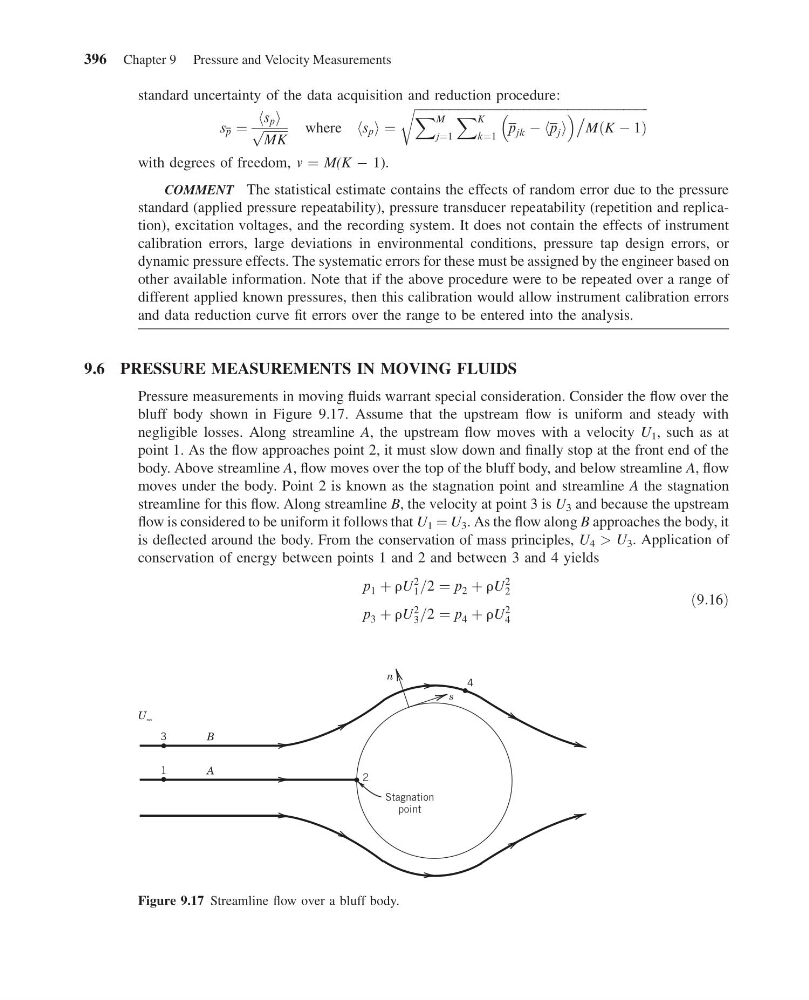
Pressure measurements in moving fluids warrant special consideration. Consider the flow over the
bluff body shown in Figure 9.17. Assume that the upstream flow is uniform and steady with
negligible losses. Along streamline A, the upstream flow moves with a velocity U 1 , such as at
point 1. As the flow approaches point 2, it must slow down and finally stop at the front end of the
body. Above streamline A, flow moves over the top of the bluff body, and below streamline A, flow
moves under the body. Point 2 is known as the stagnation point and streamline A the stagnation
streamline for this flow. Along streamline B, the velocity at point 3 is U 3 and because the upstream
flow is considered to be uniform it follows that U 1 ¼ U 3 . As the flow along B approaches the body, it
is deflected around the body. From the conservation of mass principles, U 4 > U 3 . Application of
conservation of energy between points 1 and 2 and between 3 and 4 yields
p 1 þ rU
2
1 =2 ¼ p 2 þ rU
2
2
p 3 þ rU
2
3 =2 ¼ p 4 þ rU
2
4
ð9:16Þ
n
s
B
U ∞
A
2
3
1
4
Stagnation
point
Figure 9.17 Streamline flow over a bluff body.
396 Chapter 9 Pressure and Velocity Measurements
15:4:54 Page 396
standard uncertainty of the data acquisition and reduction procedure:
s p ¼
hs p i
ffiffiffiffiffiffiffiffi
MK
p
where hs p i ¼
ffiffiffiffiffiffiffiffiffiffiffiffiffiffiffiffiffiffiffiffiffiffiffiffiffiffiffiffiffiffiffiffiffiffiffiffiffiffiffiffiffiffiffiffiffiffiffiffiffiffiffiffiffiffiffiffiffiffiffiffiffiffiffiffiffiffiffiffiffiffiffiffiffiffi ffi
X M
j¼1
X K
k¼1
p jk À hp j i
=M K À 1
ð
Þ
r
with degrees of freedom, v ¼ M(K À 1).
COMMENT The statistical estimate contains the effects of random error due to the pressure
standard (applied pressure repeatability), pressure transducer repeatability (repetition and replication), excitation voltages, and the recording system. It does not contain the effects of instrument
calibration errors, large deviations in environmental conditions, pressure tap design errors, or
dynamic pressure effects. The systematic errors for these must be assigned by the engineer based on
other available information. Note that if the above procedure were to be repeated over a range of
different applied known pressures, then this calibration would allow instrument calibration errors
and data reduction curve fit errors over the range to be entered into the analysis.
9.6 PRESSURE MEASUREMENTS IN MOVING FLUIDS
Pressure measurements in moving fluids warrant special consideration. Consider the flow over the
bluff body shown in Figure 9.17. Assume that the upstream flow is uniform and steady with
negligible losses. Along streamline A, the upstream flow moves with a velocity U 1 , such as at
point 1. As the flow approaches point 2, it must slow down and finally stop at the front end of the
body. Above streamline A, flow moves over the top of the bluff body, and below streamline A, flow
moves under the body. Point 2 is known as the stagnation point and streamline A the stagnation
streamline for this flow. Along streamline B, the velocity at point 3 is U 3 and because the upstream
flow is considered to be uniform it follows that U 1 ¼ U 3 . As the flow along B approaches the body, it
is deflected around the body. From the conservation of mass principles, U 4 > U 3 . Application of
conservation of energy between points 1 and 2 and between 3 and 4 yields
p 1 þ rU
2
1 =2 ¼ p 2 þ rU
2
2
p 3 þ rU
2
3 =2 ¼ p 4 þ rU
2
4
ð9:16Þ
n
s
B
U ∞
A
2
3
1
4
Stagnation
point
Figure 9.17 Streamline flow over a bluff body.
396 Chapter 9 Pressure and Velocity Measurements