

E1C09 09/14/2010
15:4:54 Page 392
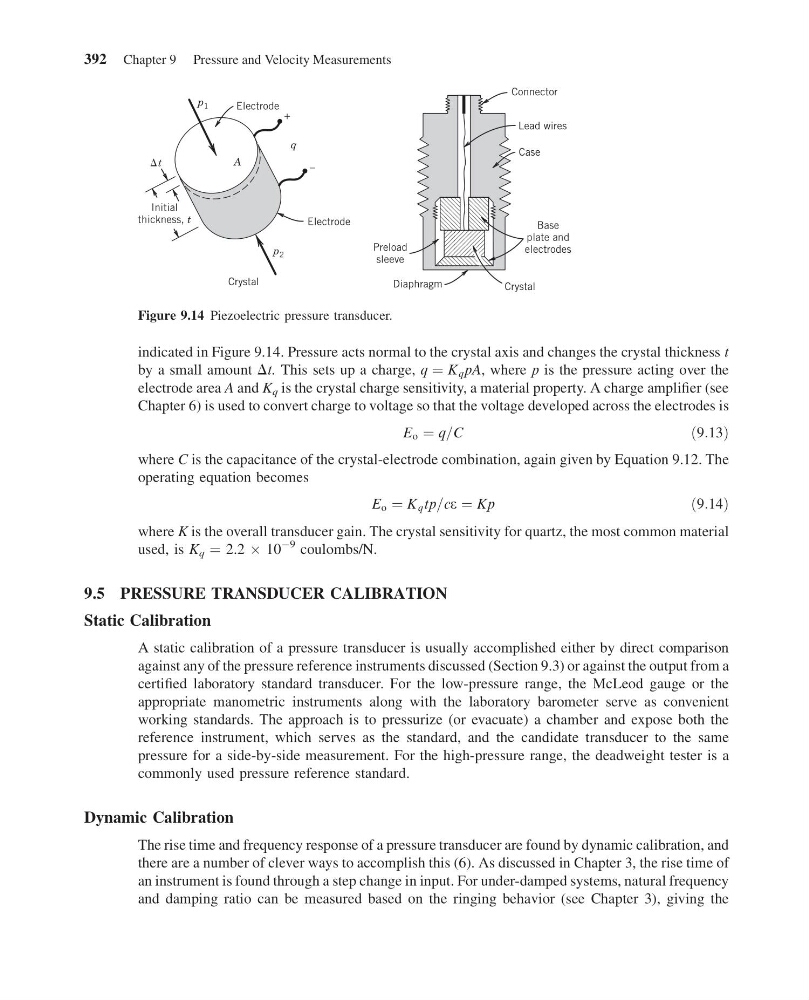
indicated in Figure 9.14. Pressure acts normal to the crystal axis and changes the crystal thickness t
by a small amount Dt. This sets up a charge, q ¼ K q pA, where p is the pressure acting over the
electrode area A and K q is the crystal charge sensitivity, a material property. A charge amplifier (see
Chapter 6) is used to convert charge to voltage so that the voltage developed across the electrodes is
E o ¼ q=C
ð9:13Þ
where C is the capacitance of the crystal-electrode combination, again given by Equation 9.12. The
operating equation becomes
E o ¼ K q tp=ce ¼ Kp
ð9:14Þ
where K is the overall transducer gain. The crystal sensitivity for quartz, the most common material
used, is K q ¼ 2.2 Â 10
À9 coulombs/N.
9.5 PRESSURE TRANSDUCER CALIBRATION
Static Calibration
A static calibration of a pressure transducer is usually accomplished either by direct comparison
against any of the pressure reference instruments discussed (Section 9.3) or against the output from a
certified laboratory standard transducer. For the low-pressure range, the McLeod gauge or the
appropriate manometric instruments along with the laboratory barometer serve as convenient
working standards. The approach is to pressurize (or evacuate) a chamber and expose both the
reference instrument, which serves as the standard, and the candidate transducer to the same
pressure for a side-by-side measurement. For the high-pressure range, the deadweight tester is a
commonly used pressure reference standard.
Dynamic Calibration
The rise time and frequency response of a pressure transducer are found by dynamic calibration, and
there are a number of clever ways to accomplish this (6). As discussed in Chapter 3, the rise time of
an instrument is found through a step change in input. For under-damped systems, natural frequency
and damping ratio can be measured based on the ringing behavior (see Chapter 3), giving the
Connector
Lead wires
Case
Base
plate and
electrodes
+
_
p 1
p 2
q
A
t
Initial
thickness, t
Crystal
Crystal
Diaphragm
Preload
sleeve
Electrode
Electrode
Figure 9.14 Piezoelectric pressure transducer.
392 Chapter 9 Pressure and Velocity Measurements
15:4:54 Page 392
indicated in Figure 9.14. Pressure acts normal to the crystal axis and changes the crystal thickness t
by a small amount Dt. This sets up a charge, q ¼ K q pA, where p is the pressure acting over the
electrode area A and K q is the crystal charge sensitivity, a material property. A charge amplifier (see
Chapter 6) is used to convert charge to voltage so that the voltage developed across the electrodes is
E o ¼ q=C
ð9:13Þ
where C is the capacitance of the crystal-electrode combination, again given by Equation 9.12. The
operating equation becomes
E o ¼ K q tp=ce ¼ Kp
ð9:14Þ
where K is the overall transducer gain. The crystal sensitivity for quartz, the most common material
used, is K q ¼ 2.2 Â 10
À9 coulombs/N.
9.5 PRESSURE TRANSDUCER CALIBRATION
Static Calibration
A static calibration of a pressure transducer is usually accomplished either by direct comparison
against any of the pressure reference instruments discussed (Section 9.3) or against the output from a
certified laboratory standard transducer. For the low-pressure range, the McLeod gauge or the
appropriate manometric instruments along with the laboratory barometer serve as convenient
working standards. The approach is to pressurize (or evacuate) a chamber and expose both the
reference instrument, which serves as the standard, and the candidate transducer to the same
pressure for a side-by-side measurement. For the high-pressure range, the deadweight tester is a
commonly used pressure reference standard.
Dynamic Calibration
The rise time and frequency response of a pressure transducer are found by dynamic calibration, and
there are a number of clever ways to accomplish this (6). As discussed in Chapter 3, the rise time of
an instrument is found through a step change in input. For under-damped systems, natural frequency
and damping ratio can be measured based on the ringing behavior (see Chapter 3), giving the
Connector
Lead wires
Case
Base
plate and
electrodes
+
_
p 1
p 2
q
A
t
Initial
thickness, t
Crystal
Crystal
Diaphragm
Preload
sleeve
Electrode
Electrode
Figure 9.14 Piezoelectric pressure transducer.
392 Chapter 9 Pressure and Velocity Measurements