

E1C09 09/14/2010
15:4:53 Page 390
By using semiconductor technology in pressure transducer construction, we now have a variety
of very fast, very small, highly sensitive strain gauge diaphragm transducers. Silicone piezoresistive
strain gauges can be diffused into a single crystal of silicone wafer, which forms the diaphragm.
Semiconductor strain gauges have a static sensitivity that is 50 times greater than conventional
metallic strain gauges. Because the piezoresistive gauges are integral to the diaphragm, they are
relatively immune to the thermoelastic strains prevalent in conventional metallic strain gauge–
diaphragm constructions. Furthermore, a silicone diaphragm does not creep with age (as does a
metallic gauge), thus minimizing calibration drift over time. However, uncoated silicone does not
tolerate liquids.
Capacitance Elements
Another common method to convert diaphragm displacement to a measurable signal is a
capacitance sensor. One version uses a thin metallic diaphragm as one plate of a capacitor paired
with a fixed plate to complete the capacitor. The diaphragm is exposed to the process pressure on
one side and to a reference pressure on the other or to a differential pressure. When pressure
changes, so as to deflect the diaphragm, the gap between the plates changes, which causes a change
in capacitance.
To illustrate this, a transducer using this method is depicted in Figure 9.13. The capacitance C
developed between two parallel plates separated by average gap t is determined by
C ¼ c e A=t
ð9:12Þ
where the product ce is the permittivity of the material between the plates relative to a vacuum (e ¼
8.85 Â 10
À12 F/m; c ¼ dielectric constant), and A is the overlapping area of the two plates. The
dielectric constant depends on the material in the gap, which for air is c =1 but for water is c ¼ 80.
The capacitance responds to an instantaneous change in the area-averaged plate gap separation from
which the time-dependent pressure is determined. However, the capacitance change is small relative
p reference
Resistance
strain gauges
Lead
wires
Excitation voltage in
Electrical signal out
Signal
conditioning
electronics
Diaphragm
Dead volume, ∀
(b) Bridge–strain gauge circuit
for pressure diaphragms.
(a) Sensing scheme
p
E o
R 1
R 2
R 3
R 4
E i
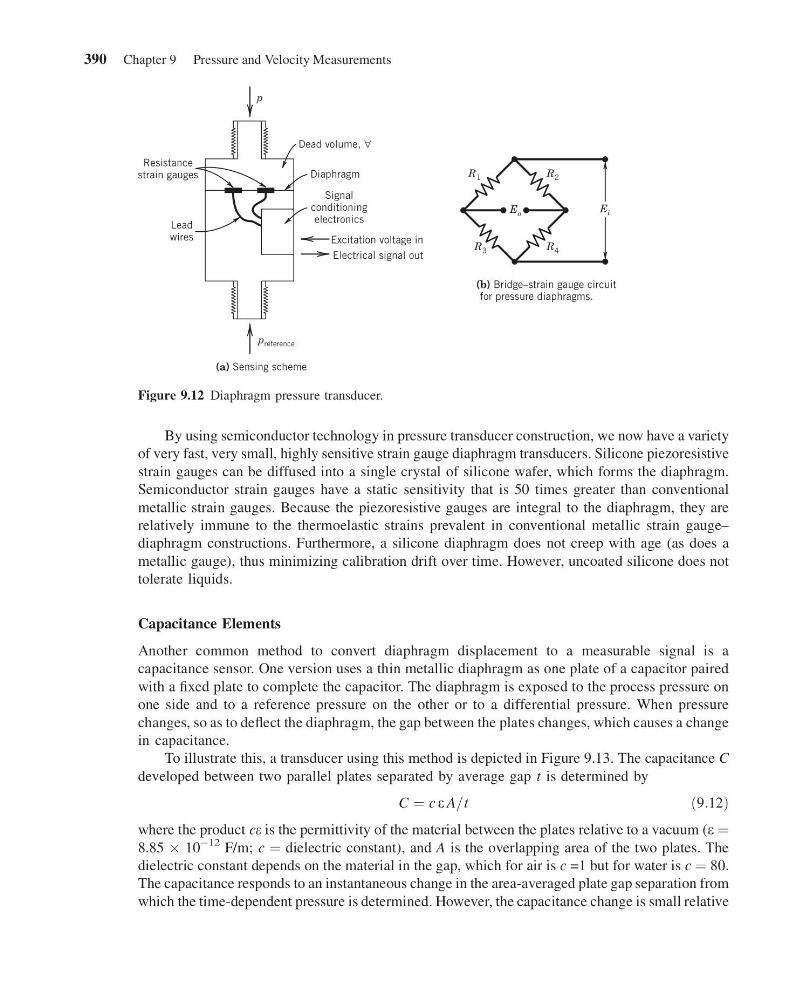
Figure 9.12 Diaphragm pressure transducer.
390 Chapter 9 Pressure and Velocity Measurements
15:4:53 Page 390
By using semiconductor technology in pressure transducer construction, we now have a variety
of very fast, very small, highly sensitive strain gauge diaphragm transducers. Silicone piezoresistive
strain gauges can be diffused into a single crystal of silicone wafer, which forms the diaphragm.
Semiconductor strain gauges have a static sensitivity that is 50 times greater than conventional
metallic strain gauges. Because the piezoresistive gauges are integral to the diaphragm, they are
relatively immune to the thermoelastic strains prevalent in conventional metallic strain gauge–
diaphragm constructions. Furthermore, a silicone diaphragm does not creep with age (as does a
metallic gauge), thus minimizing calibration drift over time. However, uncoated silicone does not
tolerate liquids.
Capacitance Elements
Another common method to convert diaphragm displacement to a measurable signal is a
capacitance sensor. One version uses a thin metallic diaphragm as one plate of a capacitor paired
with a fixed plate to complete the capacitor. The diaphragm is exposed to the process pressure on
one side and to a reference pressure on the other or to a differential pressure. When pressure
changes, so as to deflect the diaphragm, the gap between the plates changes, which causes a change
in capacitance.
To illustrate this, a transducer using this method is depicted in Figure 9.13. The capacitance C
developed between two parallel plates separated by average gap t is determined by
C ¼ c e A=t
ð9:12Þ
where the product ce is the permittivity of the material between the plates relative to a vacuum (e ¼
8.85 Â 10
À12 F/m; c ¼ dielectric constant), and A is the overlapping area of the two plates. The
dielectric constant depends on the material in the gap, which for air is c =1 but for water is c ¼ 80.
The capacitance responds to an instantaneous change in the area-averaged plate gap separation from
which the time-dependent pressure is determined. However, the capacitance change is small relative
p reference
Resistance
strain gauges
Lead
wires
Excitation voltage in
Electrical signal out
Signal
conditioning
electronics
Diaphragm
Dead volume, ∀
(b) Bridge–strain gauge circuit
for pressure diaphragms.
(a) Sensing scheme
p
E o
R 1
R 2
R 3
R 4
E i
Figure 9.12 Diaphragm pressure transducer.
390 Chapter 9 Pressure and Velocity Measurements