

E1C09 09/14/2010
15:4:53 Page 389
or capsule displacement. The LVDT design has a high sensitivity and is commonly found in pressure
transducers rated for low pressures and for small pressure ranges, such as zero to several
hundred mm Hg absolute, gauge, or differential.
Diaphragms
An effective primary pressure element is a diaphragm (Figure 9.9), which is a thin elastic circular
plate supported about its circumference. The action of a diaphragm within a pressure transducer is
similar to the action of a trampoline; a pressure differential on the top and bottom diaphragm faces
acts to deform it. The magnitude of the deformation is proportional to the pressure difference. Both
membrane and corrugated designs are used. Membranes are made of metal or nonmetallic material,
such as plastic or neoprene. The material chosen depends on the pressure range anticipated and the
fluid in contact with it. Corrugated diaphragms contain a number of corrugations that serve to
increase diaphragm stiffness and to increase the diaphragm effective surface area.
Pressure transducers that use a diaphragm sensor are well suited for either static or dynamic
pressure measurements. They have good linearity and resolution over their useful range. An
advantage of the diaphragm sensor is that the very low mass and relative stiffness of the thin
diaphragm give the sensor a very high natural frequency with a small damping ratio. Hence, these
transducers can have a very wide frequency response and very short 90% rise and settling times. The
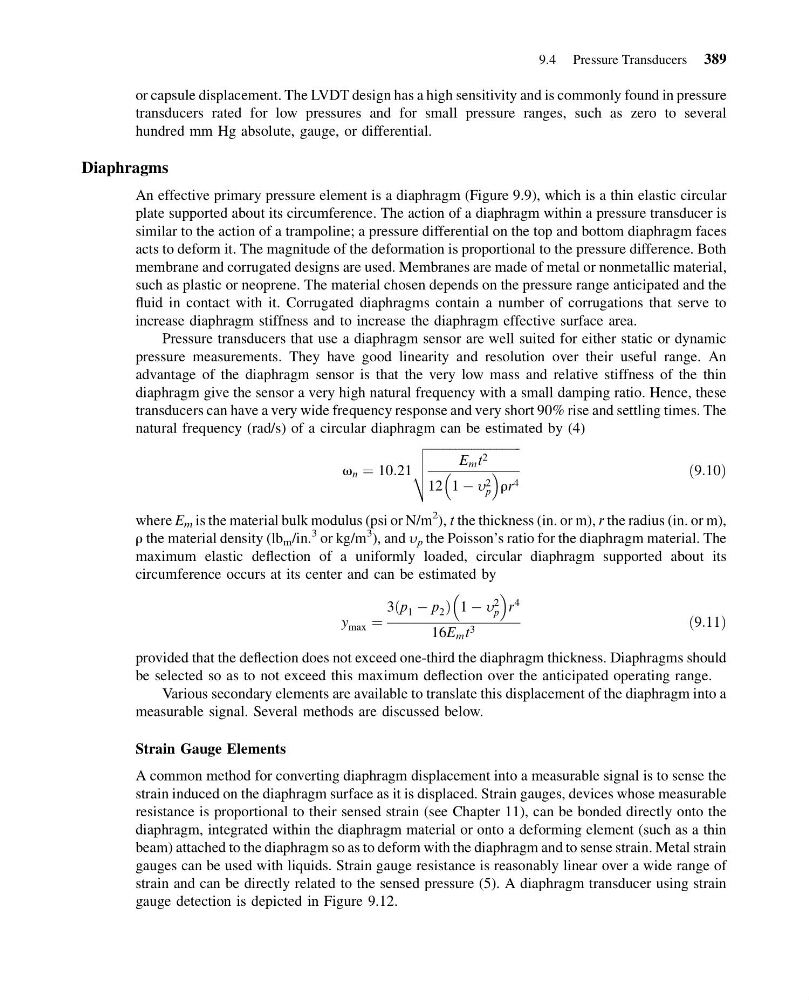
natural frequency (rad/s) of a circular diaphragm can be estimated by (4)
v n ¼ 10:21
ffiffiffiffiffiffiffiffiffiffiffiffiffiffiffiffiffiffiffiffiffiffiffiffiffiffiffiffiffi ffi
E m t 2
12 1 À y 2
p
rr 4
v
u
u
t
ð9:10Þ
where E m is the material bulk modulus (psi or N/m
2 ), t the thickness (in. or m), r the radius (in. or m),
r the material density (lb m /in.
3 or kg/m
3 ), and y p the Poisson’s ratio for the diaphragm material. The
maximum elastic deflection of a uniformly loaded, circular diaphragm supported about its
circumference occurs at its center and can be estimated by
y max ¼
3 p 1 À p 2
ð
Þ 1 À y
2
p
r
4
16E m t 3
ð9:11Þ
provided that the deflection does not exceed one-third the diaphragm thickness. Diaphragms should
be selected so as to not exceed this maximum deflection over the anticipated operating range.
Various secondary elements are available to translate this displacement of the diaphragm into a
measurable signal. Several methods are discussed below.
Strain Gauge Elements
A common method for converting diaphragm displacement into a measurable signal is to sense the
strain induced on the diaphragm surface as it is displaced. Strain gauges, devices whose measurable
resistance is proportional to their sensed strain (see Chapter 11), can be bonded directly onto the
diaphragm, integrated within the diaphragm material or onto a deforming element (such as a thin
beam) attached to the diaphragm so as to deform with the diaphragm and to sense strain. Metal strain
gauges can be used with liquids. Strain gauge resistance is reasonably linear over a wide range of
strain and can be directly related to the sensed pressure (5). A diaphragm transducer using strain
gauge detection is depicted in Figure 9.12.
9.4 Pressure Transducers 389
15:4:53 Page 389
or capsule displacement. The LVDT design has a high sensitivity and is commonly found in pressure
transducers rated for low pressures and for small pressure ranges, such as zero to several
hundred mm Hg absolute, gauge, or differential.
Diaphragms
An effective primary pressure element is a diaphragm (Figure 9.9), which is a thin elastic circular
plate supported about its circumference. The action of a diaphragm within a pressure transducer is
similar to the action of a trampoline; a pressure differential on the top and bottom diaphragm faces
acts to deform it. The magnitude of the deformation is proportional to the pressure difference. Both
membrane and corrugated designs are used. Membranes are made of metal or nonmetallic material,
such as plastic or neoprene. The material chosen depends on the pressure range anticipated and the
fluid in contact with it. Corrugated diaphragms contain a number of corrugations that serve to
increase diaphragm stiffness and to increase the diaphragm effective surface area.
Pressure transducers that use a diaphragm sensor are well suited for either static or dynamic
pressure measurements. They have good linearity and resolution over their useful range. An
advantage of the diaphragm sensor is that the very low mass and relative stiffness of the thin
diaphragm give the sensor a very high natural frequency with a small damping ratio. Hence, these
transducers can have a very wide frequency response and very short 90% rise and settling times. The
natural frequency (rad/s) of a circular diaphragm can be estimated by (4)
v n ¼ 10:21
ffiffiffiffiffiffiffiffiffiffiffiffiffiffiffiffiffiffiffiffiffiffiffiffiffiffiffiffiffi ffi
E m t 2
12 1 À y 2
p
rr 4
v
u
u
t
ð9:10Þ
where E m is the material bulk modulus (psi or N/m
2 ), t the thickness (in. or m), r the radius (in. or m),
r the material density (lb m /in.
3 or kg/m
3 ), and y p the Poisson’s ratio for the diaphragm material. The
maximum elastic deflection of a uniformly loaded, circular diaphragm supported about its
circumference occurs at its center and can be estimated by
y max ¼
3 p 1 À p 2
ð
Þ 1 À y
2
p
r
4
16E m t 3
ð9:11Þ
provided that the deflection does not exceed one-third the diaphragm thickness. Diaphragms should
be selected so as to not exceed this maximum deflection over the anticipated operating range.
Various secondary elements are available to translate this displacement of the diaphragm into a
measurable signal. Several methods are discussed below.
Strain Gauge Elements
A common method for converting diaphragm displacement into a measurable signal is to sense the
strain induced on the diaphragm surface as it is displaced. Strain gauges, devices whose measurable
resistance is proportional to their sensed strain (see Chapter 11), can be bonded directly onto the
diaphragm, integrated within the diaphragm material or onto a deforming element (such as a thin
beam) attached to the diaphragm so as to deform with the diaphragm and to sense strain. Metal strain
gauges can be used with liquids. Strain gauge resistance is reasonably linear over a wide range of
strain and can be directly related to the sensed pressure (5). A diaphragm transducer using strain
gauge detection is depicted in Figure 9.12.
9.4 Pressure Transducers 389