

E1C09 09/14/2010
15:4:53 Page 382
The inclined tube manometer is also used to measure small changes in pressure. It is essentially
a U-tube manometer with one leg inclined at an angle u, typically from 10 to 30 degrees relative to
the horizontal. As indicated in Figure 9.7, a change in pressure equivalent to a deflection of height H
in a U-tube manometer would bring about a change in position of the meniscus in the inclined leg of
L ¼ H/sin u. This provides an increased sensitivity over the conventional U-tube by the factor of
1/sin u.
A number of elemental errors affect the instrument uncertainty of all types of manometers.
These include scale and alignment errors, zero error, temperature error, gravity error, and capillary
and meniscus errors. The specific weight of the manometer fluid varies with temperature but can be
corrected. For example, the common manometer fluid of mercury has a temperature dependence
approximated by
g Hg ¼
133:084
1 þ 0:00006T
N=m
3
Â
à ¼
848:707
1 þ 0:000101 T À 32
ð
Þ
lb=ft
3
Â
Ã
with T in
C or
F, respectively. A gravity correction for elevation z and latitude f corrects for
gravity error effects using the dimensionless correction,
e 1 ¼ Àð2:637 Â 10
À3 cos2f þ 9:6 Â 10
À8
z þ 5 Â 10
À5
Þ US
ð9:6aÞ
¼ Àð2:637 Â 10
À3 cos2f þ 2:9 Â 10
À8
z þ 5 Â 10
À5
Þ metric
ð9:6bÞ
where f is in degrees and z is in feet for Equation 9.6a and meters in Equation 9.6b. Tube-to-liquid
capillary forces lead to the development of a meniscus. Although the actual effect varies with purity
of the manometer liquid, these effects can be minimized by using manometer tube bores of greater
than about 6 mm (0.25 in.). In general, the instrument uncertainty in measuring pressure can be as
low as 0.02% to 0.2% of the reading.
Inclined tube
Meniscus
Set
mark
Micrometer
adjusting
Reservoir
screw
Flexible
tube
H
p 1
p 2
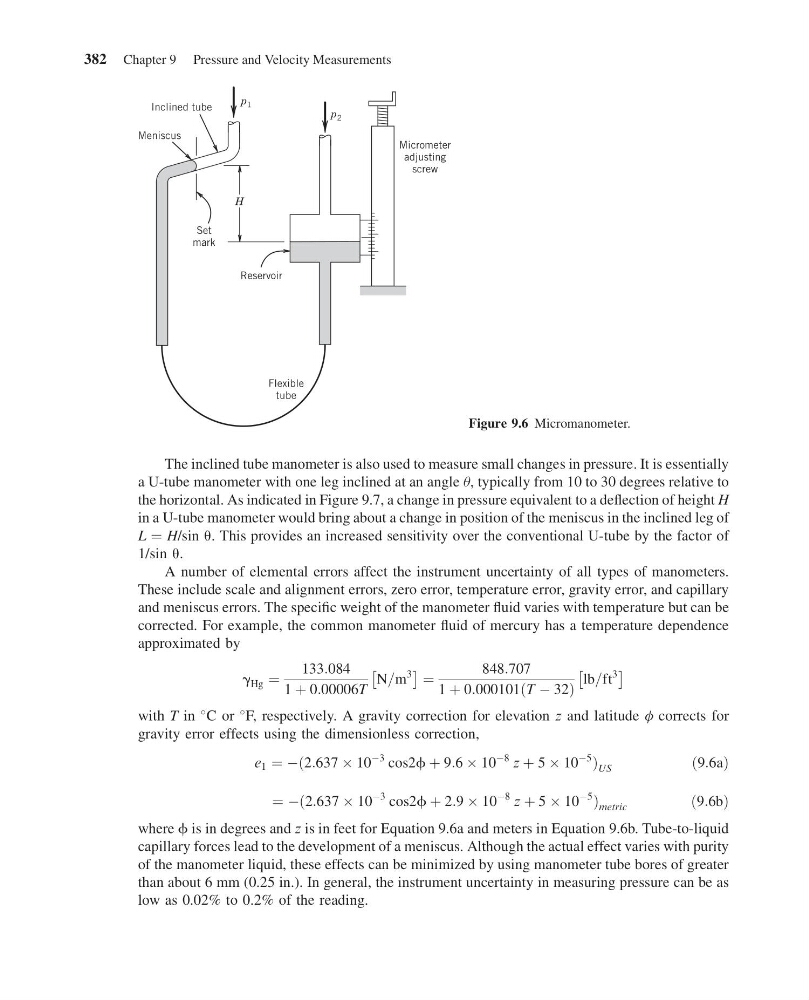
Figure 9.6 Micromanometer.
382 Chapter 9 Pressure and Velocity Measurements
15:4:53 Page 382
The inclined tube manometer is also used to measure small changes in pressure. It is essentially
a U-tube manometer with one leg inclined at an angle u, typically from 10 to 30 degrees relative to
the horizontal. As indicated in Figure 9.7, a change in pressure equivalent to a deflection of height H
in a U-tube manometer would bring about a change in position of the meniscus in the inclined leg of
L ¼ H/sin u. This provides an increased sensitivity over the conventional U-tube by the factor of
1/sin u.
A number of elemental errors affect the instrument uncertainty of all types of manometers.
These include scale and alignment errors, zero error, temperature error, gravity error, and capillary
and meniscus errors. The specific weight of the manometer fluid varies with temperature but can be
corrected. For example, the common manometer fluid of mercury has a temperature dependence
approximated by
g Hg ¼
133:084
1 þ 0:00006T
N=m
3
Â
à ¼
848:707
1 þ 0:000101 T À 32
ð
Þ
lb=ft
3
Â
Ã
with T in
C or
F, respectively. A gravity correction for elevation z and latitude f corrects for
gravity error effects using the dimensionless correction,
e 1 ¼ Àð2:637 Â 10
À3 cos2f þ 9:6 Â 10
À8
z þ 5 Â 10
À5
Þ US
ð9:6aÞ
¼ Àð2:637 Â 10
À3 cos2f þ 2:9 Â 10
À8
z þ 5 Â 10
À5
Þ metric
ð9:6bÞ
where f is in degrees and z is in feet for Equation 9.6a and meters in Equation 9.6b. Tube-to-liquid
capillary forces lead to the development of a meniscus. Although the actual effect varies with purity
of the manometer liquid, these effects can be minimized by using manometer tube bores of greater
than about 6 mm (0.25 in.). In general, the instrument uncertainty in measuring pressure can be as
low as 0.02% to 0.2% of the reading.
Inclined tube
Meniscus
Set
mark
Micrometer
adjusting
Reservoir
screw
Flexible
tube
H
p 1
p 2
Figure 9.6 Micromanometer.
382 Chapter 9 Pressure and Velocity Measurements