

E1C08 09/14/2010
14:54:4 Page 372
indicated by the probe? Local atmospheric pressure at 7000 m is approximately 45 kPa, which results
in an air density of 0.66 kg/m
3 . Discuss additional factors that might affect the accuracy of the static
temperature reading.
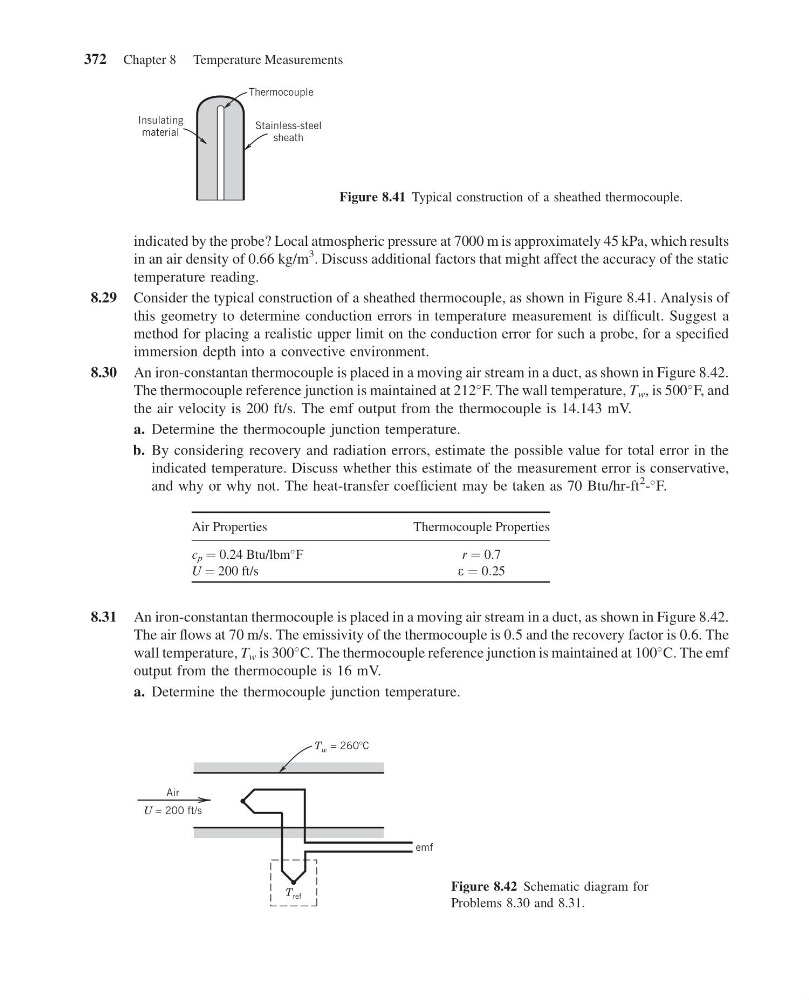
8.29 Consider the typical construction of a sheathed thermocouple, as shown in Figure 8.41. Analysis of
this geometry to determine conduction errors in temperature measurement is difficult. Suggest a
method for placing a realistic upper limit on the conduction error for such a probe, for a specified
immersion depth into a convective environment.
8.30 An iron-constantan thermocouple is placed in a moving air stream in a duct, as shown in Figure 8.42.
The thermocouple reference junction is maintained at 212
F. The wall temperature, T w , is 500
F, and
the air velocity is 200 ft/s. The emf output from the thermocouple is 14.143 mV.
a. Determine the thermocouple junction temperature.
b. By considering recovery and radiation errors, estimate the possible value for total error in the
indicated temperature. Discuss whether this estimate of the measurement error is conservative,
and why or why not. The heat-transfer coefficient may be taken as 70 Btu/hr-ft
2 -
F.
Air Properties
Thermocouple Properties
c p ¼ 0.24 Btu/lbm
F
r ¼ 0.7
U ¼ 200 ft/s
e ¼ 0:25
8.31 An iron-constantan thermocouple is placed in a moving air stream in a duct, as shown in Figure 8.42.
The air flows at 70 m/s. The emissivity of the thermocouple is 0.5 and the recovery factor is 0.6. The
wall temperature, T w is 300
C. The thermocouple reference junction is maintained at 100
C. The emf
output from the thermocouple is 16 mV.
a. Determine the thermocouple junction temperature.
Insulating
material
Thermocouple
Stainless-steel
sheath
Figure 8.41 Typical construction of a sheathed thermocouple.
T ref
emf
Air
U = 200 ft/s
T w = 260 C
Figure 8.42 Schematic diagram for
Problems 8.30 and 8.31.
372 Chapter 8 Temperature Measurements
14:54:4 Page 372
indicated by the probe? Local atmospheric pressure at 7000 m is approximately 45 kPa, which results
in an air density of 0.66 kg/m
3 . Discuss additional factors that might affect the accuracy of the static
temperature reading.
8.29 Consider the typical construction of a sheathed thermocouple, as shown in Figure 8.41. Analysis of
this geometry to determine conduction errors in temperature measurement is difficult. Suggest a
method for placing a realistic upper limit on the conduction error for such a probe, for a specified
immersion depth into a convective environment.
8.30 An iron-constantan thermocouple is placed in a moving air stream in a duct, as shown in Figure 8.42.
The thermocouple reference junction is maintained at 212
F. The wall temperature, T w , is 500
F, and
the air velocity is 200 ft/s. The emf output from the thermocouple is 14.143 mV.
a. Determine the thermocouple junction temperature.
b. By considering recovery and radiation errors, estimate the possible value for total error in the
indicated temperature. Discuss whether this estimate of the measurement error is conservative,
and why or why not. The heat-transfer coefficient may be taken as 70 Btu/hr-ft
2 -
F.
Air Properties
Thermocouple Properties
c p ¼ 0.24 Btu/lbm
F
r ¼ 0.7
U ¼ 200 ft/s
e ¼ 0:25
8.31 An iron-constantan thermocouple is placed in a moving air stream in a duct, as shown in Figure 8.42.
The air flows at 70 m/s. The emissivity of the thermocouple is 0.5 and the recovery factor is 0.6. The
wall temperature, T w is 300
C. The thermocouple reference junction is maintained at 100
C. The emf
output from the thermocouple is 16 mV.
a. Determine the thermocouple junction temperature.
Insulating
material
Thermocouple
Stainless-steel
sheath
Figure 8.41 Typical construction of a sheathed thermocouple.
T ref
emf
Air
U = 200 ft/s
T w = 260 C
Figure 8.42 Schematic diagram for
Problems 8.30 and 8.31.
372 Chapter 8 Temperature Measurements