

E1C08 09/14/2010
14:54:4 Page 371
calibration was 30.1 in. Hg. The steam-point temperature as a function of barometric pressure may be
expressed as
T st ¼ 212 þ 50:422
p
p 0
À 1
À 20:95
p
p 0
À 1
2
F
½
where p 0 ¼ 29.921 in. Hg. At the steam point, the emf produced by the thermocouple, referenced to
0
C, is measured as 5.310 mV. Construct a calibration curve for this thermocouple by plotting the
difference between the thermocouple reference table value and the measured value (emf ref À
emf meas ) versus temperature. What is this difference at 0
C? Suggest a means for measuring
temperatures between 0
and 100
C using this calibration, and estimate the contribution to the total
uncertainty.
8.24 A J-type thermocouple is calibrated against an RTD standard within Æ0.01
C (95%) between 0
and
200
C. The emf is measured with a potentiometer having 0.001 mV resolution and less than
0.015 mV (95%) systematic uncertainty. The reference junction temperature is provided by an ice
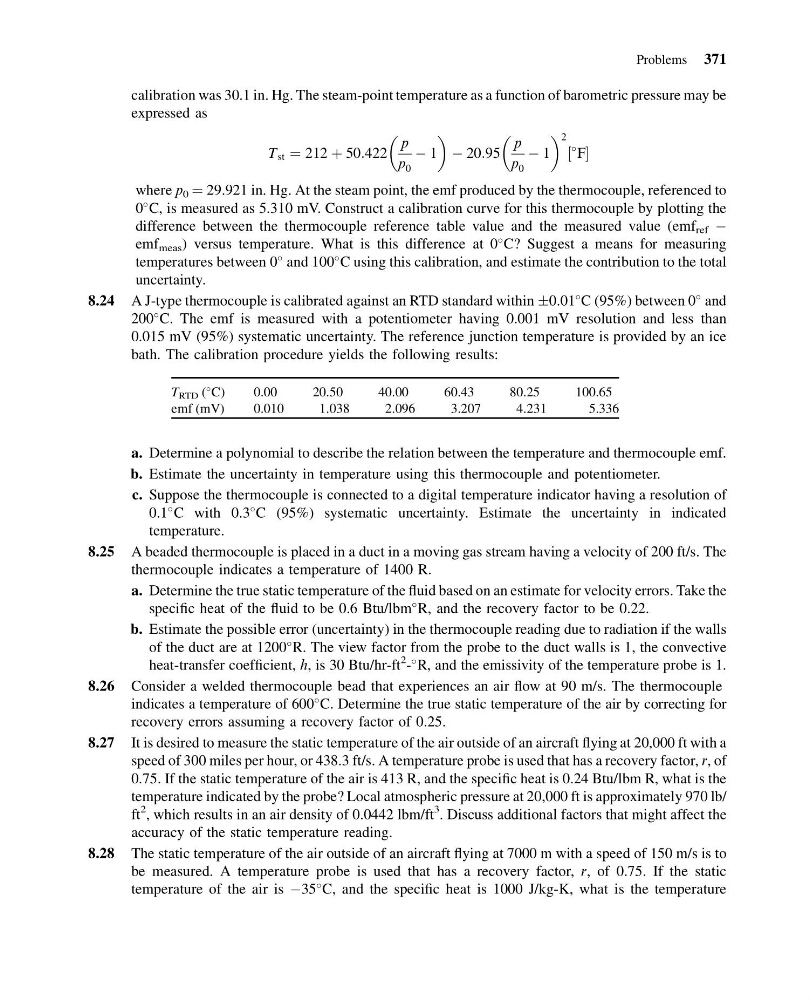
bath. The calibration procedure yields the following results:
T RTD (
C)
0.00
20.50
40.00
60.43
80.25
100.65
emf (mV)
0.010
1.038
2.096
3.207
4.231
5.336
a. Determine a polynomial to describe the relation between the temperature and thermocouple emf.
b. Estimate the uncertainty in temperature using this thermocouple and potentiometer.
c. Suppose the thermocouple is connected to a digital temperature indicator having a resolution of
0.1
C with 0.3
C (95%) systematic uncertainty. Estimate the uncertainty in indicated
temperature.
8.25 A beaded thermocouple is placed in a duct in a moving gas stream having a velocity of 200 ft/s. The
thermocouple indicates a temperature of 1400 R.
a. Determine the true static temperature of the fluid based on an estimate for velocity errors. Take the
specific heat of the fluid to be 0.6 Btu/lbm
R, and the recovery factor to be 0.22.
b. Estimate the possible error (uncertainty) in the thermocouple reading due to radiation if the walls
of the duct are at 1200
R. The view factor from the probe to the duct walls is 1, the convective
heat-transfer coefficient, h, is 30 Btu/hr-ft
2 -
R, and the emissivity of the temperature probe is 1.
8.26 Consider a welded thermocouple bead that experiences an air flow at 90 m/s. The thermocouple
indicates a temperature of 600
C. Determine the true static temperature of the air by correcting for
recovery errors assuming a recovery factor of 0.25.
8.27 It is desired to measure the static temperature of the air outside of an aircraft flying at 20,000 ft with a
speed of 300 miles per hour, or 438.3 ft/s. A temperature probe is used that has a recovery factor, r, of
0.75. If the static temperature of the air is 413 R, and the specific heat is 0.24 Btu/lbm R, what is the
temperature indicated by the probe? Local atmospheric pressure at 20,000 ft is approximately 970 lb/
ft
2 , which results in an air density of 0.0442 lbm/ft
3 . Discuss additional factors that might affect the
accuracy of the static temperature reading.
8.28 The static temperature of the air outside of an aircraft flying at 7000 m with a speed of 150 m/s is to
be measured. A temperature probe is used that has a recovery factor, r, of 0.75. If the static
temperature of the air is À35
C, and the specific heat is 1000 J/kg-K, what is the temperature
Problems 371
14:54:4 Page 371
calibration was 30.1 in. Hg. The steam-point temperature as a function of barometric pressure may be
expressed as
T st ¼ 212 þ 50:422
p
p 0
À 1
À 20:95
p
p 0
À 1
2
F
½
where p 0 ¼ 29.921 in. Hg. At the steam point, the emf produced by the thermocouple, referenced to
0
C, is measured as 5.310 mV. Construct a calibration curve for this thermocouple by plotting the
difference between the thermocouple reference table value and the measured value (emf ref À
emf meas ) versus temperature. What is this difference at 0
C? Suggest a means for measuring
temperatures between 0
and 100
C using this calibration, and estimate the contribution to the total
uncertainty.
8.24 A J-type thermocouple is calibrated against an RTD standard within Æ0.01
C (95%) between 0
and
200
C. The emf is measured with a potentiometer having 0.001 mV resolution and less than
0.015 mV (95%) systematic uncertainty. The reference junction temperature is provided by an ice
bath. The calibration procedure yields the following results:
T RTD (
C)
0.00
20.50
40.00
60.43
80.25
100.65
emf (mV)
0.010
1.038
2.096
3.207
4.231
5.336
a. Determine a polynomial to describe the relation between the temperature and thermocouple emf.
b. Estimate the uncertainty in temperature using this thermocouple and potentiometer.
c. Suppose the thermocouple is connected to a digital temperature indicator having a resolution of
0.1
C with 0.3
C (95%) systematic uncertainty. Estimate the uncertainty in indicated
temperature.
8.25 A beaded thermocouple is placed in a duct in a moving gas stream having a velocity of 200 ft/s. The
thermocouple indicates a temperature of 1400 R.
a. Determine the true static temperature of the fluid based on an estimate for velocity errors. Take the
specific heat of the fluid to be 0.6 Btu/lbm
R, and the recovery factor to be 0.22.
b. Estimate the possible error (uncertainty) in the thermocouple reading due to radiation if the walls
of the duct are at 1200
R. The view factor from the probe to the duct walls is 1, the convective
heat-transfer coefficient, h, is 30 Btu/hr-ft
2 -
R, and the emissivity of the temperature probe is 1.
8.26 Consider a welded thermocouple bead that experiences an air flow at 90 m/s. The thermocouple
indicates a temperature of 600
C. Determine the true static temperature of the air by correcting for
recovery errors assuming a recovery factor of 0.25.
8.27 It is desired to measure the static temperature of the air outside of an aircraft flying at 20,000 ft with a
speed of 300 miles per hour, or 438.3 ft/s. A temperature probe is used that has a recovery factor, r, of
0.75. If the static temperature of the air is 413 R, and the specific heat is 0.24 Btu/lbm R, what is the
temperature indicated by the probe? Local atmospheric pressure at 20,000 ft is approximately 970 lb/
ft
2 , which results in an air density of 0.0442 lbm/ft
3 . Discuss additional factors that might affect the
accuracy of the static temperature reading.
8.28 The static temperature of the air outside of an aircraft flying at 7000 m with a speed of 150 m/s is to
be measured. A temperature probe is used that has a recovery factor, r, of 0.75. If the static
temperature of the air is À35
C, and the specific heat is 1000 J/kg-K, what is the temperature
Problems 371