

E1C07 09/14/2010
14:43:48 Page 265
Example 7.1
A 10-Hz sine wave is sampled at 12 Hz. Compute the maximum frequency that can be represented in
the resulting discrete signal. Compute the alias frequency.
KNOWN f ¼ 10 Hz
f s ¼ 12 Hz
ASSUMPTION Constant sample rate
FIND f N and f a
SOLUTION The Nyquist frequency f N sets the maximum frequency that can be represented in
a resulting data set. Using Equation 7.9 with f s ¼ 12 Hz gives the Nyquist frequency f N ¼ 6 Hz. This
is the maximum frequency that can be sampled correctly. So the measured frequency is in error.
All frequency content in the analog signal above f N appears as an alias frequency f a between 0
and f N . Because f/f N % 1.67, f is folded back and appears in the sampled signal as a frequency
between 0 and f N . Reading Figure 7.3, f ¼ 1.67f N is located directly above 0.33 f N . So f is folded
back to appear as f a ¼ 0.33f N or 2 Hz. This folding is indicated by the dashed arrow in Figure 7.3. As
a consequence, the 10-Hz sine wave sampled at 12 Hz is completely indistinguishable from a 2-Hz
sine wave sampled at 12 Hz in the discrete time series. The 10-Hz signal takes on the identity of a
2-Hz signal—that’s aliasing.
COMMENT The programs Sampling.m and Aliasing.vi can be used to explore the effects of
sample rate on the resulting signal. Aliasing.vi exercises the folding diagram concept.
Example 7.2
A complex periodic signal has the form
yðtÞ ¼ A 1 sin2pð25Þt þ A 2 sin2pð75Þt þ A 3 sin2pð125Þt
If the signal is sampled at 100 Hz, determine the frequency content of the resulting discrete series.
KNOWN f s ¼ 100 Hz
f 1 ¼ 25 Hz f 2 ¼ 75 Hz f 3 ¼ 125 Hz
ASSUMPTION Constant sample rate
FIND The alias frequencies f a1 , f a2 , and f a3 and discrete set {y(rdt)}
SOLUTION From Equation 7.9 for a sample rate of 100 Hz, the Nyquist frequency is 50 Hz.
All frequency content in the analog signal above f N takes on an alias frequency between 0 and f N in
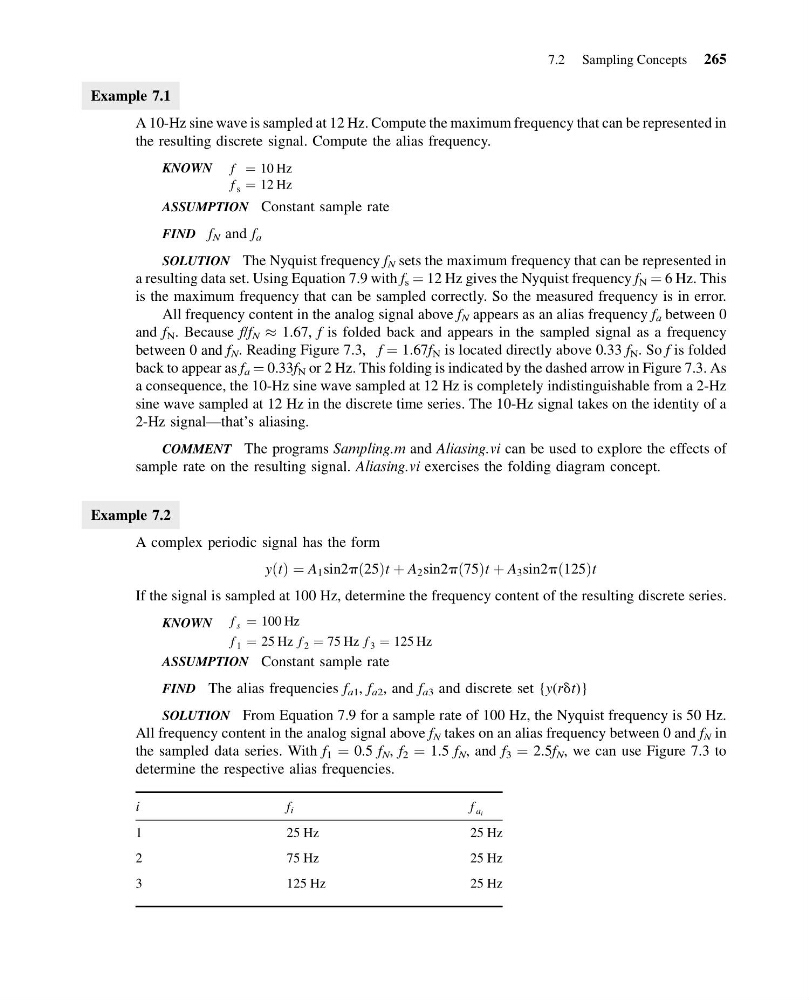
the sampled data series. With f 1 ¼ 0.5 f N , f 2 ¼ 1.5 f N , and f 3 ¼ 2.5f N , we can use Figure 7.3 to
determine the respective alias frequencies.
i
f i
f ai
1
25 Hz
25 Hz
2
75 Hz
25 Hz
3
125 Hz
25 Hz
7.2 Sampling Concepts 265
14:43:48 Page 265
Example 7.1
A 10-Hz sine wave is sampled at 12 Hz. Compute the maximum frequency that can be represented in
the resulting discrete signal. Compute the alias frequency.
KNOWN f ¼ 10 Hz
f s ¼ 12 Hz
ASSUMPTION Constant sample rate
FIND f N and f a
SOLUTION The Nyquist frequency f N sets the maximum frequency that can be represented in
a resulting data set. Using Equation 7.9 with f s ¼ 12 Hz gives the Nyquist frequency f N ¼ 6 Hz. This
is the maximum frequency that can be sampled correctly. So the measured frequency is in error.
All frequency content in the analog signal above f N appears as an alias frequency f a between 0
and f N . Because f/f N % 1.67, f is folded back and appears in the sampled signal as a frequency
between 0 and f N . Reading Figure 7.3, f ¼ 1.67f N is located directly above 0.33 f N . So f is folded
back to appear as f a ¼ 0.33f N or 2 Hz. This folding is indicated by the dashed arrow in Figure 7.3. As
a consequence, the 10-Hz sine wave sampled at 12 Hz is completely indistinguishable from a 2-Hz
sine wave sampled at 12 Hz in the discrete time series. The 10-Hz signal takes on the identity of a
2-Hz signal—that’s aliasing.
COMMENT The programs Sampling.m and Aliasing.vi can be used to explore the effects of
sample rate on the resulting signal. Aliasing.vi exercises the folding diagram concept.
Example 7.2
A complex periodic signal has the form
yðtÞ ¼ A 1 sin2pð25Þt þ A 2 sin2pð75Þt þ A 3 sin2pð125Þt
If the signal is sampled at 100 Hz, determine the frequency content of the resulting discrete series.
KNOWN f s ¼ 100 Hz
f 1 ¼ 25 Hz f 2 ¼ 75 Hz f 3 ¼ 125 Hz
ASSUMPTION Constant sample rate
FIND The alias frequencies f a1 , f a2 , and f a3 and discrete set {y(rdt)}
SOLUTION From Equation 7.9 for a sample rate of 100 Hz, the Nyquist frequency is 50 Hz.
All frequency content in the analog signal above f N takes on an alias frequency between 0 and f N in
the sampled data series. With f 1 ¼ 0.5 f N , f 2 ¼ 1.5 f N , and f 3 ¼ 2.5f N , we can use Figure 7.3 to
determine the respective alias frequencies.
i
f i
f ai
1
25 Hz
25 Hz
2
75 Hz
25 Hz
3
125 Hz
25 Hz
7.2 Sampling Concepts 265