

E1C07 09/14/2010
14:43:48 Page 261
understand how instruments interface with data-acquisition systems, and
perform basic image processing on digital images.
7.2 SAMPLING CONCEPTS
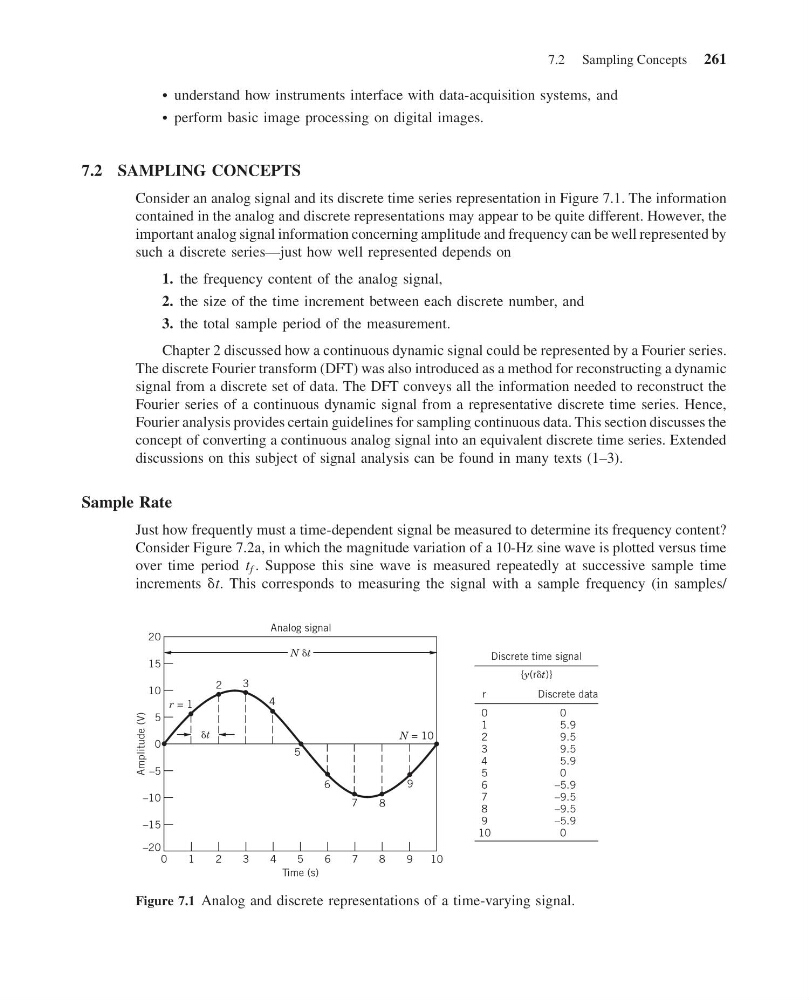
Consider an analog signal and its discrete time series representation in Figure 7.1. The information
contained in the analog and discrete representations may appear to be quite different. However, the
important analog signal information concerning amplitude and frequency can be well represented by
such a discrete series—just how well represented depends on
1. the frequency content of the analog signal,
2. the size of the time increment between each discrete number, and
3. the total sample period of the measurement.
Chapter 2 discussed how a continuous dynamic signal could be represented by a Fourier series.
The discrete Fourier transform (DFT) was also introduced as a method for reconstructing a dynamic
signal from a discrete set of data. The DFT conveys all the information needed to reconstruct the
Fourier series of a continuous dynamic signal from a representative discrete time series. Hence,
Fourier analysis provides certain guidelines for sampling continuous data. This section discusses the
concept of converting a continuous analog signal into an equivalent discrete time series. Extended
discussions on this subject of signal analysis can be found in many texts (1–3).
Sample Rate
Just how frequently must a time-dependent signal be measured to determine its frequency content?
Consider Figure 7.2a, in which the magnitude variation of a 10-Hz sine wave is plotted versus time
over time period t f . Suppose this sine wave is measured repeatedly at successive sample time
increments dt. This corresponds to measuring the signal with a sample frequency (in samples/
0
1
2
3
2
3
4
5
6
7
8
9
N = 10
r = 1
4
Analog signal
5
6
7
8
0
1
2
3
4
5
6
7
8
9
10
0
5.9
9.5
9.5
5.9
0
–5.9
–9.5
–9.5
–5.9
0
Discrete data
Discrete time signal
r
9
10
Time (s)
Amplitude (V)
–20
–15
–10
–5
0
5
10
15
20
N t
{y(r t)}
t
Figure 7.1 Analog and discrete representations of a time-varying signal.
7.2 Sampling Concepts 261
14:43:48 Page 261
understand how instruments interface with data-acquisition systems, and
perform basic image processing on digital images.
7.2 SAMPLING CONCEPTS
Consider an analog signal and its discrete time series representation in Figure 7.1. The information
contained in the analog and discrete representations may appear to be quite different. However, the
important analog signal information concerning amplitude and frequency can be well represented by
such a discrete series—just how well represented depends on
1. the frequency content of the analog signal,
2. the size of the time increment between each discrete number, and
3. the total sample period of the measurement.
Chapter 2 discussed how a continuous dynamic signal could be represented by a Fourier series.
The discrete Fourier transform (DFT) was also introduced as a method for reconstructing a dynamic
signal from a discrete set of data. The DFT conveys all the information needed to reconstruct the
Fourier series of a continuous dynamic signal from a representative discrete time series. Hence,
Fourier analysis provides certain guidelines for sampling continuous data. This section discusses the
concept of converting a continuous analog signal into an equivalent discrete time series. Extended
discussions on this subject of signal analysis can be found in many texts (1–3).
Sample Rate
Just how frequently must a time-dependent signal be measured to determine its frequency content?
Consider Figure 7.2a, in which the magnitude variation of a 10-Hz sine wave is plotted versus time
over time period t f . Suppose this sine wave is measured repeatedly at successive sample time
increments dt. This corresponds to measuring the signal with a sample frequency (in samples/
0
1
2
3
2
3
4
5
6
7
8
9
N = 10
r = 1
4
Analog signal
5
6
7
8
0
1
2
3
4
5
6
7
8
9
10
0
5.9
9.5
9.5
5.9
0
–5.9
–9.5
–9.5
–5.9
0
Discrete data
Discrete time signal
r
9
10
Time (s)
Amplitude (V)
–20
–15
–10
–5
0
5
10
15
20
N t
{y(r t)}
t
Figure 7.1 Analog and discrete representations of a time-varying signal.
7.2 Sampling Concepts 261