

E1C05 09/14/2010
14:36:33 Page 207
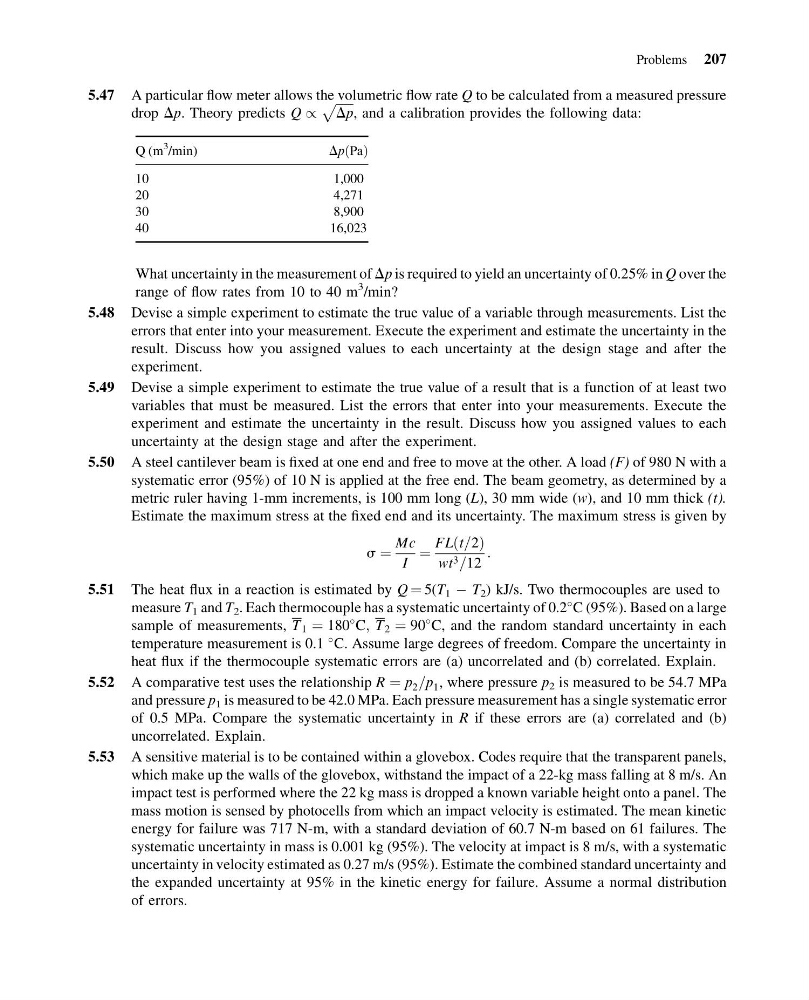
5.47 A particular flow meter allows the volumetric flow rate Q to be calculated from a measured pressure
drop Dp. Theory predicts Q /
ffiffiffiffiffiffi
Dp
p
, and a calibration provides the following data:
Q (m
3
/min)
Dp Pa
ð Þ
10
1,000
20
4,271
30
8,900
40
16,023
What uncertainty in the measurement of Dp is required to yield an uncertainty of 0.25% in Q over the
range of flow rates from 10 to 40 m
3 /min?
5.48 Devise a simple experiment to estimate the true value of a variable through measurements. List the
errors that enter into your measurement. Execute the experiment and estimate the uncertainty in the
result. Discuss how you assigned values to each uncertainty at the design stage and after the
experiment.
5.49 Devise a simple experiment to estimate the true value of a result that is a function of at least two
variables that must be measured. List the errors that enter into your measurements. Execute the
experiment and estimate the uncertainty in the result. Discuss how you assigned values to each
uncertainty at the design stage and after the experiment.
5.50 A steel cantilever beam is fixed at one end and free to move at the other. A load (F) of 980 N with a
systematic error (95%) of 10 N is applied at the free end. The beam geometry, as determined by a
metric ruler having 1-mm increments, is 100 mm long (L), 30 mm wide (w), and 10 mm thick (t).
Estimate the maximum stress at the fixed end and its uncertainty. The maximum stress is given by
s ¼
Mc
I
¼
FL t=2
ð Þ
wt 3 =12
:
5.51 The heat flux in a reaction is estimated by Q ¼ 5(T 1 À T 2 ) kJ/s. Two thermocouples are used to
measure T 1 and T 2 . Each thermocouple has a systematic uncertainty of 0.2
C (95%). Based on a large
sample of measurements, T 1 ¼ 180
C; T 2 ¼ 90
C, and the random standard uncertainty in each
temperature measurement is 0.1
C. Assume large degrees of freedom. Compare the uncertainty in
heat flux if the thermocouple systematic errors are (a) uncorrelated and (b) correlated. Explain.
5.52 A comparative test uses the relationship R ¼ p 2 =p 1 , where pressure p 2 is measured to be 54.7 MPa
and pressure p 1 is measured to be 42.0 MPa. Each pressure measurement has a single systematic error
of 0.5 MPa. Compare the systematic uncertainty in R if these errors are (a) correlated and (b)
uncorrelated. Explain.
5.53 A sensitive material is to be contained within a glovebox. Codes require that the transparent panels,
which make up the walls of the glovebox, withstand the impact of a 22-kg mass falling at 8 m/s. An
impact test is performed where the 22 kg mass is dropped a known variable height onto a panel. The
mass motion is sensed by photocells from which an impact velocity is estimated. The mean kinetic
energy for failure was 717 N-m, with a standard deviation of 60.7 N-m based on 61 failures. The
systematic uncertainty in mass is 0.001 kg (95%). The velocity at impact is 8 m/s, with a systematic
uncertainty in velocity estimated as 0.27 m/s (95%). Estimate the combined standard uncertainty and
the expanded uncertainty at 95% in the kinetic energy for failure. Assume a normal distribution
of errors.
Problems 207
14:36:33 Page 207
5.47 A particular flow meter allows the volumetric flow rate Q to be calculated from a measured pressure
drop Dp. Theory predicts Q /
ffiffiffiffiffiffi
Dp
p
, and a calibration provides the following data:
Q (m
3
/min)
Dp Pa
ð Þ
10
1,000
20
4,271
30
8,900
40
16,023
What uncertainty in the measurement of Dp is required to yield an uncertainty of 0.25% in Q over the
range of flow rates from 10 to 40 m
3 /min?
5.48 Devise a simple experiment to estimate the true value of a variable through measurements. List the
errors that enter into your measurement. Execute the experiment and estimate the uncertainty in the
result. Discuss how you assigned values to each uncertainty at the design stage and after the
experiment.
5.49 Devise a simple experiment to estimate the true value of a result that is a function of at least two
variables that must be measured. List the errors that enter into your measurements. Execute the
experiment and estimate the uncertainty in the result. Discuss how you assigned values to each
uncertainty at the design stage and after the experiment.
5.50 A steel cantilever beam is fixed at one end and free to move at the other. A load (F) of 980 N with a
systematic error (95%) of 10 N is applied at the free end. The beam geometry, as determined by a
metric ruler having 1-mm increments, is 100 mm long (L), 30 mm wide (w), and 10 mm thick (t).
Estimate the maximum stress at the fixed end and its uncertainty. The maximum stress is given by
s ¼
Mc
I
¼
FL t=2
ð Þ
wt 3 =12
:
5.51 The heat flux in a reaction is estimated by Q ¼ 5(T 1 À T 2 ) kJ/s. Two thermocouples are used to
measure T 1 and T 2 . Each thermocouple has a systematic uncertainty of 0.2
C (95%). Based on a large
sample of measurements, T 1 ¼ 180
C; T 2 ¼ 90
C, and the random standard uncertainty in each
temperature measurement is 0.1
C. Assume large degrees of freedom. Compare the uncertainty in
heat flux if the thermocouple systematic errors are (a) uncorrelated and (b) correlated. Explain.
5.52 A comparative test uses the relationship R ¼ p 2 =p 1 , where pressure p 2 is measured to be 54.7 MPa
and pressure p 1 is measured to be 42.0 MPa. Each pressure measurement has a single systematic error
of 0.5 MPa. Compare the systematic uncertainty in R if these errors are (a) correlated and (b)
uncorrelated. Explain.
5.53 A sensitive material is to be contained within a glovebox. Codes require that the transparent panels,
which make up the walls of the glovebox, withstand the impact of a 22-kg mass falling at 8 m/s. An
impact test is performed where the 22 kg mass is dropped a known variable height onto a panel. The
mass motion is sensed by photocells from which an impact velocity is estimated. The mean kinetic
energy for failure was 717 N-m, with a standard deviation of 60.7 N-m based on 61 failures. The
systematic uncertainty in mass is 0.001 kg (95%). The velocity at impact is 8 m/s, with a systematic
uncertainty in velocity estimated as 0.27 m/s (95%). Estimate the combined standard uncertainty and
the expanded uncertainty at 95% in the kinetic energy for failure. Assume a normal distribution
of errors.
Problems 207