

E1C05 09/14/2010
14:36:32 Page 201
For a full-scale output (FSO) of 20 kPa, select a readout based on appropriate uncertainty
calculations. Explain.
5.11 The shear modulus, G, of an alloy can be determined by measuring the angular twist, u, resulting
from a torque applied to a cylindrical rod made from the alloy. For a rod of radius R and a torque
applied at a length L from a fixed end, the modulus is found by G ¼ 2LT=pR
4
u. Examine the effect of
the relative uncertainty of each measured variable on the shear modulus. If during test planning all of
the uncertainties are set at 1%, what is the uncertainty in G?
5.12 An ideal heat engine operates in a cycle and produces work as a result of heat transfer from a thermal
reservoir at an elevated temperature T h and by rejecting energy to a thermal sink at T c . The efficiency
for such an ideal cycle, termed a ‘‘Carnot cycle,’’ is
h ¼ 1 À T c =T h
ð
Þ:
Determine the required uncertainty in the measurement of temperature to yield an uncertainty in
efficiency of 1%. Assume errors are uncorrelated. Use T h ¼ 1000 K and T c ¼ 300 K.
5.13 Heat transfer from a rod of diameter D immersed in a fluid can be described by the Nusselt number,
Nu ¼ hD/k, where h is the heat-transfer coefficient and k is the thermal conductivity of the fluid. If h
can be measured to within Æ7% (95%), estimate the uncertainty in Nu for the nominal value of
h ¼ 150 W/m
2 -K. Let D ¼ 20 Æ 0.5 mm and k ¼ 0.6 Æ 2% W/m-K.
5.14 Estimate the design-stage uncertainty in determining the voltage drop across an electric heating
element. The device has a nominal resistance of 30 V and power rating of 500 W. Available is an
ohmmeter (accuracy: within 0.5%; resolution: 1 V) and ammeter (accuracy: within 0.1%; resolution:
100 mA). Recall E ¼ IR.
5.15 Explain the critical difference(s) between a design-stage uncertainty analysis and an advanced-stage
uncertainty analysis.
5.16 From an uncertainty analysis perspective, what important information does replication provide that
is not found by repetition alone? How is this information included in an uncertainty analysis?
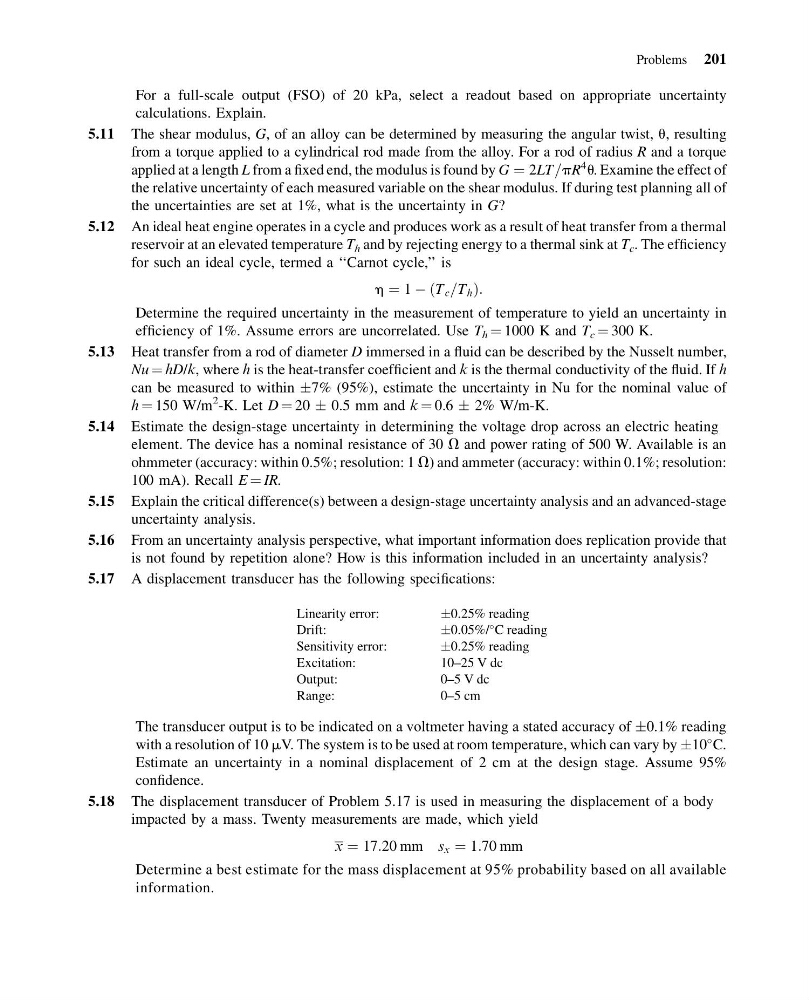
5.17 A displacement transducer has the following specifications:
Linearity error:
Æ0.25% reading
Drift:
Æ0.05%/
C reading
Sensitivity error:
Æ0.25% reading
Excitation:
10–25 V dc
Output:
0–5 V dc
Range:
0–5 cm
The transducer output is to be indicated on a voltmeter having a stated accuracy of Æ0.1% reading
with a resolution of 10 mV. The system is to be used at room temperature, which can vary by Æ10
C.
Estimate an uncertainty in a nominal displacement of 2 cm at the design stage. Assume 95%
confidence.
5.18 The displacement transducer of Problem 5.17 is used in measuring the displacement of a body
impacted by a mass. Twenty measurements are made, which yield
x ¼ 17:20 mm s x ¼ 1:70 mm
Determine a best estimate for the mass displacement at 95% probability based on all available
information.
Problems 201
14:36:32 Page 201
For a full-scale output (FSO) of 20 kPa, select a readout based on appropriate uncertainty
calculations. Explain.
5.11 The shear modulus, G, of an alloy can be determined by measuring the angular twist, u, resulting
from a torque applied to a cylindrical rod made from the alloy. For a rod of radius R and a torque
applied at a length L from a fixed end, the modulus is found by G ¼ 2LT=pR
4
u. Examine the effect of
the relative uncertainty of each measured variable on the shear modulus. If during test planning all of
the uncertainties are set at 1%, what is the uncertainty in G?
5.12 An ideal heat engine operates in a cycle and produces work as a result of heat transfer from a thermal
reservoir at an elevated temperature T h and by rejecting energy to a thermal sink at T c . The efficiency
for such an ideal cycle, termed a ‘‘Carnot cycle,’’ is
h ¼ 1 À T c =T h
ð
Þ:
Determine the required uncertainty in the measurement of temperature to yield an uncertainty in
efficiency of 1%. Assume errors are uncorrelated. Use T h ¼ 1000 K and T c ¼ 300 K.
5.13 Heat transfer from a rod of diameter D immersed in a fluid can be described by the Nusselt number,
Nu ¼ hD/k, where h is the heat-transfer coefficient and k is the thermal conductivity of the fluid. If h
can be measured to within Æ7% (95%), estimate the uncertainty in Nu for the nominal value of
h ¼ 150 W/m
2 -K. Let D ¼ 20 Æ 0.5 mm and k ¼ 0.6 Æ 2% W/m-K.
5.14 Estimate the design-stage uncertainty in determining the voltage drop across an electric heating
element. The device has a nominal resistance of 30 V and power rating of 500 W. Available is an
ohmmeter (accuracy: within 0.5%; resolution: 1 V) and ammeter (accuracy: within 0.1%; resolution:
100 mA). Recall E ¼ IR.
5.15 Explain the critical difference(s) between a design-stage uncertainty analysis and an advanced-stage
uncertainty analysis.
5.16 From an uncertainty analysis perspective, what important information does replication provide that
is not found by repetition alone? How is this information included in an uncertainty analysis?
5.17 A displacement transducer has the following specifications:
Linearity error:
Æ0.25% reading
Drift:
Æ0.05%/
C reading
Sensitivity error:
Æ0.25% reading
Excitation:
10–25 V dc
Output:
0–5 V dc
Range:
0–5 cm
The transducer output is to be indicated on a voltmeter having a stated accuracy of Æ0.1% reading
with a resolution of 10 mV. The system is to be used at room temperature, which can vary by Æ10
C.
Estimate an uncertainty in a nominal displacement of 2 cm at the design stage. Assume 95%
confidence.
5.18 The displacement transducer of Problem 5.17 is used in measuring the displacement of a body
impacted by a mass. Twenty measurements are made, which yield
x ¼ 17:20 mm s x ¼ 1:70 mm
Determine a best estimate for the mass displacement at 95% probability based on all available
information.
Problems 201