

E1C05 09/14/2010
14:36:32 Page 200
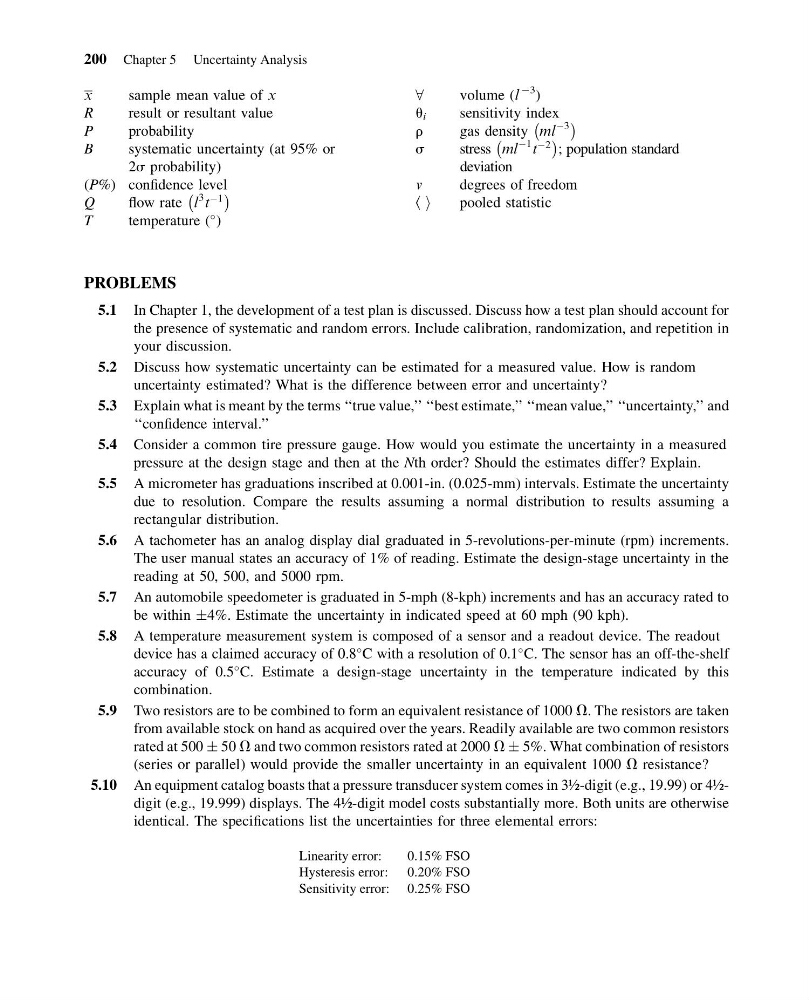
x
sample mean value of x
R
result or resultant value
P
probability
B
systematic uncertainty (at 95% or
2s probability)
(P%) confidence level
Q
flow rate l
3
t
À1
À
Á
T
temperature (
)
8
volume (l
À3 )
u i
sensitivity index
r
gas density ml
À3
À
Á
s
stress ml
À1
t
À2
À
Á
; population standard
deviation
v
degrees of freedom
k i
pooled statistic
PROBLEMS
5.1 In Chapter 1, the development of a test plan is discussed. Discuss how a test plan should account for
the presence of systematic and random errors. Include calibration, randomization, and repetition in
your discussion.
5.2 Discuss how systematic uncertainty can be estimated for a measured value. How is random
uncertainty estimated? What is the difference between error and uncertainty?
5.3 Explain what is meant by the terms ‘‘true value,’’ ‘‘best estimate,’’ ‘‘mean value,’’ ‘‘uncertainty,’’ and
‘‘confidence interval.’’
5.4 Consider a common tire pressure gauge. How would you estimate the uncertainty in a measured
pressure at the design stage and then at the Nth order? Should the estimates differ? Explain.
5.5 A micrometer has graduations inscribed at 0.001-in. (0.025-mm) intervals. Estimate the uncertainty
due to resolution. Compare the results assuming a normal distribution to results assuming a
rectangular distribution.
5.6 A tachometer has an analog display dial graduated in 5-revolutions-per-minute (rpm) increments.
The user manual states an accuracy of 1% of reading. Estimate the design-stage uncertainty in the
reading at 50, 500, and 5000 rpm.
5.7 An automobile speedometer is graduated in 5-mph (8-kph) increments and has an accuracy rated to
be within Æ4%. Estimate the uncertainty in indicated speed at 60 mph (90 kph).
5.8 A temperature measurement system is composed of a sensor and a readout device. The readout
device has a claimed accuracy of 0.8
C with a resolution of 0.1
C. The sensor has an off-the-shelf
accuracy of 0.5
C. Estimate a design-stage uncertainty in the temperature indicated by this
combination.
5.9 Two resistors are to be combined to form an equivalent resistance of 1000 V. The resistors are taken
from available stock on hand as acquired over the years. Readily available are two common resistors
rated at 500 Æ 50 V and two common resistors rated at 2000 V Æ 5%. What combination of resistors
(series or parallel) would provide the smaller uncertainty in an equivalent 1000 V resistance?
5.10 An equipment catalog boasts that a pressure transducer system comes in 3½-digit (e.g., 19.99) or 4½digit (e.g., 19.999) displays. The 4½-digit model costs substantially more. Both units are otherwise
identical. The specifications list the uncertainties for three elemental errors:
Linearity error:
0.15% FSO
Hysteresis error: 0.20% FSO
Sensitivity error: 0.25% FSO
200 Chapter 5 Uncertainty Analysis
14:36:32 Page 200
x
sample mean value of x
R
result or resultant value
P
probability
B
systematic uncertainty (at 95% or
2s probability)
(P%) confidence level
Q
flow rate l
3
t
À1
À
Á
T
temperature (
)
8
volume (l
À3 )
u i
sensitivity index
r
gas density ml
À3
À
Á
s
stress ml
À1
t
À2
À
Á
; population standard
deviation
v
degrees of freedom
k i
pooled statistic
PROBLEMS
5.1 In Chapter 1, the development of a test plan is discussed. Discuss how a test plan should account for
the presence of systematic and random errors. Include calibration, randomization, and repetition in
your discussion.
5.2 Discuss how systematic uncertainty can be estimated for a measured value. How is random
uncertainty estimated? What is the difference between error and uncertainty?
5.3 Explain what is meant by the terms ‘‘true value,’’ ‘‘best estimate,’’ ‘‘mean value,’’ ‘‘uncertainty,’’ and
‘‘confidence interval.’’
5.4 Consider a common tire pressure gauge. How would you estimate the uncertainty in a measured
pressure at the design stage and then at the Nth order? Should the estimates differ? Explain.
5.5 A micrometer has graduations inscribed at 0.001-in. (0.025-mm) intervals. Estimate the uncertainty
due to resolution. Compare the results assuming a normal distribution to results assuming a
rectangular distribution.
5.6 A tachometer has an analog display dial graduated in 5-revolutions-per-minute (rpm) increments.
The user manual states an accuracy of 1% of reading. Estimate the design-stage uncertainty in the
reading at 50, 500, and 5000 rpm.
5.7 An automobile speedometer is graduated in 5-mph (8-kph) increments and has an accuracy rated to
be within Æ4%. Estimate the uncertainty in indicated speed at 60 mph (90 kph).
5.8 A temperature measurement system is composed of a sensor and a readout device. The readout
device has a claimed accuracy of 0.8
C with a resolution of 0.1
C. The sensor has an off-the-shelf
accuracy of 0.5
C. Estimate a design-stage uncertainty in the temperature indicated by this
combination.
5.9 Two resistors are to be combined to form an equivalent resistance of 1000 V. The resistors are taken
from available stock on hand as acquired over the years. Readily available are two common resistors
rated at 500 Æ 50 V and two common resistors rated at 2000 V Æ 5%. What combination of resistors
(series or parallel) would provide the smaller uncertainty in an equivalent 1000 V resistance?
5.10 An equipment catalog boasts that a pressure transducer system comes in 3½-digit (e.g., 19.99) or 4½digit (e.g., 19.999) displays. The 4½-digit model costs substantially more. Both units are otherwise
identical. The specifications list the uncertainties for three elemental errors:
Linearity error:
0.15% FSO
Hysteresis error: 0.20% FSO
Sensitivity error: 0.25% FSO
200 Chapter 5 Uncertainty Analysis