

E1C05 09/14/2010
14:36:28 Page 189
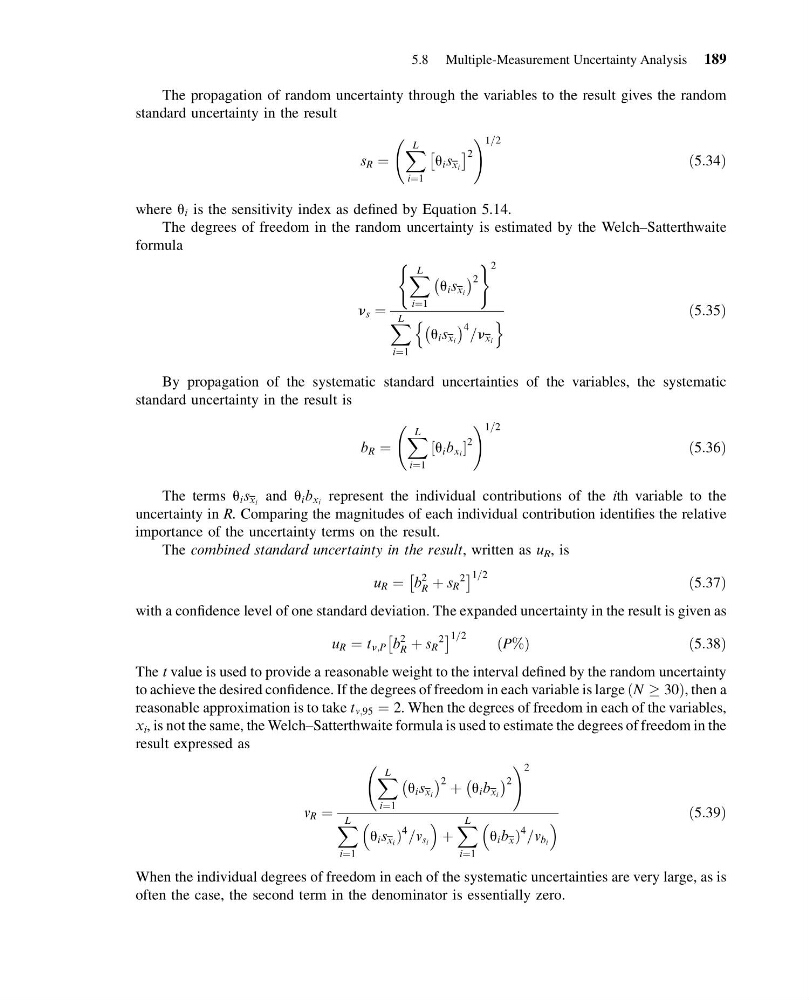
The propagation of random uncertainty through the variables to the result gives the random
standard uncertainty in the result
s R ¼
X L
i¼1
u i s x i
Â
à 2
! 1=2
ð5:34Þ
where u i is the sensitivity index as defined by Equation 5.14.
The degrees of freedom in the random uncertainty is estimated by the Welch–Satterthwaite
formula
n s ¼
X L
i¼1
u i s x i
À
Á 2
(
) 2
X L
i¼1
u i s x i
À
Á 4 =n x i
n
o
ð5:35Þ
By propagation of the systematic standard uncertainties of the variables, the systematic
standard uncertainty in the result is
b R ¼
X L
i¼1
u i b x i
½
2
! 1=2
ð5:36Þ
The terms u i s x i and u i b x i represent the individual contributions of the ith variable to the
uncertainty in R. Comparing the magnitudes of each individual contribution identifies the relative
importance of the uncertainty terms on the result.
The combined standard uncertainty in the result, written as u R , is
u R ¼ b
2
R þ s R
2
Â
à 1=2
ð5:37Þ
with a confidence level of one standard deviation. The expanded uncertainty in the result is given as
u R ¼ t n;P b
2
R þ s R
2
Â
à 1=2
ðP%Þ
ð 5:38Þ
The t value is used to provide a reasonable weight to the interval defined by the random uncertainty
to achieve the desired confidence. If the degrees of freedom in each variable is large N ! 30
ð
Þ , then a
reasonable approximation is to take t v;95 ¼ 2. When the degrees of freedom in each of the variables,
x i , is not the same, the Welch–Satterthwaite formula is used to estimate the degrees of freedom in the
result expressed as
v R ¼
X L
i¼1
u i s x i
À
Á 2 þ u i b x i
À
Á 2
! 2
X L
i¼1
u i s x i Þ
4 =v s i
þ
X L
i¼1
u i b x Þ
4 =v b i
ð5:39Þ
When the individual degrees of freedom in each of the systematic uncertainties are very large, as is
often the case, the second term in the denominator is essentially zero.
5.8 Multiple-Measurement Uncertainty Analysis 189
14:36:28 Page 189
The propagation of random uncertainty through the variables to the result gives the random
standard uncertainty in the result
s R ¼
X L
i¼1
u i s x i
Â
à 2
! 1=2
ð5:34Þ
where u i is the sensitivity index as defined by Equation 5.14.
The degrees of freedom in the random uncertainty is estimated by the Welch–Satterthwaite
formula
n s ¼
X L
i¼1
u i s x i
À
Á 2
(
) 2
X L
i¼1
u i s x i
À
Á 4 =n x i
n
o
ð5:35Þ
By propagation of the systematic standard uncertainties of the variables, the systematic
standard uncertainty in the result is
b R ¼
X L
i¼1
u i b x i
½
2
! 1=2
ð5:36Þ
The terms u i s x i and u i b x i represent the individual contributions of the ith variable to the
uncertainty in R. Comparing the magnitudes of each individual contribution identifies the relative
importance of the uncertainty terms on the result.
The combined standard uncertainty in the result, written as u R , is
u R ¼ b
2
R þ s R
2
Â
à 1=2
ð5:37Þ
with a confidence level of one standard deviation. The expanded uncertainty in the result is given as
u R ¼ t n;P b
2
R þ s R
2
Â
à 1=2
ðP%Þ
ð 5:38Þ
The t value is used to provide a reasonable weight to the interval defined by the random uncertainty
to achieve the desired confidence. If the degrees of freedom in each variable is large N ! 30
ð
Þ , then a
reasonable approximation is to take t v;95 ¼ 2. When the degrees of freedom in each of the variables,
x i , is not the same, the Welch–Satterthwaite formula is used to estimate the degrees of freedom in the
result expressed as
v R ¼
X L
i¼1
u i s x i
À
Á 2 þ u i b x i
À
Á 2
! 2
X L
i¼1
u i s x i Þ
4 =v s i
þ
X L
i¼1
u i b x Þ
4 =v b i
ð5:39Þ
When the individual degrees of freedom in each of the systematic uncertainties are very large, as is
often the case, the second term in the denominator is essentially zero.
5.8 Multiple-Measurement Uncertainty Analysis 189