

E1C05 09/14/2010
14:36:28 Page 188
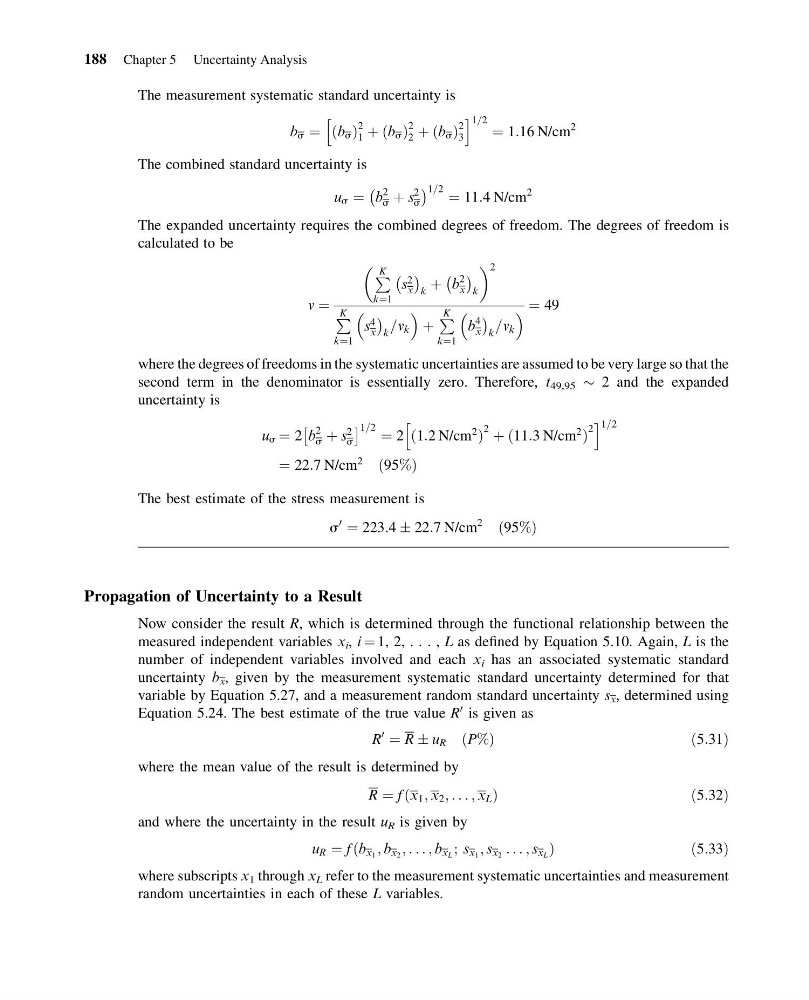
The measurement systematic standard uncertainty is
b s ¼ b s
ð Þ
2
1 þ b s
ð Þ
2
2 þ b s
ð Þ
2
3
h
i 1=2 ¼ 1:16 N/cm
2
The combined standard uncertainty is
u s ¼ b
2
s þ s
2
s
À
Á 1=2 ¼ 11:4 N/cm
2
The expanded uncertainty requires the combined degrees of freedom. The degrees of freedom is
calculated to be
v ¼
P K
k¼1
s
2
x
À Á
k
þ b
2
x
À Á
k
2
P K
k¼1
s 4
x
Á
k
=v k
þ
P K
k¼1
b
4
x
Á
k
=v k
¼ 49
where the degrees of freedoms in the systematic uncertainties are assumed to be very large so that the
second term in the denominator is essentially zero. Therefore, t 49,95 $ 2 and the expanded
uncertainty is
u s ¼ 2 b
2
s þ s
2
s
Â
à 1=2 ¼ 2 1:2 N/cm
2
ð
Þ
2 þ 11:3 N/cm
2
ð
Þ
2
h
i 1=2
¼ 22:7 N/cm
2
ð95%Þ
The best estimate of the stress measurement is
s
0
¼ 223:4 Æ 22:7 N/cm
2
ð95%Þ
Propagation of Uncertainty to a Result
Now consider the result R, which is determined through the functional relationship between the
measured independent variables x i , i ¼ 1, 2, . . . , L as defined by Equation 5.10. Again, L is the
number of independent variables involved and each x i has an associated systematic standard
uncertainty b x , given by the measurement systematic standard uncertainty determined for that
variable by Equation 5.27, and a measurement random standard uncertainty s x , determined using
Equation 5.24. The best estimate of the true value R
0 is given as
R
0
¼ R Æ u R P%
ð Þ
ð5:31Þ
where the mean value of the result is determined by
R ¼ f x 1 ; x 2 ; . . . ; x L
ð
Þ
ð 5:32Þ
and where the uncertainty in the result u R is given by
u R ¼ f b x 1 ; b x 2 ; . . . ; b x L ; s x 1 ; s x 2 . . . ; s x L
ð
Þ
ð 5:33Þ
where subscripts x 1 through x L refer to the measurement systematic uncertainties and measurement
random uncertainties in each of these L variables.
188 Chapter 5 Uncertainty Analysis
14:36:28 Page 188
The measurement systematic standard uncertainty is
b s ¼ b s
ð Þ
2
1 þ b s
ð Þ
2
2 þ b s
ð Þ
2
3
h
i 1=2 ¼ 1:16 N/cm
2
The combined standard uncertainty is
u s ¼ b
2
s þ s
2
s
À
Á 1=2 ¼ 11:4 N/cm
2
The expanded uncertainty requires the combined degrees of freedom. The degrees of freedom is
calculated to be
v ¼
P K
k¼1
s
2
x
À Á
k
þ b
2
x
À Á
k
2
P K
k¼1
s 4
x
Á
k
=v k
þ
P K
k¼1
b
4
x
Á
k
=v k
¼ 49
where the degrees of freedoms in the systematic uncertainties are assumed to be very large so that the
second term in the denominator is essentially zero. Therefore, t 49,95 $ 2 and the expanded
uncertainty is
u s ¼ 2 b
2
s þ s
2
s
Â
à 1=2 ¼ 2 1:2 N/cm
2
ð
Þ
2 þ 11:3 N/cm
2
ð
Þ
2
h
i 1=2
¼ 22:7 N/cm
2
ð95%Þ
The best estimate of the stress measurement is
s
0
¼ 223:4 Æ 22:7 N/cm
2
ð95%Þ
Propagation of Uncertainty to a Result
Now consider the result R, which is determined through the functional relationship between the
measured independent variables x i , i ¼ 1, 2, . . . , L as defined by Equation 5.10. Again, L is the
number of independent variables involved and each x i has an associated systematic standard
uncertainty b x , given by the measurement systematic standard uncertainty determined for that
variable by Equation 5.27, and a measurement random standard uncertainty s x , determined using
Equation 5.24. The best estimate of the true value R
0 is given as
R
0
¼ R Æ u R P%
ð Þ
ð5:31Þ
where the mean value of the result is determined by
R ¼ f x 1 ; x 2 ; . . . ; x L
ð
Þ
ð 5:32Þ
and where the uncertainty in the result u R is given by
u R ¼ f b x 1 ; b x 2 ; . . . ; b x L ; s x 1 ; s x 2 . . . ; s x L
ð
Þ
ð 5:33Þ
where subscripts x 1 through x L refer to the measurement systematic uncertainties and measurement
random uncertainties in each of these L variables.
188 Chapter 5 Uncertainty Analysis