

E1C05 09/14/2010
14:36:27 Page 183
and is in harmony with international guidelines (1). The procedures assume that the errors follow a
normal probability distribution, although the procedures are actually quite insensitive to deviations
away from such behavior (4). Sufficient repetitions must be present in the measured data to assess
random error; otherwise, some estimate of the magnitude of expected variation should be provided
in the analysis.
Propagation of Elemental Errors
The procedures for multiple-measurement uncertainty analysis consist of the following steps:
Identify the elemental errors in the measurement. As an aid, consider the errors in each of the
three source groups (calibration, data acquisition, and data reduction).
Estimate the magnitude of systematic and random error in each of the elemental errors.
Calculate the uncertainty estimate for the result.
Considerable guidance can be obtained from Tables 5.1 to 5.3 for identifying the elemental errors. In
multiple-measurement analysis, it is possible to divide the estimates for elemental errors into
random and systematic uncertainties.
Consider the measurement of variable x, which is subject to elemental random errors each
estimated by their random standard uncertainty, s x
ð Þ k , and systematic errors each estimated by
their systematic standard uncertainty, b x
ð Þ k . Let subscript k, where k ¼ 1; 2; . . . ; K, refer to each
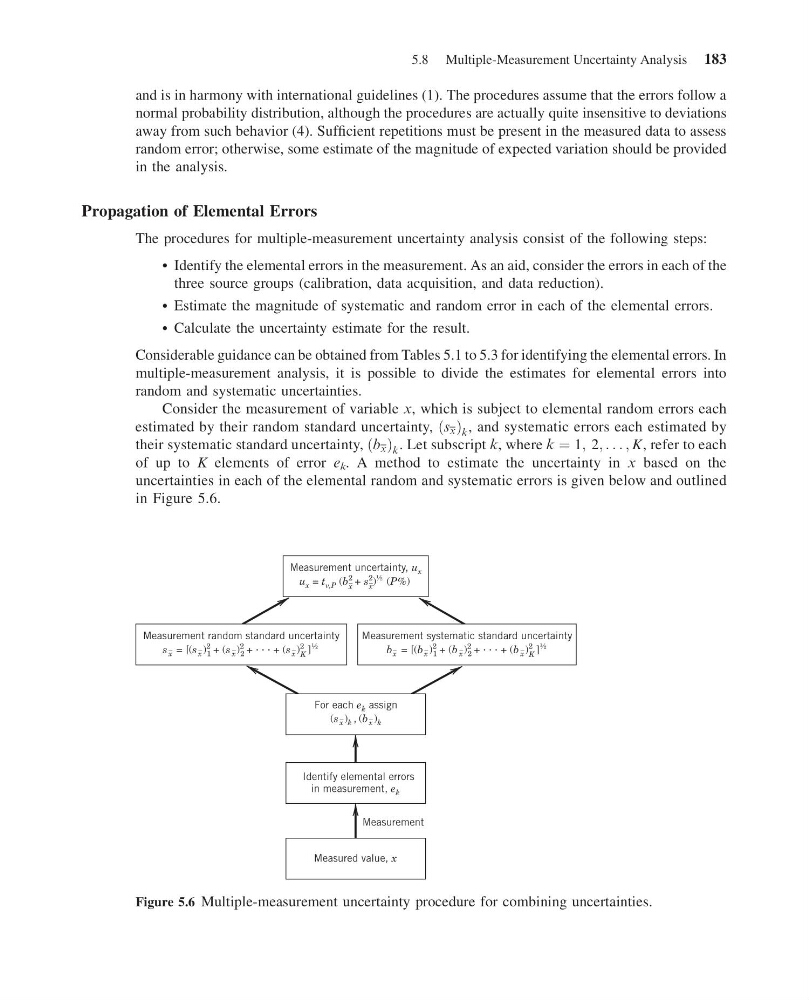
of up to K elements of error e k . A method to estimate the uncertainty in x based on the
uncertainties in each of the elemental random and systematic errors is given below and outlined
in Figure 5.6.
For each e k assign
Measured value, x
Measurement
Identify elemental errors
in measurement, e k
,
(s ) k
x –
(b ) k
x –
Measurement random standard uncertainty
s = [(s )
2
1 + (s )
2
2 + · · · + (s )
2
K
]
½
x –
x –
x –
x –
Measurement systematic standard uncertainty
b = [(b )
2
1 + (b )
2
2 + · · · + (b )
2
K
]
½
x –
x –
x –
x –
Measurement uncertainty, u x
x –
x –
u x = t ,P (b
2 + s
2 )
½ (P%)
Figure 5.6 Multiple-measurement uncertainty procedure for combining uncertainties.
5.8 Multiple-Measurement Uncertainty Analysis 183
14:36:27 Page 183
and is in harmony with international guidelines (1). The procedures assume that the errors follow a
normal probability distribution, although the procedures are actually quite insensitive to deviations
away from such behavior (4). Sufficient repetitions must be present in the measured data to assess
random error; otherwise, some estimate of the magnitude of expected variation should be provided
in the analysis.
Propagation of Elemental Errors
The procedures for multiple-measurement uncertainty analysis consist of the following steps:
Identify the elemental errors in the measurement. As an aid, consider the errors in each of the
three source groups (calibration, data acquisition, and data reduction).
Estimate the magnitude of systematic and random error in each of the elemental errors.
Calculate the uncertainty estimate for the result.
Considerable guidance can be obtained from Tables 5.1 to 5.3 for identifying the elemental errors. In
multiple-measurement analysis, it is possible to divide the estimates for elemental errors into
random and systematic uncertainties.
Consider the measurement of variable x, which is subject to elemental random errors each
estimated by their random standard uncertainty, s x
ð Þ k , and systematic errors each estimated by
their systematic standard uncertainty, b x
ð Þ k . Let subscript k, where k ¼ 1; 2; . . . ; K, refer to each
of up to K elements of error e k . A method to estimate the uncertainty in x based on the
uncertainties in each of the elemental random and systematic errors is given below and outlined
in Figure 5.6.
For each e k assign
Measured value, x
Measurement
Identify elemental errors
in measurement, e k
,
(s ) k
x –
(b ) k
x –
Measurement random standard uncertainty
s = [(s )
2
1 + (s )
2
2 + · · · + (s )
2
K
]
½
x –
x –
x –
x –
Measurement systematic standard uncertainty
b = [(b )
2
1 + (b )
2
2 + · · · + (b )
2
K
]
½
x –
x –
x –
x –
Measurement uncertainty, u x
x –
x –
u x = t ,P (b
2 + s
2 )
½ (P%)
Figure 5.6 Multiple-measurement uncertainty procedure for combining uncertainties.
5.8 Multiple-Measurement Uncertainty Analysis 183