

E1C05 09/14/2010
14:36:27 Page 181
2. The time t required to collect 1 ft
3 of liquid can be measured.
Suppose we determine an Nth-order uncertainty in time of 0.15 s. In either case the same
instruments are used. Determine which method is better to minimize uncertainty over a range
of flow rates based on these preliminary estimates.
KNOWN u 8 ¼ 0:001 ft
3
u t ¼ 0:15 s
Q ¼ f 8; t
ð Þ ¼ 8=t
ASSUMPTIONS Flow diversion is instantaneous; 95% confidence levels.
FIND Preferred method
SOLUTION From the available information, the propagation of probable uncertainty to the
result Q is estimated from Equation 5.15:
u Q ¼
qQ
q8
u 8
2
þ
qQ
qt
u t
2
"
# 1=2
By dividing through by Q, we obtain the relative (fractional percent) uncertainty in flow rate u Q /Q
u Q
Q
¼
u 8
8
2 þ
u t
t
2
! 1=2
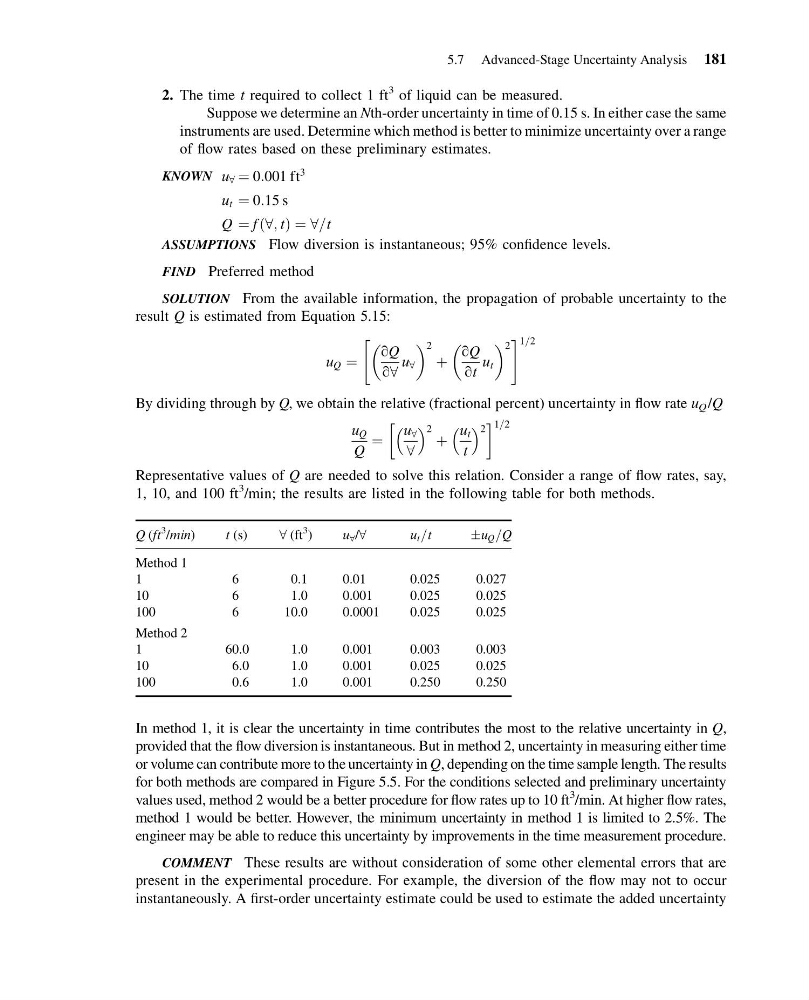
Representative values of Q are needed to solve this relation. Consider a range of flow rates, say,
1, 10, and 100 ft
3 /min; the results are listed in the following table for both methods.
Q (ft
3
/min)
t (s)
8 (ft
3
)
u 8 /8
u t =t
Æu Q =Q
Method 1
1
6
0.1
0.01
0.025
0.027
10
6
1.0
0.001
0.025
0.025
100
6
10.0
0.0001
0.025
0.025
Method 2
1
60.0
1.0
0.001
0.003
0.003
10
6.0
1.0
0.001
0.025
0.025
100
0.6
1.0
0.001
0.250
0.250
In method 1, it is clear the uncertainty in time contributes the most to the relative uncertainty in Q,
provided that the flow diversion is instantaneous. But in method 2, uncertainty in measuring either time
or volume can contribute more to the uncertainty in Q, depending on the time sample length. The results
for both methods are compared in Figure 5.5. For the conditions selected and preliminary uncertainty
values used, method 2 would be a better procedure for flow rates up to 10 ft
3
/min. At higher flow rates,
method 1 would be better. However, the minimum uncertainty in method 1 is limited to 2.5%. The
engineer may be able to reduce this uncertainty by improvements in the time measurement procedure.
COMMENT These results are without consideration of some other elemental errors that are
present in the experimental procedure. For example, the diversion of the flow may not to occur
instantaneously. A first-order uncertainty estimate could be used to estimate the added uncertainty
5.7 Advanced-Stage Uncertainty Analysis 181
14:36:27 Page 181
2. The time t required to collect 1 ft
3 of liquid can be measured.
Suppose we determine an Nth-order uncertainty in time of 0.15 s. In either case the same
instruments are used. Determine which method is better to minimize uncertainty over a range
of flow rates based on these preliminary estimates.
KNOWN u 8 ¼ 0:001 ft
3
u t ¼ 0:15 s
Q ¼ f 8; t
ð Þ ¼ 8=t
ASSUMPTIONS Flow diversion is instantaneous; 95% confidence levels.
FIND Preferred method
SOLUTION From the available information, the propagation of probable uncertainty to the
result Q is estimated from Equation 5.15:
u Q ¼
q8
u 8
2
þ
qt
u t
2
"
# 1=2
By dividing through by Q, we obtain the relative (fractional percent) uncertainty in flow rate u Q /Q
u Q
Q
¼
u 8
8
2 þ
u t
t
2
! 1=2
Representative values of Q are needed to solve this relation. Consider a range of flow rates, say,
1, 10, and 100 ft
3 /min; the results are listed in the following table for both methods.
Q (ft
3
/min)
t (s)
8 (ft
3
)
u 8 /8
u t =t
Æu Q =Q
Method 1
1
6
0.1
0.01
0.025
0.027
10
6
1.0
0.001
0.025
0.025
100
6
10.0
0.0001
0.025
0.025
Method 2
1
60.0
1.0
0.001
0.003
0.003
10
6.0
1.0
0.001
0.025
0.025
100
0.6
1.0
0.001
0.250
0.250
In method 1, it is clear the uncertainty in time contributes the most to the relative uncertainty in Q,
provided that the flow diversion is instantaneous. But in method 2, uncertainty in measuring either time
or volume can contribute more to the uncertainty in Q, depending on the time sample length. The results
for both methods are compared in Figure 5.5. For the conditions selected and preliminary uncertainty
values used, method 2 would be a better procedure for flow rates up to 10 ft
3
/min. At higher flow rates,
method 1 would be better. However, the minimum uncertainty in method 1 is limited to 2.5%. The
engineer may be able to reduce this uncertainty by improvements in the time measurement procedure.
COMMENT These results are without consideration of some other elemental errors that are
present in the experimental procedure. For example, the diversion of the flow may not to occur
instantaneously. A first-order uncertainty estimate could be used to estimate the added uncertainty
5.7 Advanced-Stage Uncertainty Analysis 181