

E1C03 09/14/2010
15:24:54 Page 107
3.6 MULTIPLE-FUNCTION INPUTS
So far we have discussed measurement system response to a signal containing only a single frequency.
What about measurement system response to multiple input frequencies? Or to an input that consists of
both a static and a dynamic part, such as a periodic strain signal from an oscillating beam? When using
models that are linear, such as ordinary differential equations subjected to inputs that are linear in terms
of the dependent variable, the principle of superposition of linear systems applies in the solution of
these equations. The principle of superposition states that a linear combination of input signals applied
to a linear measurement system produces an output signal that is simply the linear addition of the
separate output signals that would result if each input term had been applied separately. Because the
form of the transient response is not affected by the input function, we can focus on the steady
response. In general, we can write that if the forcing function of a form
F t
ð Þ ¼ A 0 þ
X 1
k¼1
A k sin v k t
ð3:35Þ
is applied to a system, then the combined steady response will have the form
y steady ðtÞ ¼ KA 0 þ
X 1
k¼1
B v k
ð Þsin v k t þ F v k
ð Þ
½
ð 3:36Þ
where B v k
ð Þ ¼ KA k M v k
ð Þ. The development of the superposition principle can be found in basic
texts on dynamic systems (4).
0
1
2
Time delay between
u(t) and v(t)
3
4
Signal
–3
–2
–1
0
1
2
3
u(t)
u(t)
v(t)
v(t)
w(t)
w(t)
t [s]
Time delay between
u(t) and w(t)
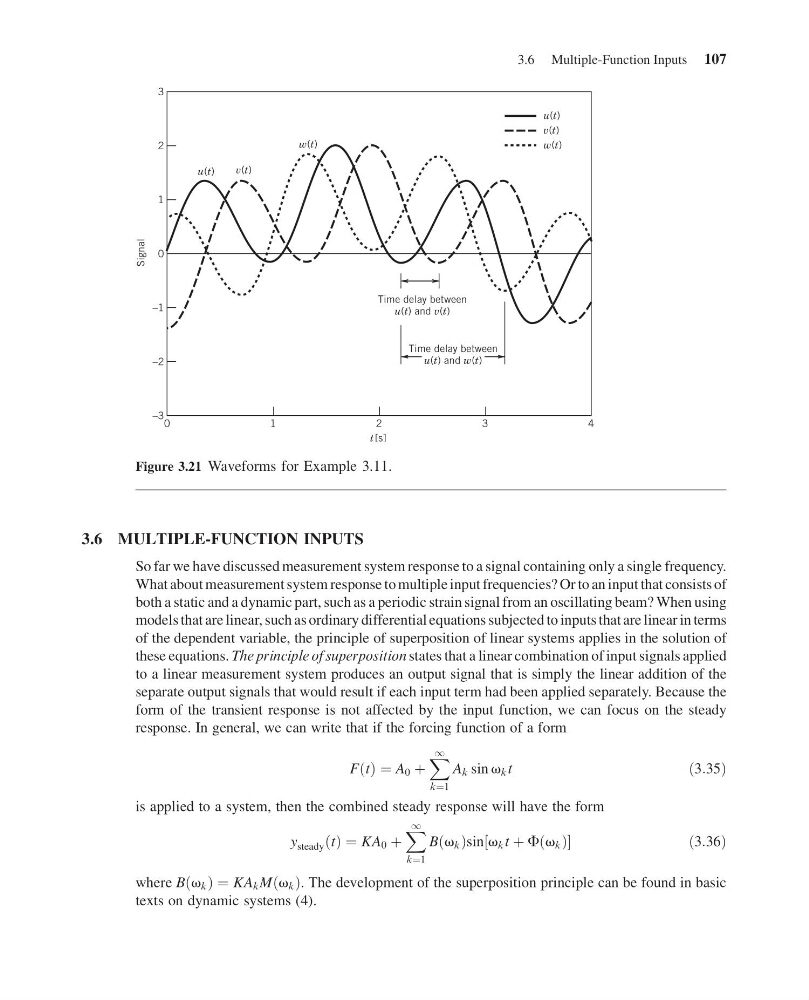
Figure 3.21 Waveforms for Example 3.11.
3.6 Multiple-Function Inputs 107
15:24:54 Page 107
3.6 MULTIPLE-FUNCTION INPUTS
So far we have discussed measurement system response to a signal containing only a single frequency.
What about measurement system response to multiple input frequencies? Or to an input that consists of
both a static and a dynamic part, such as a periodic strain signal from an oscillating beam? When using
models that are linear, such as ordinary differential equations subjected to inputs that are linear in terms
of the dependent variable, the principle of superposition of linear systems applies in the solution of
these equations. The principle of superposition states that a linear combination of input signals applied
to a linear measurement system produces an output signal that is simply the linear addition of the
separate output signals that would result if each input term had been applied separately. Because the
form of the transient response is not affected by the input function, we can focus on the steady
response. In general, we can write that if the forcing function of a form
F t
ð Þ ¼ A 0 þ
X 1
k¼1
A k sin v k t
ð3:35Þ
is applied to a system, then the combined steady response will have the form
y steady ðtÞ ¼ KA 0 þ
X 1
k¼1
B v k
ð Þsin v k t þ F v k
ð Þ
½
ð 3:36Þ
where B v k
ð Þ ¼ KA k M v k
ð Þ. The development of the superposition principle can be found in basic
texts on dynamic systems (4).
0
1
2
Time delay between
u(t) and v(t)
3
4
Signal
–3
–2
–1
0
1
2
3
u(t)
u(t)
v(t)
v(t)
w(t)
w(t)
t [s]
Time delay between
u(t) and w(t)
Figure 3.21 Waveforms for Example 3.11.
3.6 Multiple-Function Inputs 107