

4.5 DET-Type Bi-Way Bioelectrocatalysis
87
to the equilibrium potential (E eq ) of the substrate redox couple. Such reversible bidirectional inter-conversions are realized for: the 2H
+ /H 2 redox couple using several
kinds of membrane-bound H 2 ases usually with a [NiFe] cluster [37], the carbon
dioxide (CO 2 )/carbon monoxide redox couple by using CO 2 dehydrogenase with a
[Ni4Fe–4S] cluster, the CO 2 /formate (HCOO
− ) redox couple by using FoDH with
a W-pterin active site, and the NAD
+ /NADH redox couple by using mitochondrial
complex I [45]. Introductive interpretation of steady-state sigmoidal bioelectrocatalytic wave has been reported elsewhere [46]. These experimental findings clearly
indicate that redox enzymes can work as extremely efficient electrocatalysts of several
electrochemical reactions that are otherwise extremely poor in kinetics.
Interestingly, NAD-linked soluble H 2 ase electro-catalyzes with two sets of
reversible bi-directional inter-conversion between the 2H
+ /H 2 redox couple and
between the NAD
+ / NADH redox couple in a DET-type bioelectrocatalysis [47].
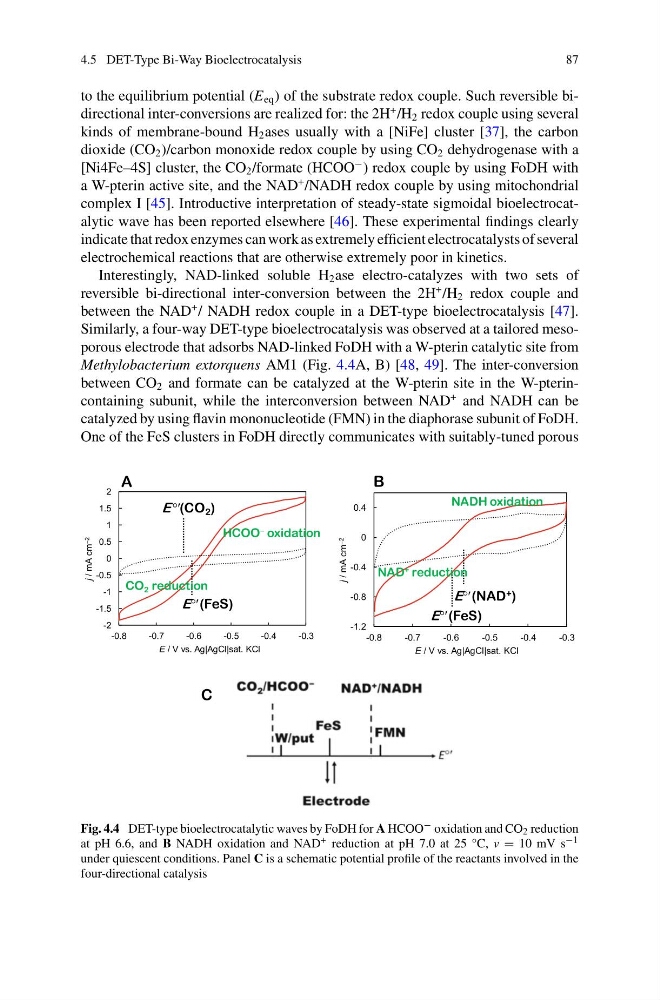
Similarly, a four-way DET-type bioelectrocatalysis was observed at a tailored mesoporous electrode that adsorbs NAD-linked FoDH with a W-pterin catalytic site from
Methylobacterium extorquens AM1 (Fig. 4.4A, B) [48, 49]. The inter-conversion
between CO 2 and formate can be catalyzed at the W-pterin site in the W-pterincontaining subunit, while the interconversion between NAD
+ and NADH can be
catalyzed by using flavin mononucleotide (FMN) in the diaphorase subunit of FoDH.
One of the FeS clusters in FoDH directly communicates with suitably-tuned porous
Fig. 4.4 DET-type bioelectrocatalytic waves by FoDH for A HCOO − oxidation and CO 2 reduction
at pH 6.6, and B NADH oxidation and NAD + reduction at pH 7.0 at 25 °C, v = 10 mV s −1
under quiescent conditions. Panel C is a schematic potential profile of the reactants involved in the
four-directional catalysis
87
to the equilibrium potential (E eq ) of the substrate redox couple. Such reversible bidirectional inter-conversions are realized for: the 2H
+ /H 2 redox couple using several
kinds of membrane-bound H 2 ases usually with a [NiFe] cluster [37], the carbon
dioxide (CO 2 )/carbon monoxide redox couple by using CO 2 dehydrogenase with a
[Ni4Fe–4S] cluster, the CO 2 /formate (HCOO
− ) redox couple by using FoDH with
a W-pterin active site, and the NAD
+ /NADH redox couple by using mitochondrial
complex I [45]. Introductive interpretation of steady-state sigmoidal bioelectrocatalytic wave has been reported elsewhere [46]. These experimental findings clearly
indicate that redox enzymes can work as extremely efficient electrocatalysts of several
electrochemical reactions that are otherwise extremely poor in kinetics.
Interestingly, NAD-linked soluble H 2 ase electro-catalyzes with two sets of
reversible bi-directional inter-conversion between the 2H
+ /H 2 redox couple and
between the NAD
+ / NADH redox couple in a DET-type bioelectrocatalysis [47].
Similarly, a four-way DET-type bioelectrocatalysis was observed at a tailored mesoporous electrode that adsorbs NAD-linked FoDH with a W-pterin catalytic site from
Methylobacterium extorquens AM1 (Fig. 4.4A, B) [48, 49]. The inter-conversion
between CO 2 and formate can be catalyzed at the W-pterin site in the W-pterincontaining subunit, while the interconversion between NAD
+ and NADH can be
catalyzed by using flavin mononucleotide (FMN) in the diaphorase subunit of FoDH.
One of the FeS clusters in FoDH directly communicates with suitably-tuned porous
Fig. 4.4 DET-type bioelectrocatalytic waves by FoDH for A HCOO − oxidation and CO 2 reduction
at pH 6.6, and B NADH oxidation and NAD + reduction at pH 7.0 at 25 °C, v = 10 mV s −1
under quiescent conditions. Panel C is a schematic potential profile of the reactants involved in the
four-directional catalysis