

88
4 Characteristic Properties of Redox Enzymes as Electrocatalysts
electrodes. By considering the fact that the formal potential of the CO 2 /HCOO
− redox
couple (E
◦◦
CO 2 /HCOO
− ) is 0.11 V more negative than that of the NAD
+ /NADH redox
couple (E
◦◦
NAD
+ /NADH ) under neutral conditions [50], schematic energetics can be
illustrated in Fig. 4.4C, which indicates that the standard Gibb energy of the reaction
( r G
o ) is quite positive for one of the intramolecular electron transfer processes.
Even under such conditions, FoDH shows clear bi-directional DET-type bioelectrocatalytic reduction and oxidation waves of the CO 2 /HCOO
− and NAD
+ /NADH
couples. This means that the rate constants of the self-electron-exchange reactions of
the electron-donating and -accepting sites (k DD and k AA ) are very large at the redox
sites in the enzyme, as evidenced by the Marcus cross reaction theory [51]:
k ≈
k AA k DD exp
−
r G o
RT
,
(4.4)
where k denotes the rate constant of the intramolecular electron transfer in FoDH. By
considering a quadratic function of the energy map of reactant and product,
‡ G
o
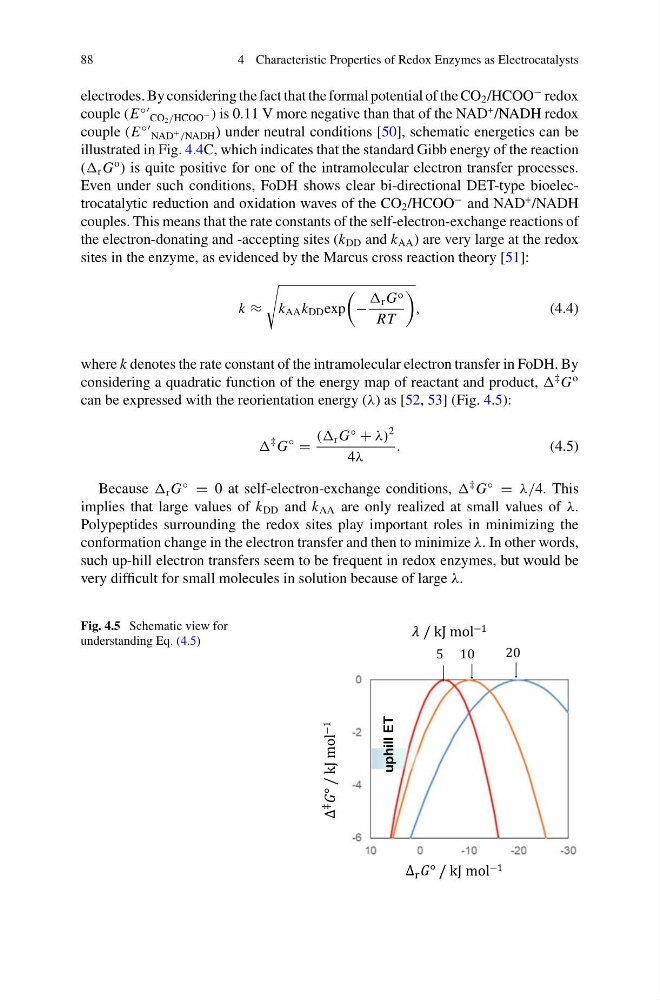
can be expressed with the reorientation energy (λ) as [52, 53] (Fig. 4.5):
‡ G
◦
=
( r G
◦
+ λ)
2
4λ
.
(4.5)
Because r G
◦
= 0 at self-electron-exchange conditions,
‡ G
◦
= λ/4. This
implies that large values of k DD and k AA are only realized at small values of λ.
Polypeptides surrounding the redox sites play important roles in minimizing the
conformation change in the electron transfer and then to minimize λ. In other words,
such up-hill electron transfers seem to be frequent in redox enzymes, but would be
very difficult for small molecules in solution because of large λ.
Fig. 4.5 Schematic view for
understanding Eq. (4.5)
4 Characteristic Properties of Redox Enzymes as Electrocatalysts
electrodes. By considering the fact that the formal potential of the CO 2 /HCOO
− redox
couple (E
◦◦
CO 2 /HCOO
− ) is 0.11 V more negative than that of the NAD
+ /NADH redox
couple (E
◦◦
NAD
+ /NADH ) under neutral conditions [50], schematic energetics can be
illustrated in Fig. 4.4C, which indicates that the standard Gibb energy of the reaction
( r G
o ) is quite positive for one of the intramolecular electron transfer processes.
Even under such conditions, FoDH shows clear bi-directional DET-type bioelectrocatalytic reduction and oxidation waves of the CO 2 /HCOO
− and NAD
+ /NADH
couples. This means that the rate constants of the self-electron-exchange reactions of
the electron-donating and -accepting sites (k DD and k AA ) are very large at the redox
sites in the enzyme, as evidenced by the Marcus cross reaction theory [51]:
k ≈
k AA k DD exp
−
r G o
RT
,
(4.4)
where k denotes the rate constant of the intramolecular electron transfer in FoDH. By
considering a quadratic function of the energy map of reactant and product,
‡ G
o
can be expressed with the reorientation energy (λ) as [52, 53] (Fig. 4.5):
‡ G
◦
=
( r G
◦
+ λ)
2
4λ
.
(4.5)
Because r G
◦
= 0 at self-electron-exchange conditions,
‡ G
◦
= λ/4. This
implies that large values of k DD and k AA are only realized at small values of λ.
Polypeptides surrounding the redox sites play important roles in minimizing the
conformation change in the electron transfer and then to minimize λ. In other words,
such up-hill electron transfers seem to be frequent in redox enzymes, but would be
very difficult for small molecules in solution because of large λ.
Fig. 4.5 Schematic view for
understanding Eq. (4.5)