

2.6 Immobilization of Enzymes and Mediators
47
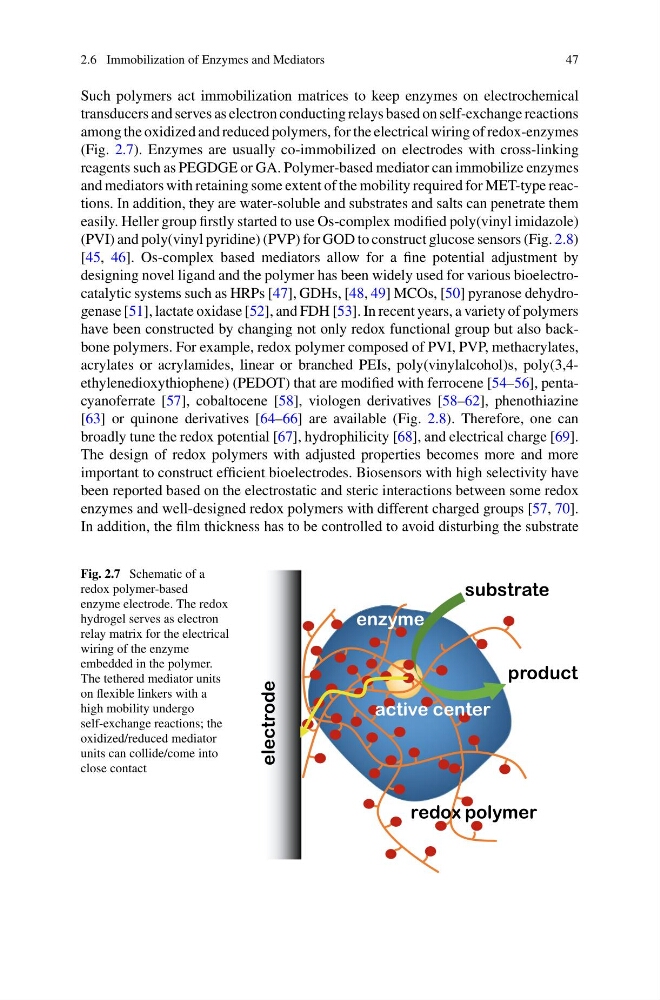
Such polymers act immobilization matrices to keep enzymes on electrochemical
transducers and serves as electron conducting relays based on self-exchange reactions
among the oxidized and reduced polymers, for the electrical wiring of redox-enzymes
(Fig. 2.7). Enzymes are usually co-immobilized on electrodes with cross-linking
reagents such as PEGDGE or GA. Polymer-based mediator can immobilize enzymes
and mediators with retaining some extent of the mobility required for MET-type reactions. In addition, they are water-soluble and substrates and salts can penetrate them
easily. Heller group firstly started to use Os-complex modified poly(vinyl imidazole)
(PVI) and poly(vinyl pyridine) (PVP) for GOD to construct glucose sensors (Fig. 2.8)
[45, 46]. Os-complex based mediators allow for a fine potential adjustment by
designing novel ligand and the polymer has been widely used for various bioelectrocatalytic systems such as HRPs [47], GDHs, [48, 49] MCOs, [50] pyranose dehydrogenase [51], lactate oxidase [52], and FDH [53]. In recent years, a variety of polymers
have been constructed by changing not only redox functional group but also backbone polymers. For example, redox polymer composed of PVI, PVP, methacrylates,
acrylates or acrylamides, linear or branched PEIs, poly(vinylalcohol)s, poly(3,4ethylenedioxythiophene) (PEDOT) that are modified with ferrocene [54–56], pentacyanoferrate [57], cobaltocene [58], viologen derivatives [58–62], phenothiazine
[63] or quinone derivatives [64–66] are available (Fig. 2.8). Therefore, one can
broadly tune the redox potential [67], hydrophilicity [68], and electrical charge [69].
The design of redox polymers with adjusted properties becomes more and more
important to construct efficient bioelectrodes. Biosensors with high selectivity have
been reported based on the electrostatic and steric interactions between some redox
enzymes and well-designed redox polymers with different charged groups [57, 70].
In addition, the film thickness has to be controlled to avoid disturbing the substrate
Fig. 2.7 Schematic of a
redox polymer-based
enzyme electrode. The redox
hydrogel serves as electron
relay matrix for the electrical
wiring of the enzyme
embedded in the polymer.
The tethered mediator units
on flexible linkers with a
high mobility undergo
self-exchange reactions; the
oxidized/reduced mediator
units can collide/come into
close contact
substrate
product
enzyme
redox polymer
active center
electrode
47
Such polymers act immobilization matrices to keep enzymes on electrochemical
transducers and serves as electron conducting relays based on self-exchange reactions
among the oxidized and reduced polymers, for the electrical wiring of redox-enzymes
(Fig. 2.7). Enzymes are usually co-immobilized on electrodes with cross-linking
reagents such as PEGDGE or GA. Polymer-based mediator can immobilize enzymes
and mediators with retaining some extent of the mobility required for MET-type reactions. In addition, they are water-soluble and substrates and salts can penetrate them
easily. Heller group firstly started to use Os-complex modified poly(vinyl imidazole)
(PVI) and poly(vinyl pyridine) (PVP) for GOD to construct glucose sensors (Fig. 2.8)
[45, 46]. Os-complex based mediators allow for a fine potential adjustment by
designing novel ligand and the polymer has been widely used for various bioelectrocatalytic systems such as HRPs [47], GDHs, [48, 49] MCOs, [50] pyranose dehydrogenase [51], lactate oxidase [52], and FDH [53]. In recent years, a variety of polymers
have been constructed by changing not only redox functional group but also backbone polymers. For example, redox polymer composed of PVI, PVP, methacrylates,
acrylates or acrylamides, linear or branched PEIs, poly(vinylalcohol)s, poly(3,4ethylenedioxythiophene) (PEDOT) that are modified with ferrocene [54–56], pentacyanoferrate [57], cobaltocene [58], viologen derivatives [58–62], phenothiazine
[63] or quinone derivatives [64–66] are available (Fig. 2.8). Therefore, one can
broadly tune the redox potential [67], hydrophilicity [68], and electrical charge [69].
The design of redox polymers with adjusted properties becomes more and more
important to construct efficient bioelectrodes. Biosensors with high selectivity have
been reported based on the electrostatic and steric interactions between some redox
enzymes and well-designed redox polymers with different charged groups [57, 70].
In addition, the film thickness has to be controlled to avoid disturbing the substrate
Fig. 2.7 Schematic of a
redox polymer-based
enzyme electrode. The redox
hydrogel serves as electron
relay matrix for the electrical
wiring of the enzyme
embedded in the polymer.
The tethered mediator units
on flexible linkers with a
high mobility undergo
self-exchange reactions; the
oxidized/reduced mediator
units can collide/come into
close contact
substrate
product
enzyme
redox polymer
active center
electrode