

24
2 MET-Type Bioelectrocatalysis
i
n M F A
= −D M
∂c M ox (0,t)
∂ x
,
(2.3)
where D M denotes the diffusion coefficient of M, A denote the surface area of an
electrode, and c M ox (x,t) denotes the concentration of M ox and is the function of the
distance from the electrode surface (x) and the time (t) in general. It is difficult
to get general analytical solution of the current in MET-type bioelectrocatalysis,
because of non-linear relation in the enzymatic reaction (2.1) to the concentration
of substrate(s). Therefore, the steady-state assumption and the simplification of the
enzymatic reaction mechanism are frequently applied to express the catalytic current
of MET-type bioelectrocatalysis [1, 2].
Under the steady-state conditions, the reaction–diffusion equation in the 1D
symmetric system is as follows:
∂c M ox (x,t)
∂t
= D M
∂
2 c M ox (x,t)
∂ x 2
− k M c M ox = 0,
(2.4)
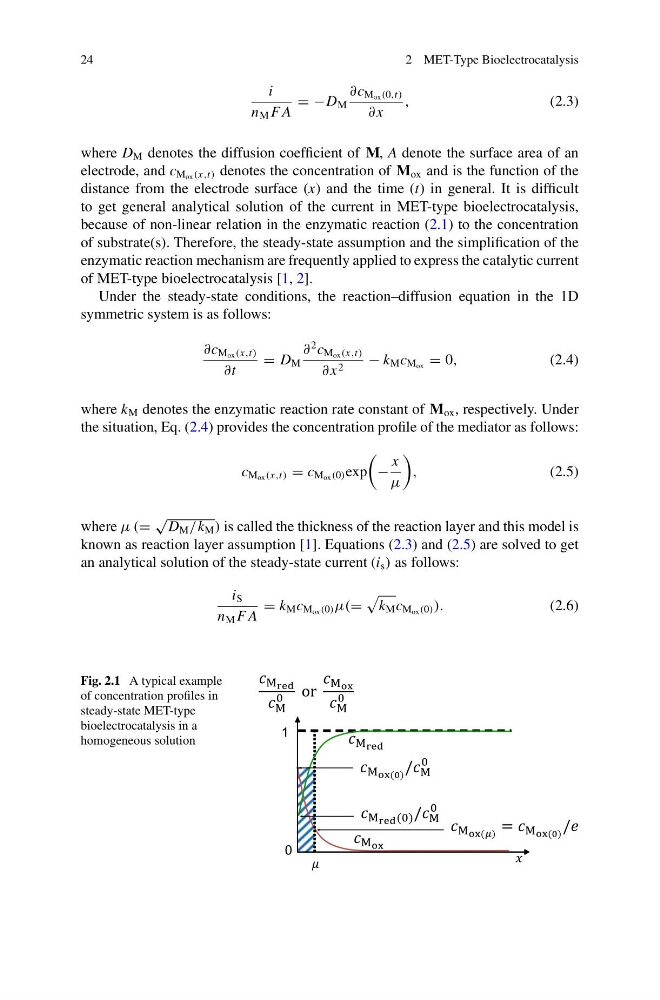
where k M denotes the enzymatic reaction rate constant of M ox , respectively. Under
the situation, Eq. (2.4) provides the concentration profile of the mediator as follows:
c M ox (x,t) = c M ox (0) exp
−
x
μ
,
(2.5)
where μ (=
√
D M /k M ) is called the thickness of the reaction layer and this model is
known as reaction layer assumption [1]. Equations (2.3) and (2.5) are solved to get
an analytical solution of the steady-state current (i s ) as follows:
i S
n M F A
= k M c M ox (0) μ(=
k M c M ox (0) ).
(2.6)
Fig. 2.1 A typical example
of concentration profiles in
steady-state MET-type
bioelectrocatalysis in a
homogeneous solution
0
1
2 MET-Type Bioelectrocatalysis
i
n M F A
= −D M
∂c M ox (0,t)
∂ x
,
(2.3)
where D M denotes the diffusion coefficient of M, A denote the surface area of an
electrode, and c M ox (x,t) denotes the concentration of M ox and is the function of the
distance from the electrode surface (x) and the time (t) in general. It is difficult
to get general analytical solution of the current in MET-type bioelectrocatalysis,
because of non-linear relation in the enzymatic reaction (2.1) to the concentration
of substrate(s). Therefore, the steady-state assumption and the simplification of the
enzymatic reaction mechanism are frequently applied to express the catalytic current
of MET-type bioelectrocatalysis [1, 2].
Under the steady-state conditions, the reaction–diffusion equation in the 1D
symmetric system is as follows:
∂c M ox (x,t)
∂t
= D M
∂
2 c M ox (x,t)
∂ x 2
− k M c M ox = 0,
(2.4)
where k M denotes the enzymatic reaction rate constant of M ox , respectively. Under
the situation, Eq. (2.4) provides the concentration profile of the mediator as follows:
c M ox (x,t) = c M ox (0) exp
−
x
μ
,
(2.5)
where μ (=
√
D M /k M ) is called the thickness of the reaction layer and this model is
known as reaction layer assumption [1]. Equations (2.3) and (2.5) are solved to get
an analytical solution of the steady-state current (i s ) as follows:
i S
n M F A
= k M c M ox (0) μ(=
k M c M ox (0) ).
(2.6)
Fig. 2.1 A typical example
of concentration profiles in
steady-state MET-type
bioelectrocatalysis in a
homogeneous solution
0
1