

16
1 Redox Proteins and Bioelectrocatalysis
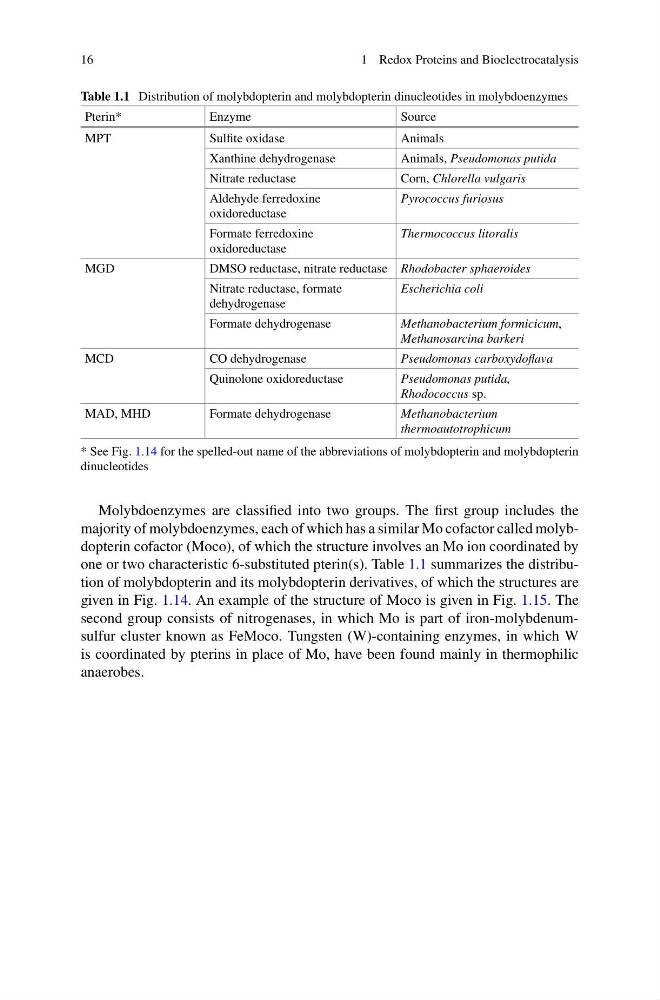
Table 1.1 Distribution of molybdopterin and molybdopterin dinucleotides in molybdoenzymes
Pterin*
Enzyme
Source
MPT
Sulfite oxidase
Animals
Xanthine dehydrogenase
Animals, Pseudomonas putida
Nitrate reductase
Corn, Chlorella vulgaris
Aldehyde ferredoxine
oxidoreductase
Pyrococcus furiosus
Formate ferredoxine
oxidoreductase
Thermococcus litoralis
MGD
DMSO reductase, nitrate reductase Rhodobacter sphaeroides
Nitrate reductase, formate
dehydrogenase
Escherichia coli
Formate dehydrogenase
Methanobacterium formicicum,
Methanosarcina barkeri
MCD
CO dehydrogenase
Pseudomonas carboxydoflava
Quinolone oxidoreductase
Pseudomonas putida,
Rhodococcus sp.
MAD, MHD
Formate dehydrogenase
Methanobacterium
thermoautotrophicum
* See Fig. 1.14 for the spelled-out name of the abbreviations of molybdopterin and molybdopterin
dinucleotides
Molybdoenzymes are classified into two groups. The first group includes the
majority of molybdoenzymes, each of which has a similar Mo cofactor called molybdopterin cofactor (Moco), of which the structure involves an Mo ion coordinated by
one or two characteristic 6-substituted pterin(s). Table 1.1 summarizes the distribution of molybdopterin and its molybdopterin derivatives, of which the structures are
given in Fig. 1.14. An example of the structure of Moco is given in Fig. 1.15. The
second group consists of nitrogenases, in which Mo is part of iron-molybdenumsulfur cluster known as FeMoco. Tungsten (W)-containing enzymes, in which W
is coordinated by pterins in place of Mo, have been found mainly in thermophilic
anaerobes.
1 Redox Proteins and Bioelectrocatalysis
Table 1.1 Distribution of molybdopterin and molybdopterin dinucleotides in molybdoenzymes
Pterin*
Enzyme
Source
MPT
Sulfite oxidase
Animals
Xanthine dehydrogenase
Animals, Pseudomonas putida
Nitrate reductase
Corn, Chlorella vulgaris
Aldehyde ferredoxine
oxidoreductase
Pyrococcus furiosus
Formate ferredoxine
oxidoreductase
Thermococcus litoralis
MGD
DMSO reductase, nitrate reductase Rhodobacter sphaeroides
Nitrate reductase, formate
dehydrogenase
Escherichia coli
Formate dehydrogenase
Methanobacterium formicicum,
Methanosarcina barkeri
MCD
CO dehydrogenase
Pseudomonas carboxydoflava
Quinolone oxidoreductase
Pseudomonas putida,
Rhodococcus sp.
MAD, MHD
Formate dehydrogenase
Methanobacterium
thermoautotrophicum
* See Fig. 1.14 for the spelled-out name of the abbreviations of molybdopterin and molybdopterin
dinucleotides
Molybdoenzymes are classified into two groups. The first group includes the
majority of molybdoenzymes, each of which has a similar Mo cofactor called molybdopterin cofactor (Moco), of which the structure involves an Mo ion coordinated by
one or two characteristic 6-substituted pterin(s). Table 1.1 summarizes the distribution of molybdopterin and its molybdopterin derivatives, of which the structures are
given in Fig. 1.14. An example of the structure of Moco is given in Fig. 1.15. The
second group consists of nitrogenases, in which Mo is part of iron-molybdenumsulfur cluster known as FeMoco. Tungsten (W)-containing enzymes, in which W
is coordinated by pterins in place of Mo, have been found mainly in thermophilic
anaerobes.