

1.2 Redox Components
15
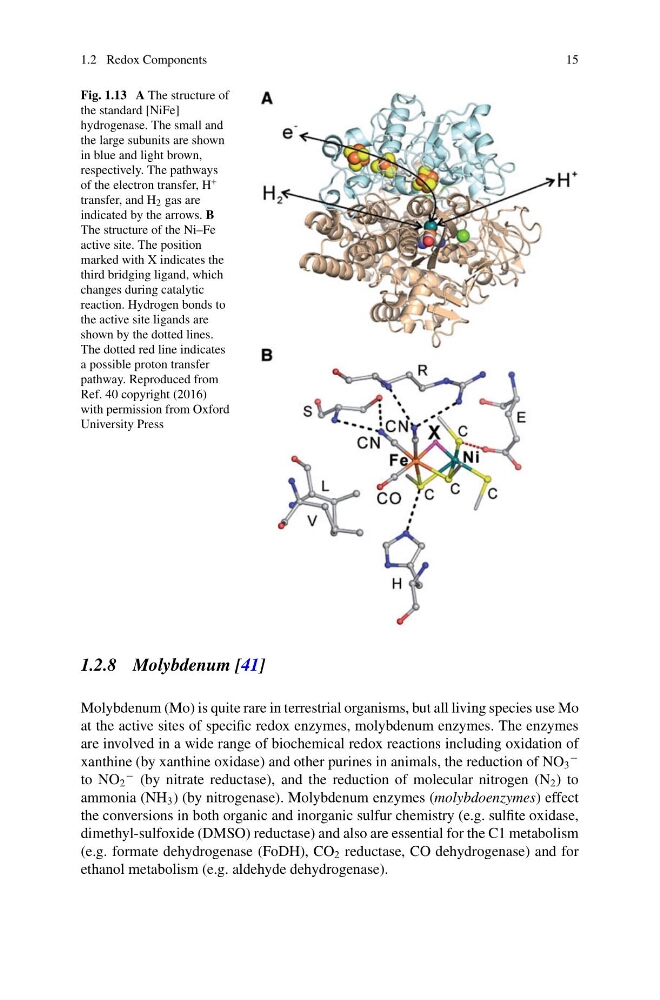
Fig. 1.13 A The structure of
the standard [NiFe]
hydrogenase. The small and
the large subunits are shown
in blue and light brown,
respectively. The pathways
of the electron transfer, H +
transfer, and H 2 gas are
indicated by the arrows. B
The structure of the Ni–Fe
active site. The position
marked with X indicates the
third bridging ligand, which
changes during catalytic
reaction. Hydrogen bonds to
the active site ligands are
shown by the dotted lines.
The dotted red line indicates
a possible proton transfer
pathway. Reproduced from
Ref. 40 copyright (2016)
with permission from Oxford
University Press
1.2.8 Molybdenum [41]
Molybdenum (Mo) is quite rare in terrestrial organisms, but all living species use Mo
at the active sites of specific redox enzymes, molybdenum enzymes. The enzymes
are involved in a wide range of biochemical redox reactions including oxidation of
xanthine (by xanthine oxidase) and other purines in animals, the reduction of NO 3
−
to NO 2
− (by nitrate reductase), and the reduction of molecular nitrogen (N 2 ) to
ammonia (NH 3 ) (by nitrogenase). Molybdenum enzymes (molybdoenzymes) effect
the conversions in both organic and inorganic sulfur chemistry (e.g. sulfite oxidase,
dimethyl-sulfoxide (DMSO) reductase) and also are essential for the C1 metabolism
(e.g. formate dehydrogenase (FoDH), CO 2 reductase, CO dehydrogenase) and for
ethanol metabolism (e.g. aldehyde dehydrogenase).
15
Fig. 1.13 A The structure of
the standard [NiFe]
hydrogenase. The small and
the large subunits are shown
in blue and light brown,
respectively. The pathways
of the electron transfer, H +
transfer, and H 2 gas are
indicated by the arrows. B
The structure of the Ni–Fe
active site. The position
marked with X indicates the
third bridging ligand, which
changes during catalytic
reaction. Hydrogen bonds to
the active site ligands are
shown by the dotted lines.
The dotted red line indicates
a possible proton transfer
pathway. Reproduced from
Ref. 40 copyright (2016)
with permission from Oxford
University Press
1.2.8 Molybdenum [41]
Molybdenum (Mo) is quite rare in terrestrial organisms, but all living species use Mo
at the active sites of specific redox enzymes, molybdenum enzymes. The enzymes
are involved in a wide range of biochemical redox reactions including oxidation of
xanthine (by xanthine oxidase) and other purines in animals, the reduction of NO 3
−
to NO 2
− (by nitrate reductase), and the reduction of molecular nitrogen (N 2 ) to
ammonia (NH 3 ) (by nitrogenase). Molybdenum enzymes (molybdoenzymes) effect
the conversions in both organic and inorganic sulfur chemistry (e.g. sulfite oxidase,
dimethyl-sulfoxide (DMSO) reductase) and also are essential for the C1 metabolism
(e.g. formate dehydrogenase (FoDH), CO 2 reductase, CO dehydrogenase) and for
ethanol metabolism (e.g. aldehyde dehydrogenase).