

1.1 Oxidoreductases
3
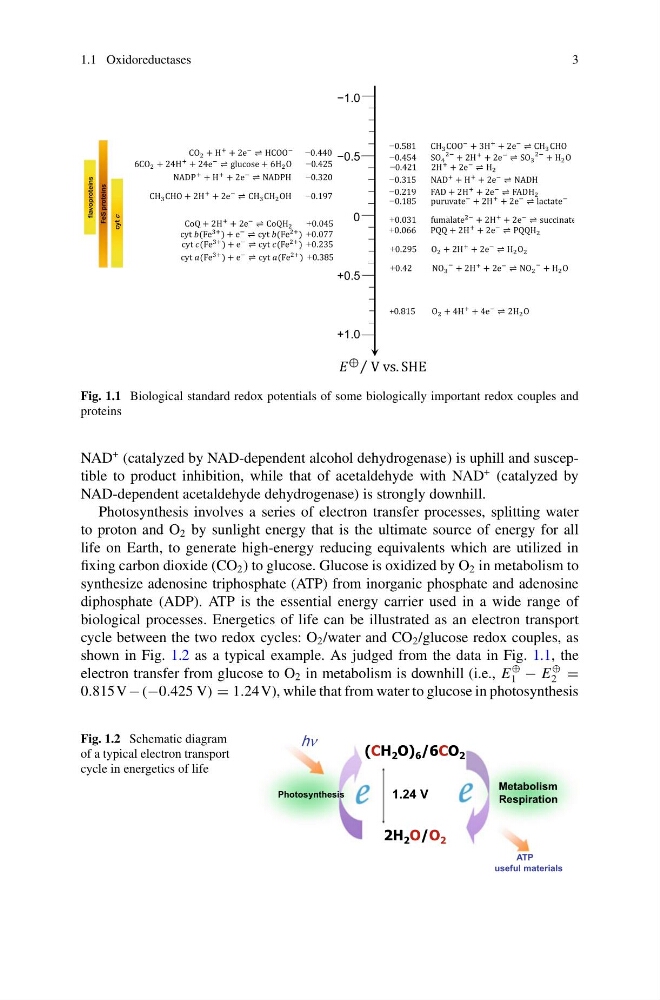
Fig. 1.1 Biological standard redox potentials of some biologically important redox couples and
proteins
NAD
+ (catalyzed by NAD-dependent alcohol dehydrogenase) is uphill and susceptible to product inhibition, while that of acetaldehyde with NAD
+ (catalyzed by
NAD-dependent acetaldehyde dehydrogenase) is strongly downhill.
Photosynthesis involves a series of electron transfer processes, splitting water
to proton and O 2 by sunlight energy that is the ultimate source of energy for all
life on Earth, to generate high-energy reducing equivalents which are utilized in
fixing carbon dioxide (CO 2 ) to glucose. Glucose is oxidized by O 2 in metabolism to
synthesize adenosine triphosphate (ATP) from inorganic phosphate and adenosine
diphosphate (ADP). ATP is the essential energy carrier used in a wide range of
biological processes. Energetics of life can be illustrated as an electron transport
cycle between the two redox cycles: O 2 /water and CO 2 /glucose redox couples, as
shown in Fig. 1.2 as a typical example. As judged from the data in Fig. 1.1, the
electron transfer from glucose to O 2 in metabolism is downhill (i.e., E
⊕
1 − E
⊕
2 =
0.815V −(−0.425 V) = 1.24V), while that from water to glucose in photosynthesis
Fig. 1.2 Schematic diagram
of a typical electron transport
cycle in energetics of life
hν
Metabolism
Respiration
Photosynthesis
2H 2 O/O 2
(CH 2 O) 6 /6CO 2
ATP
useful materials
1.24 V
3
Fig. 1.1 Biological standard redox potentials of some biologically important redox couples and
proteins
NAD
+ (catalyzed by NAD-dependent alcohol dehydrogenase) is uphill and susceptible to product inhibition, while that of acetaldehyde with NAD
+ (catalyzed by
NAD-dependent acetaldehyde dehydrogenase) is strongly downhill.
Photosynthesis involves a series of electron transfer processes, splitting water
to proton and O 2 by sunlight energy that is the ultimate source of energy for all
life on Earth, to generate high-energy reducing equivalents which are utilized in
fixing carbon dioxide (CO 2 ) to glucose. Glucose is oxidized by O 2 in metabolism to
synthesize adenosine triphosphate (ATP) from inorganic phosphate and adenosine
diphosphate (ADP). ATP is the essential energy carrier used in a wide range of
biological processes. Energetics of life can be illustrated as an electron transport
cycle between the two redox cycles: O 2 /water and CO 2 /glucose redox couples, as
shown in Fig. 1.2 as a typical example. As judged from the data in Fig. 1.1, the
electron transfer from glucose to O 2 in metabolism is downhill (i.e., E
⊕
1 − E
⊕
2 =
0.815V −(−0.425 V) = 1.24V), while that from water to glucose in photosynthesis
Fig. 1.2 Schematic diagram
of a typical electron transport
cycle in energetics of life
hν
Metabolism
Respiration
Photosynthesis
2H 2 O/O 2
(CH 2 O) 6 /6CO 2
ATP
useful materials
1.24 V