

2
1 Redox Proteins and Bioelectrocatalysis
and/or hydride ion; the flavin cofactor communicates with NAD(P)(H) in hydride
ion transfer under natural conditions, but also with other redox compounds in electron transfer under artificial conditions. The names oxidase and peroxidase are only
used where dioxygen (O 2 ) and hydrogen peroxide (H 2 O 2 ) are the electron acceptors, respectively. Oxygenase and hydroxylase incorporate O 2 into the substrate being
oxidized.
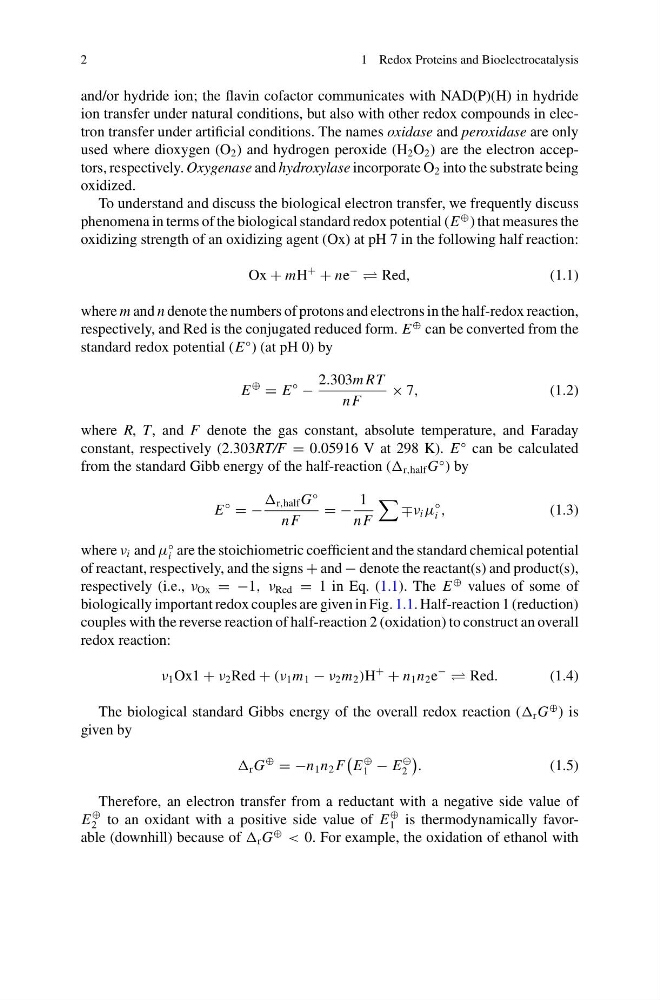
To understand and discuss the biological electron transfer, we frequently discuss
phenomena in terms of the biological standard redox potential (E
⊕ ) that measures the
oxidizing strength of an oxidizing agent (Ox) at pH 7 in the following half reaction:
Ox + mH
+
+ ne
−
Red,
(1.1)
where m and n denote the numbers of protons and electrons in the half-redox reaction,
respectively, and Red is the conjugated reduced form. E
⊕ can be converted from the
standard redox potential (E
◦ ) (at pH 0) by
E
⊕
= E
◦
−
2.303m RT
n F
× 7,
(1.2)
where R, T, and F denote the gas constant, absolute temperature, and Faraday
constant, respectively (2.303RT/F = 0.05916 V at 298 K). E
◦ can be calculated
from the standard Gibb energy of the half-reaction ( r,half G
◦ ) by
E
◦
= −
r,half G
◦
n F
= −
1
n F
∓ν i μ
◦
i ,
(1.3)
where ν i and μ
◦
i are the stoichiometric coefficient and the standard chemical potential
of reactant, respectively, and the signs + and − denote the reactant(s) and product(s),
respectively (i.e., ν Ox = −1, ν Red = 1 in Eq. (1.1). The E
⊕ values of some of
biologically important redox couples are given in Fig. 1.1. Half-reaction 1 (reduction)
couples with the reverse reaction of half-reaction 2 (oxidation) to construct an overall
redox reaction:
ν 1 Ox1 + ν 2 Red + (ν 1 m 1 − ν 2 m 2 )H
+
+ n 1 n 2 e
−
Red.
(1.4)
The biological standard Gibbs energy of the overall redox reaction ( r G
⊕ ) is
given by
r G
⊕
= −n 1 n 2 F
E
⊕
1 − E
⊕
2
.
(1.5)
Therefore, an electron transfer from a reductant with a negative side value of
E
⊕
2 to an oxidant with a positive side value of E
⊕
1 is thermodynamically favorable (downhill) because of r G
⊕
< 0. For example, the oxidation of ethanol with
1 Redox Proteins and Bioelectrocatalysis
and/or hydride ion; the flavin cofactor communicates with NAD(P)(H) in hydride
ion transfer under natural conditions, but also with other redox compounds in electron transfer under artificial conditions. The names oxidase and peroxidase are only
used where dioxygen (O 2 ) and hydrogen peroxide (H 2 O 2 ) are the electron acceptors, respectively. Oxygenase and hydroxylase incorporate O 2 into the substrate being
oxidized.
To understand and discuss the biological electron transfer, we frequently discuss
phenomena in terms of the biological standard redox potential (E
⊕ ) that measures the
oxidizing strength of an oxidizing agent (Ox) at pH 7 in the following half reaction:
Ox + mH
+
+ ne
−
Red,
(1.1)
where m and n denote the numbers of protons and electrons in the half-redox reaction,
respectively, and Red is the conjugated reduced form. E
⊕ can be converted from the
standard redox potential (E
◦ ) (at pH 0) by
E
⊕
= E
◦
−
2.303m RT
n F
× 7,
(1.2)
where R, T, and F denote the gas constant, absolute temperature, and Faraday
constant, respectively (2.303RT/F = 0.05916 V at 298 K). E
◦ can be calculated
from the standard Gibb energy of the half-reaction ( r,half G
◦ ) by
E
◦
= −
r,half G
◦
n F
= −
1
n F
∓ν i μ
◦
i ,
(1.3)
where ν i and μ
◦
i are the stoichiometric coefficient and the standard chemical potential
of reactant, respectively, and the signs + and − denote the reactant(s) and product(s),
respectively (i.e., ν Ox = −1, ν Red = 1 in Eq. (1.1). The E
⊕ values of some of
biologically important redox couples are given in Fig. 1.1. Half-reaction 1 (reduction)
couples with the reverse reaction of half-reaction 2 (oxidation) to construct an overall
redox reaction:
ν 1 Ox1 + ν 2 Red + (ν 1 m 1 − ν 2 m 2 )H
+
+ n 1 n 2 e
−
Red.
(1.4)
The biological standard Gibbs energy of the overall redox reaction ( r G
⊕ ) is
given by
r G
⊕
= −n 1 n 2 F
E
⊕
1 − E
⊕
2
.
(1.5)
Therefore, an electron transfer from a reductant with a negative side value of
E
⊕
2 to an oxidant with a positive side value of E
⊕
1 is thermodynamically favorable (downhill) because of r G
⊕
< 0. For example, the oxidation of ethanol with