

126
7 Applications to Biofuel Cells and Bioreactors
are realized even under such multi-step electron transfer. It is noteworthy that the
reversible electrode reaction of the NAD(P)
+ /NAD(P)H redox couple can be easily
coupled with NAD(P)-dependent dehydrogenase reactions. The coupling can create
variety of applications including biosensors, biofuel cells, and bioreactors, since the
NAD(P)
+ /NAD(P)H redox couple is the most important in biological redox system
and there are a huge variety of NAD(P)-dependent enzymes in nature.
Although H 2 has many excellent properties as fuel, H 2 has critical problems
in its storage and transportation issues because of its gaseous properties. One of
possible alternatives is HCOO
− [37, 38], and from the thermodynamic point of
view, the interconversion between the two redox couples is very useful to support
the sustainable society:
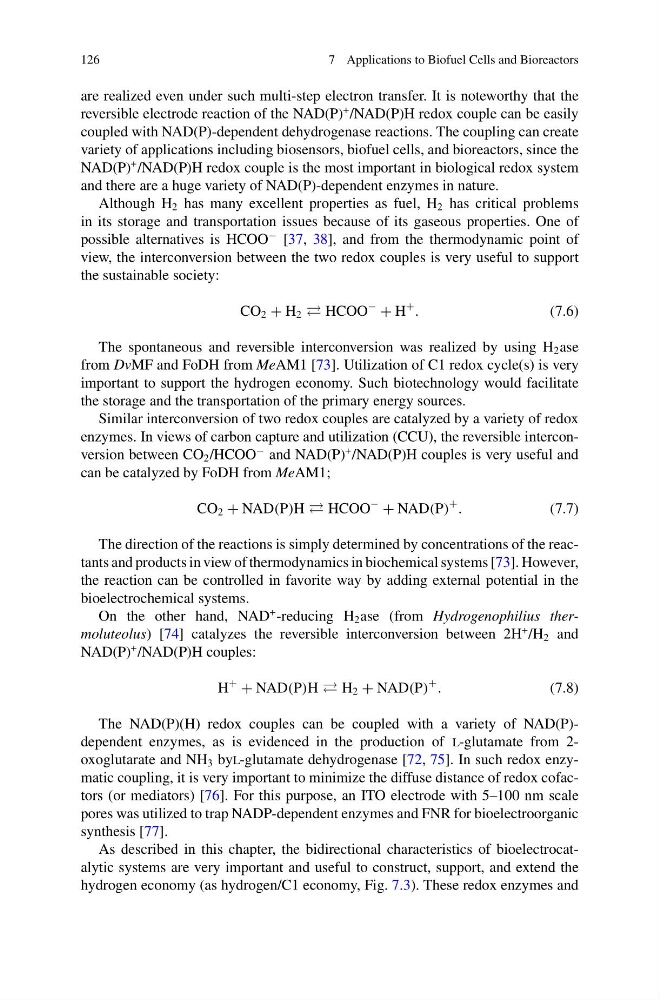
CO 2 + H 2 HCOO
−
+ H
+
.
(7.6)
The spontaneous and reversible interconversion was realized by using H 2 ase
from DvMF and FoDH from MeAM1 [73]. Utilization of C1 redox cycle(s) is very
important to support the hydrogen economy. Such biotechnology would facilitate
the storage and the transportation of the primary energy sources.
Similar interconversion of two redox couples are catalyzed by a variety of redox
enzymes. In views of carbon capture and utilization (CCU), the reversible interconversion between CO 2 /HCOO
− and NAD(P)
+ /NAD(P)H couples is very useful and
can be catalyzed by FoDH from MeAM1;
CO 2 + NAD(P)H HCOO
−
+ NAD(P)
+
.
(7.7)
The direction of the reactions is simply determined by concentrations of the reactants and products in view of thermodynamics in biochemical systems [73]. However,
the reaction can be controlled in favorite way by adding external potential in the
bioelectrochemical systems.
On the other hand, NAD
+ -reducing H 2 ase (from Hydrogenophilius thermoluteolus) [74] catalyzes the reversible interconversion between 2H
+ /H 2 and
NAD(P)
+ /NAD(P)H couples:
H
+
+ NAD(P)H H 2 + NAD(P)
+
.
(7.8)
The NAD(P)(H) redox couples can be coupled with a variety of NAD(P)dependent enzymes, as is evidenced in the production of l-glutamate from 2oxoglutarate and NH 3 byl-glutamate dehydrogenase [72, 75]. In such redox enzymatic coupling, it is very important to minimize the diffuse distance of redox cofactors (or mediators) [76]. For this purpose, an ITO electrode with 5–100 nm scale
pores was utilized to trap NADP-dependent enzymes and FNR for bioelectroorganic
synthesis [77].
As described in this chapter, the bidirectional characteristics of bioelectrocatalytic systems are very important and useful to construct, support, and extend the
hydrogen economy (as hydrogen/C1 economy, Fig. 7.3). These redox enzymes and
7 Applications to Biofuel Cells and Bioreactors
are realized even under such multi-step electron transfer. It is noteworthy that the
reversible electrode reaction of the NAD(P)
+ /NAD(P)H redox couple can be easily
coupled with NAD(P)-dependent dehydrogenase reactions. The coupling can create
variety of applications including biosensors, biofuel cells, and bioreactors, since the
NAD(P)
+ /NAD(P)H redox couple is the most important in biological redox system
and there are a huge variety of NAD(P)-dependent enzymes in nature.
Although H 2 has many excellent properties as fuel, H 2 has critical problems
in its storage and transportation issues because of its gaseous properties. One of
possible alternatives is HCOO
− [37, 38], and from the thermodynamic point of
view, the interconversion between the two redox couples is very useful to support
the sustainable society:
CO 2 + H 2 HCOO
−
+ H
+
.
(7.6)
The spontaneous and reversible interconversion was realized by using H 2 ase
from DvMF and FoDH from MeAM1 [73]. Utilization of C1 redox cycle(s) is very
important to support the hydrogen economy. Such biotechnology would facilitate
the storage and the transportation of the primary energy sources.
Similar interconversion of two redox couples are catalyzed by a variety of redox
enzymes. In views of carbon capture and utilization (CCU), the reversible interconversion between CO 2 /HCOO
− and NAD(P)
+ /NAD(P)H couples is very useful and
can be catalyzed by FoDH from MeAM1;
CO 2 + NAD(P)H HCOO
−
+ NAD(P)
+
.
(7.7)
The direction of the reactions is simply determined by concentrations of the reactants and products in view of thermodynamics in biochemical systems [73]. However,
the reaction can be controlled in favorite way by adding external potential in the
bioelectrochemical systems.
On the other hand, NAD
+ -reducing H 2 ase (from Hydrogenophilius thermoluteolus) [74] catalyzes the reversible interconversion between 2H
+ /H 2 and
NAD(P)
+ /NAD(P)H couples:
H
+
+ NAD(P)H H 2 + NAD(P)
+
.
(7.8)
The NAD(P)(H) redox couples can be coupled with a variety of NAD(P)dependent enzymes, as is evidenced in the production of l-glutamate from 2oxoglutarate and NH 3 byl-glutamate dehydrogenase [72, 75]. In such redox enzymatic coupling, it is very important to minimize the diffuse distance of redox cofactors (or mediators) [76]. For this purpose, an ITO electrode with 5–100 nm scale
pores was utilized to trap NADP-dependent enzymes and FNR for bioelectroorganic
synthesis [77].
As described in this chapter, the bidirectional characteristics of bioelectrocatalytic systems are very important and useful to construct, support, and extend the
hydrogen economy (as hydrogen/C1 economy, Fig. 7.3). These redox enzymes and