

7.3 Photobioelectrochemical Water Splitting
125
and H 2 O with relatively small overpotential.
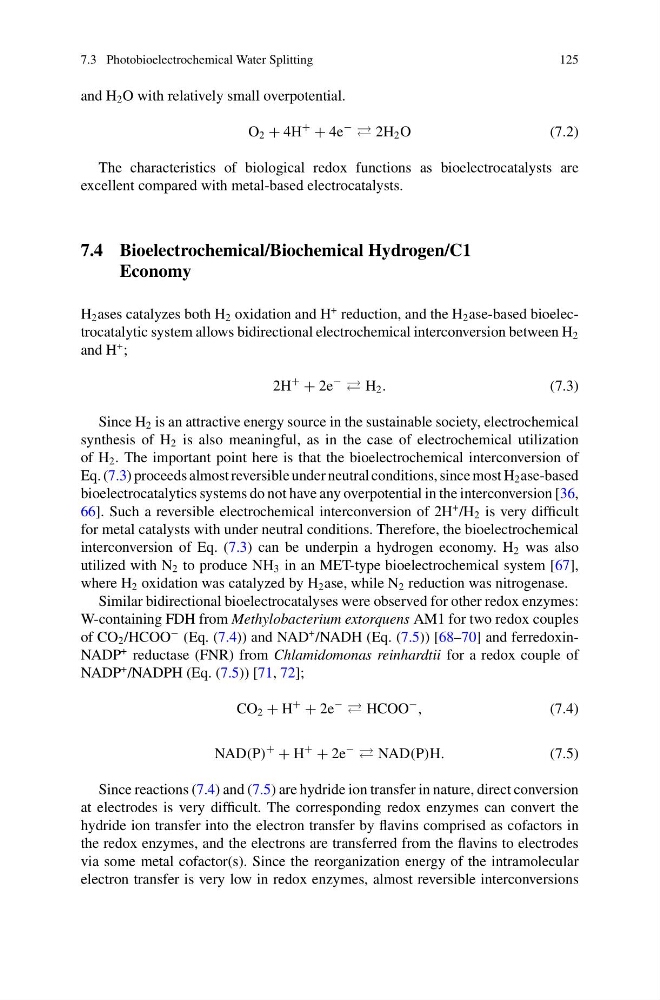
O 2 + 4H
+
+ 4e
−
2H 2 O
( 7 . 2 )
The characteristics of biological redox functions as bioelectrocatalysts are
excellent compared with metal-based electrocatalysts.
7.4 Bioelectrochemical/Biochemical Hydrogen/C1
Economy
H 2 ases catalyzes both H 2 oxidation and H
+ reduction, and the H 2 ase-based bioelectrocatalytic system allows bidirectional electrochemical interconversion between H 2
and H
+ ;
2H
+
+ 2e
−
H 2 .
(7.3)
Since H 2 is an attractive energy source in the sustainable society, electrochemical
synthesis of H 2 is also meaningful, as in the case of electrochemical utilization
of H 2 . The important point here is that the bioelectrochemical interconversion of
Eq. (7.3) proceeds almost reversible under neutral conditions, since most H 2 ase-based
bioelectrocatalytics systems do not have any overpotential in the interconversion [36,
66]. Such a reversible electrochemical interconversion of 2H
+ /H 2 is very difficult
for metal catalysts with under neutral conditions. Therefore, the bioelectrochemical
interconversion of Eq. (7.3) can be underpin a hydrogen economy. H 2 was also
utilized with N 2 to produce NH 3 in an MET-type bioelectrochemical system [67],
where H 2 oxidation was catalyzed by H 2 ase, while N 2 reduction was nitrogenase.
Similar bidirectional bioelectrocatalyses were observed for other redox enzymes:
W-containing FDH from Methylobacterium extorquens AM1 for two redox couples
of CO 2 /HCOO
− (Eq. (7.4)) and NAD
+ /NADH (Eq. (7.5)) [68–70] and ferredoxinNADP
+ reductase (FNR) from Chlamidomonas reinhardtii for a redox couple of
NADP
+ /NADPH (Eq. (7.5)) [71, 72];
CO 2 + H
+
+ 2e
−
HCOO
−
,
(7.4)
NAD(P)
+
+ H
+
+ 2e
−
NAD(P)H.
(7.5)
Since reactions (7.4) and (7.5) are hydride ion transfer in nature, direct conversion
at electrodes is very difficult. The corresponding redox enzymes can convert the
hydride ion transfer into the electron transfer by flavins comprised as cofactors in
the redox enzymes, and the electrons are transferred from the flavins to electrodes
via some metal cofactor(s). Since the reorganization energy of the intramolecular
electron transfer is very low in redox enzymes, almost reversible interconversions
125
and H 2 O with relatively small overpotential.
O 2 + 4H
+
+ 4e
−
2H 2 O
( 7 . 2 )
The characteristics of biological redox functions as bioelectrocatalysts are
excellent compared with metal-based electrocatalysts.
7.4 Bioelectrochemical/Biochemical Hydrogen/C1
Economy
H 2 ases catalyzes both H 2 oxidation and H
+ reduction, and the H 2 ase-based bioelectrocatalytic system allows bidirectional electrochemical interconversion between H 2
and H
+ ;
2H
+
+ 2e
−
H 2 .
(7.3)
Since H 2 is an attractive energy source in the sustainable society, electrochemical
synthesis of H 2 is also meaningful, as in the case of electrochemical utilization
of H 2 . The important point here is that the bioelectrochemical interconversion of
Eq. (7.3) proceeds almost reversible under neutral conditions, since most H 2 ase-based
bioelectrocatalytics systems do not have any overpotential in the interconversion [36,
66]. Such a reversible electrochemical interconversion of 2H
+ /H 2 is very difficult
for metal catalysts with under neutral conditions. Therefore, the bioelectrochemical
interconversion of Eq. (7.3) can be underpin a hydrogen economy. H 2 was also
utilized with N 2 to produce NH 3 in an MET-type bioelectrochemical system [67],
where H 2 oxidation was catalyzed by H 2 ase, while N 2 reduction was nitrogenase.
Similar bidirectional bioelectrocatalyses were observed for other redox enzymes:
W-containing FDH from Methylobacterium extorquens AM1 for two redox couples
of CO 2 /HCOO
− (Eq. (7.4)) and NAD
+ /NADH (Eq. (7.5)) [68–70] and ferredoxinNADP
+ reductase (FNR) from Chlamidomonas reinhardtii for a redox couple of
NADP
+ /NADPH (Eq. (7.5)) [71, 72];
CO 2 + H
+
+ 2e
−
HCOO
−
,
(7.4)
NAD(P)
+
+ H
+
+ 2e
−
NAD(P)H.
(7.5)
Since reactions (7.4) and (7.5) are hydride ion transfer in nature, direct conversion
at electrodes is very difficult. The corresponding redox enzymes can convert the
hydride ion transfer into the electron transfer by flavins comprised as cofactors in
the redox enzymes, and the electrons are transferred from the flavins to electrodes
via some metal cofactor(s). Since the reorganization energy of the intramolecular
electron transfer is very low in redox enzymes, almost reversible interconversions