

100
5 Protein-Engineering Approach for Improvement …
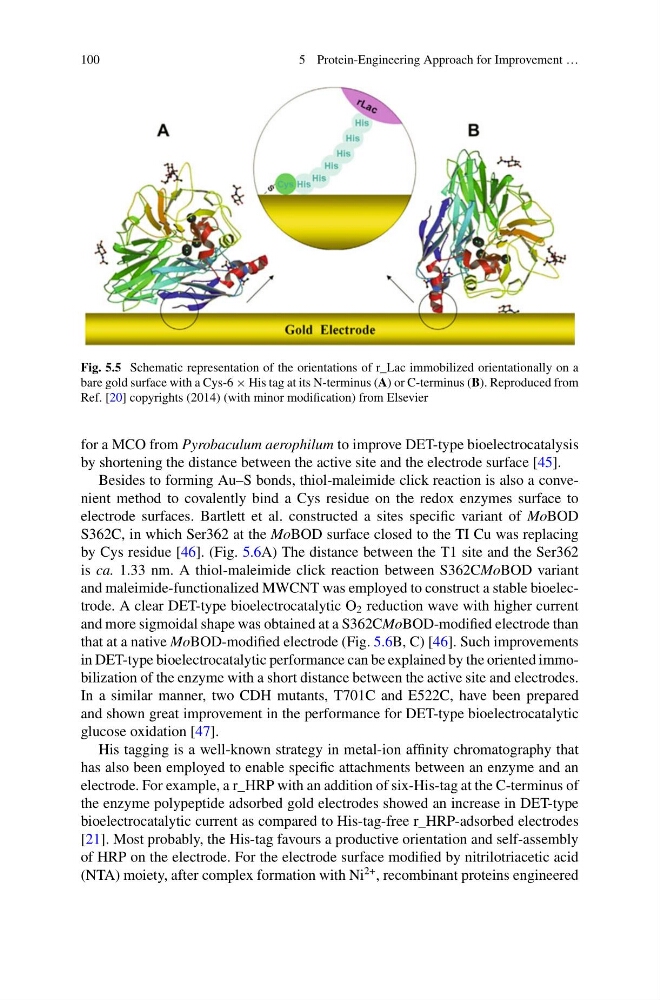
Fig. 5.5 Schematic representation of the orientations of r_Lac immobilized orientationally on a
bare gold surface with a Cys-6 × His tag at its N-terminus (A) or C-terminus (B). Reproduced from
Ref. [20] copyrights (2014) (with minor modification) from Elsevier
for a MCO from Pyrobaculum aerophilum to improve DET-type bioelectrocatalysis
by shortening the distance between the active site and the electrode surface [45].
Besides to forming Au–S bonds, thiol-maleimide click reaction is also a convenient method to covalently bind a Cys residue on the redox enzymes surface to
electrode surfaces. Bartlett et al. constructed a sites specific variant of MoBOD
S362C, in which Ser362 at the MoBOD surface closed to the TI Cu was replacing
by Cys residue [46]. (Fig. 5.6A) The distance between the T1 site and the Ser362
is ca. 1.33 nm. A thiol-maleimide click reaction between S362CMoBOD variant
and maleimide-functionalized MWCNT was employed to construct a stable bioelectrode. A clear DET-type bioelectrocatalytic O 2 reduction wave with higher current
and more sigmoidal shape was obtained at a S362CMoBOD-modified electrode than
that at a native MoBOD-modified electrode (Fig. 5.6B, C) [46]. Such improvements
in DET-type bioelectrocatalytic performance can be explained by the oriented immobilization of the enzyme with a short distance between the active site and electrodes.
In a similar manner, two CDH mutants, T701C and E522C, have been prepared
and shown great improvement in the performance for DET-type bioelectrocatalytic
glucose oxidation [47].
His tagging is a well-known strategy in metal-ion affinity chromatography that
has also been employed to enable specific attachments between an enzyme and an
electrode. For example, a r_HRP with an addition of six-His-tag at the C-terminus of
the enzyme polypeptide adsorbed gold electrodes showed an increase in DET-type
bioelectrocatalytic current as compared to His-tag-free r_HRP-adsorbed electrodes
[21]. Most probably, the His-tag favours a productive orientation and self-assembly
of HRP on the electrode. For the electrode surface modified by nitrilotriacetic acid
(NTA) moiety, after complex formation with Ni
2+ , recombinant proteins engineered
5 Protein-Engineering Approach for Improvement …
Fig. 5.5 Schematic representation of the orientations of r_Lac immobilized orientationally on a
bare gold surface with a Cys-6 × His tag at its N-terminus (A) or C-terminus (B). Reproduced from
Ref. [20] copyrights (2014) (with minor modification) from Elsevier
for a MCO from Pyrobaculum aerophilum to improve DET-type bioelectrocatalysis
by shortening the distance between the active site and the electrode surface [45].
Besides to forming Au–S bonds, thiol-maleimide click reaction is also a convenient method to covalently bind a Cys residue on the redox enzymes surface to
electrode surfaces. Bartlett et al. constructed a sites specific variant of MoBOD
S362C, in which Ser362 at the MoBOD surface closed to the TI Cu was replacing
by Cys residue [46]. (Fig. 5.6A) The distance between the T1 site and the Ser362
is ca. 1.33 nm. A thiol-maleimide click reaction between S362CMoBOD variant
and maleimide-functionalized MWCNT was employed to construct a stable bioelectrode. A clear DET-type bioelectrocatalytic O 2 reduction wave with higher current
and more sigmoidal shape was obtained at a S362CMoBOD-modified electrode than
that at a native MoBOD-modified electrode (Fig. 5.6B, C) [46]. Such improvements
in DET-type bioelectrocatalytic performance can be explained by the oriented immobilization of the enzyme with a short distance between the active site and electrodes.
In a similar manner, two CDH mutants, T701C and E522C, have been prepared
and shown great improvement in the performance for DET-type bioelectrocatalytic
glucose oxidation [47].
His tagging is a well-known strategy in metal-ion affinity chromatography that
has also been employed to enable specific attachments between an enzyme and an
electrode. For example, a r_HRP with an addition of six-His-tag at the C-terminus of
the enzyme polypeptide adsorbed gold electrodes showed an increase in DET-type
bioelectrocatalytic current as compared to His-tag-free r_HRP-adsorbed electrodes
[21]. Most probably, the His-tag favours a productive orientation and self-assembly
of HRP on the electrode. For the electrode surface modified by nitrilotriacetic acid
(NTA) moiety, after complex formation with Ni
2+ , recombinant proteins engineered