

96
5 Protein-Engineering Approach for Improvement …
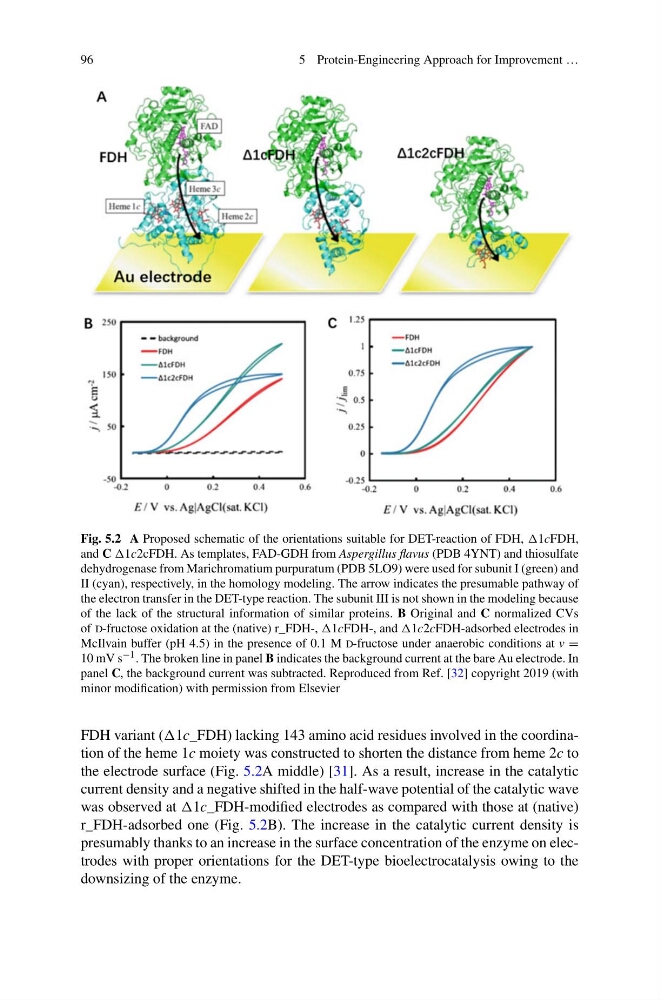
Fig. 5.2 A Proposed schematic of the orientations suitable for DET-reaction of FDH, 1cFDH,
and C 1c2cFDH. As templates, FAD-GDH from Aspergillus flavus (PDB 4YNT) and thiosulfate
dehydrogenase from Marichromatium purpuratum (PDB 5LO9) were used for subunit I (green) and
II (cyan), respectively, in the homology modeling. The arrow indicates the presumable pathway of
the electron transfer in the DET-type reaction. The subunit III is not shown in the modeling because
of the lack of the structural information of similar proteins. B Original and C normalized CVs
of d-fructose oxidation at the (native) r_FDH-, 1cFDH-, and 1c2cFDH-adsorbed electrodes in
McIlvain buffer (pH 4.5) in the presence of 0.1 M d-fructose under anaerobic conditions at v =
10 mV s −1 . The broken line in panel B indicates the background current at the bare Au electrode. In
panel C, the background current was subtracted. Reproduced from Ref. [32] copyright 2019 (with
minor modification) with permission from Elsevier
FDH variant (1c_FDH) lacking 143 amino acid residues involved in the coordination of the heme 1c moiety was constructed to shorten the distance from heme 2c to
the electrode surface (Fig. 5.2A middle) [31]. As a result, increase in the catalytic
current density and a negative shifted in the half-wave potential of the catalytic wave
was observed at 1c_FDH-modified electrodes as compared with those at (native)
r_FDH-adsorbed one (Fig. 5.2B). The increase in the catalytic current density is
presumably thanks to an increase in the surface concentration of the enzyme on electrodes with proper orientations for the DET-type bioelectrocatalysis owing to the
downsizing of the enzyme.
5 Protein-Engineering Approach for Improvement …
Fig. 5.2 A Proposed schematic of the orientations suitable for DET-reaction of FDH, 1cFDH,
and C 1c2cFDH. As templates, FAD-GDH from Aspergillus flavus (PDB 4YNT) and thiosulfate
dehydrogenase from Marichromatium purpuratum (PDB 5LO9) were used for subunit I (green) and
II (cyan), respectively, in the homology modeling. The arrow indicates the presumable pathway of
the electron transfer in the DET-type reaction. The subunit III is not shown in the modeling because
of the lack of the structural information of similar proteins. B Original and C normalized CVs
of d-fructose oxidation at the (native) r_FDH-, 1cFDH-, and 1c2cFDH-adsorbed electrodes in
McIlvain buffer (pH 4.5) in the presence of 0.1 M d-fructose under anaerobic conditions at v =
10 mV s −1 . The broken line in panel B indicates the background current at the bare Au electrode. In
panel C, the background current was subtracted. Reproduced from Ref. [32] copyright 2019 (with
minor modification) with permission from Elsevier
FDH variant (1c_FDH) lacking 143 amino acid residues involved in the coordination of the heme 1c moiety was constructed to shorten the distance from heme 2c to
the electrode surface (Fig. 5.2A middle) [31]. As a result, increase in the catalytic
current density and a negative shifted in the half-wave potential of the catalytic wave
was observed at 1c_FDH-modified electrodes as compared with those at (native)
r_FDH-adsorbed one (Fig. 5.2B). The increase in the catalytic current density is
presumably thanks to an increase in the surface concentration of the enzyme on electrodes with proper orientations for the DET-type bioelectrocatalysis owing to the
downsizing of the enzyme.