

2.5 Thermodynamic Engines
67
adiabatic steps in the engine cycle. In addition, we shall require the cylinder to be
fitted with a piston that can be employed to perform work on the external world.
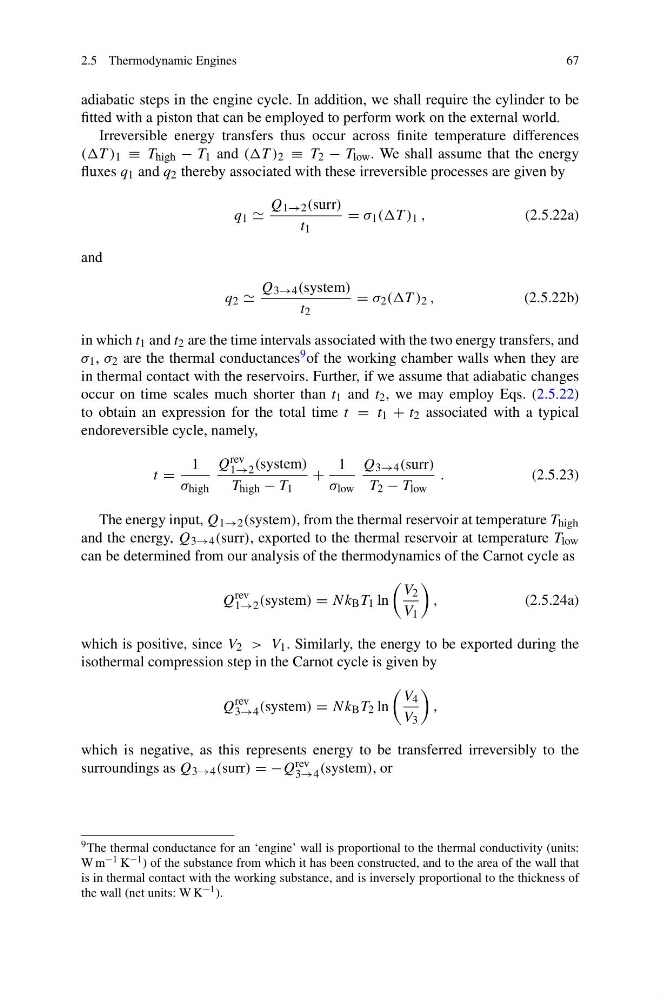
Irreversible energy transfers thus occur across finite temperature differences
((T ) 1 ≡ T high − T 1 and ((T ) 2 ≡ T 2 − T low . We shall assume that the energy
fluxes q 1 and q 2 thereby associated with these irreversible processes are given by
q 1
Q 1→2 (surr)
t 1
= σ 1 ((T ) 1 ,
(2.5.22a)
and
q 2
Q 3→4 (system)
t 2
= σ 2 ((T ) 2 ,
(2.5.22b)
in which t 1 and t 2 are the time intervals associated with the two energy transfers, and
σ 1 , σ 2 are the thermal conductances 9 of the working chamber walls when they are
in thermal contact with the reservoirs. Further, if we assume that adiabatic changes
occur on time scales much shorter than t 1 and t 2 , we may employ Eqs. (2.5.22)
to obtain an expression for the total time t = t 1 + t 2 associated with a typical
endoreversible cycle, namely,
t =
1
σ high
Q rev
1→2 (system)
T high − T 1
+
1
σ low
Q 3→4 (surr)
T 2 − T low
.
(2.5.23)
The energy input, Q 1→2 (system), from the thermal reservoir at temperature T high
and the energy, Q 3→4 (surr), exported to the thermal reservoir at temperature T low
can be determined from our analysis of the thermodynamics of the Carnot cycle as
Q
rev
1→2 (system) = Nk B T 1 ln
V 2
V 1
,
(2.5.24a)
which is positive, since V 2 > V 1 . Similarly, the energy to be exported during the
isothermal compression step in the Carnot cycle is given by
Q
rev
3→4 (system) = Nk B T 2 ln
V 4
V 3
,
which is negative, as this represents energy to be transferred irreversibly to the
surroundings as Q 3→4 (surr) = −Q rev
3→4 (system), or
9 The thermal conductance for an ‘engine’ wall is proportional to the thermal conductivity (units:
W m −1 K −1 ) of the substance from which it has been constructed, and to the area of the wall that
is in thermal contact with the working substance, and is inversely proportional to the thickness of
the wall (net units: W K −1 ).
67
adiabatic steps in the engine cycle. In addition, we shall require the cylinder to be
fitted with a piston that can be employed to perform work on the external world.
Irreversible energy transfers thus occur across finite temperature differences
((T ) 1 ≡ T high − T 1 and ((T ) 2 ≡ T 2 − T low . We shall assume that the energy
fluxes q 1 and q 2 thereby associated with these irreversible processes are given by
q 1
Q 1→2 (surr)
t 1
= σ 1 ((T ) 1 ,
(2.5.22a)
and
q 2
Q 3→4 (system)
t 2
= σ 2 ((T ) 2 ,
(2.5.22b)
in which t 1 and t 2 are the time intervals associated with the two energy transfers, and
σ 1 , σ 2 are the thermal conductances 9 of the working chamber walls when they are
in thermal contact with the reservoirs. Further, if we assume that adiabatic changes
occur on time scales much shorter than t 1 and t 2 , we may employ Eqs. (2.5.22)
to obtain an expression for the total time t = t 1 + t 2 associated with a typical
endoreversible cycle, namely,
t =
1
σ high
Q rev
1→2 (system)
T high − T 1
+
1
σ low
Q 3→4 (surr)
T 2 − T low
.
(2.5.23)
The energy input, Q 1→2 (system), from the thermal reservoir at temperature T high
and the energy, Q 3→4 (surr), exported to the thermal reservoir at temperature T low
can be determined from our analysis of the thermodynamics of the Carnot cycle as
Q
rev
1→2 (system) = Nk B T 1 ln
V 2
V 1
,
(2.5.24a)
which is positive, since V 2 > V 1 . Similarly, the energy to be exported during the
isothermal compression step in the Carnot cycle is given by
Q
rev
3→4 (system) = Nk B T 2 ln
V 4
V 3
,
which is negative, as this represents energy to be transferred irreversibly to the
surroundings as Q 3→4 (surr) = −Q rev
3→4 (system), or
9 The thermal conductance for an ‘engine’ wall is proportional to the thermal conductivity (units:
W m −1 K −1 ) of the substance from which it has been constructed, and to the area of the wall that
is in thermal contact with the working substance, and is inversely proportional to the thickness of
the wall (net units: W K −1 ).