

66
2 Macroscopic Thermodynamics
ε COP =
Nk B T low ln(V 2 /V 1 )
Nk B (T high − T low ) ln(V 2 /V 1 )
=
T low
T high − T low
.
(2.5.20)
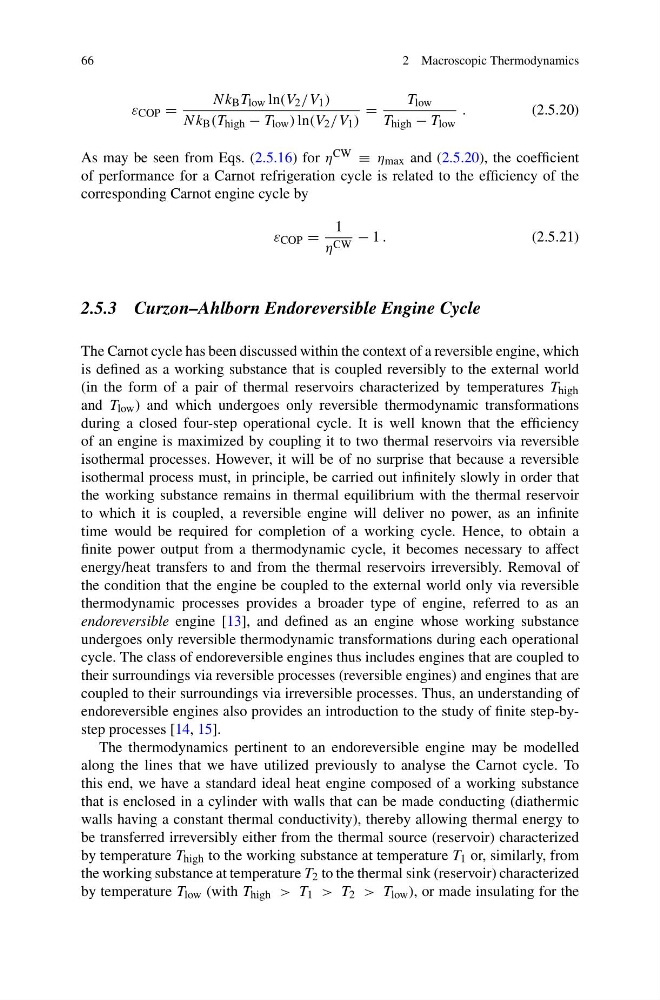
As may be seen from Eqs. (2.5.16) for η CW ≡ η max and (2.5.20), the coefficient
of performance for a Carnot refrigeration cycle is related to the efficiency of the
corresponding Carnot engine cycle by
ε COP =
1
η CW − 1 .
(2.5.21)
2.5.3 Curzon–Ahlborn Endoreversible Engine Cycle
The Carnot cycle has been discussed within the context of a reversible engine, which
is defined as a working substance that is coupled reversibly to the external world
(in the form of a pair of thermal reservoirs characterized by temperatures T high
and T low ) and which undergoes only reversible thermodynamic transformations
during a closed four-step operational cycle. It is well known that the efficiency
of an engine is maximized by coupling it to two thermal reservoirs via reversible
isothermal processes. However, it will be of no surprise that because a reversible
isothermal process must, in principle, be carried out infinitely slowly in order that
the working substance remains in thermal equilibrium with the thermal reservoir
to which it is coupled, a reversible engine will deliver no power, as an infinite
time would be required for completion of a working cycle. Hence, to obtain a
finite power output from a thermodynamic cycle, it becomes necessary to affect
energy/heat transfers to and from the thermal reservoirs irreversibly. Removal of
the condition that the engine be coupled to the external world only via reversible
thermodynamic processes provides a broader type of engine, referred to as an
endoreversible engine [13], and defined as an engine whose working substance
undergoes only reversible thermodynamic transformations during each operational
cycle. The class of endoreversible engines thus includes engines that are coupled to
their surroundings via reversible processes (reversible engines) and engines that are
coupled to their surroundings via irreversible processes. Thus, an understanding of
endoreversible engines also provides an introduction to the study of finite step-bystep processes [14, 15].
The thermodynamics pertinent to an endoreversible engine may be modelled
along the lines that we have utilized previously to analyse the Carnot cycle. To
this end, we have a standard ideal heat engine composed of a working substance
that is enclosed in a cylinder with walls that can be made conducting (diathermic
walls having a constant thermal conductivity), thereby allowing thermal energy to
be transferred irreversibly either from the thermal source (reservoir) characterized
by temperature T high to the working substance at temperature T 1 or, similarly, from
the working substance at temperature T 2 to the thermal sink (reservoir) characterized
by temperature T low (with T high > T 1 > T 2 > T low ), or made insulating for the
2 Macroscopic Thermodynamics
ε COP =
Nk B T low ln(V 2 /V 1 )
Nk B (T high − T low ) ln(V 2 /V 1 )
=
T low
T high − T low
.
(2.5.20)
As may be seen from Eqs. (2.5.16) for η CW ≡ η max and (2.5.20), the coefficient
of performance for a Carnot refrigeration cycle is related to the efficiency of the
corresponding Carnot engine cycle by
ε COP =
1
η CW − 1 .
(2.5.21)
2.5.3 Curzon–Ahlborn Endoreversible Engine Cycle
The Carnot cycle has been discussed within the context of a reversible engine, which
is defined as a working substance that is coupled reversibly to the external world
(in the form of a pair of thermal reservoirs characterized by temperatures T high
and T low ) and which undergoes only reversible thermodynamic transformations
during a closed four-step operational cycle. It is well known that the efficiency
of an engine is maximized by coupling it to two thermal reservoirs via reversible
isothermal processes. However, it will be of no surprise that because a reversible
isothermal process must, in principle, be carried out infinitely slowly in order that
the working substance remains in thermal equilibrium with the thermal reservoir
to which it is coupled, a reversible engine will deliver no power, as an infinite
time would be required for completion of a working cycle. Hence, to obtain a
finite power output from a thermodynamic cycle, it becomes necessary to affect
energy/heat transfers to and from the thermal reservoirs irreversibly. Removal of
the condition that the engine be coupled to the external world only via reversible
thermodynamic processes provides a broader type of engine, referred to as an
endoreversible engine [13], and defined as an engine whose working substance
undergoes only reversible thermodynamic transformations during each operational
cycle. The class of endoreversible engines thus includes engines that are coupled to
their surroundings via reversible processes (reversible engines) and engines that are
coupled to their surroundings via irreversible processes. Thus, an understanding of
endoreversible engines also provides an introduction to the study of finite step-bystep processes [14, 15].
The thermodynamics pertinent to an endoreversible engine may be modelled
along the lines that we have utilized previously to analyse the Carnot cycle. To
this end, we have a standard ideal heat engine composed of a working substance
that is enclosed in a cylinder with walls that can be made conducting (diathermic
walls having a constant thermal conductivity), thereby allowing thermal energy to
be transferred irreversibly either from the thermal source (reservoir) characterized
by temperature T high to the working substance at temperature T 1 or, similarly, from
the working substance at temperature T 2 to the thermal sink (reservoir) characterized
by temperature T low (with T high > T 1 > T 2 > T low ), or made insulating for the