

664
G Hamiltonian Mechanics
dp k
dt
=
N
i=1
m i
d˙ r i
dt
·
∂r i
∂q k
+ ˙
r i ·
d
dt
∂r i
∂q k
=
N
i=1
m i
¨
r i ·
∂r i
∂q k
+ ˙
r i ·
d
dt
∂r i
∂q k
.
(G.2.10)
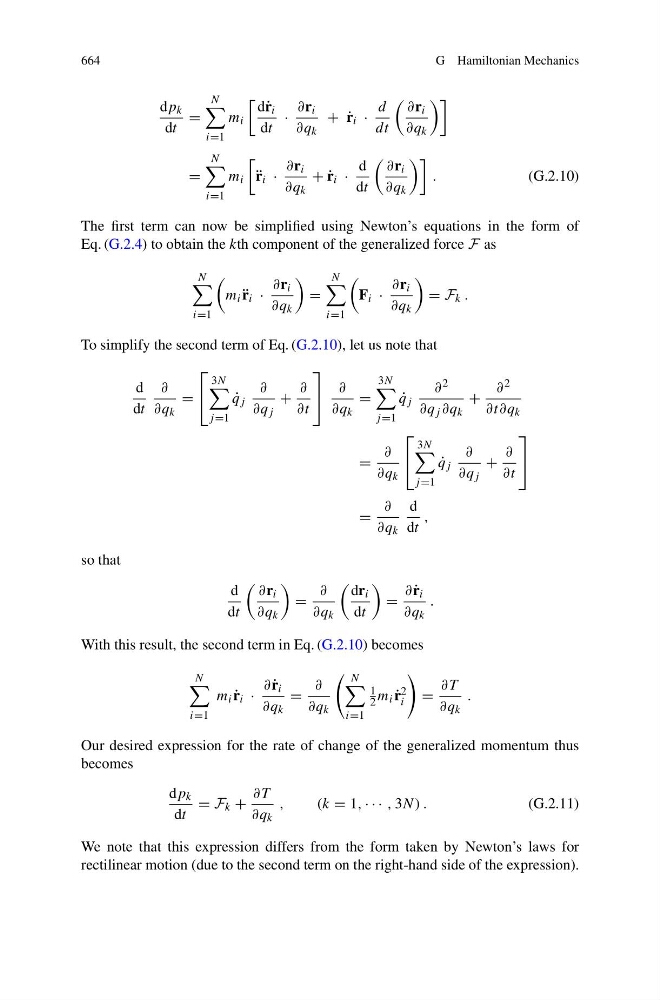
The first term can now be simplified using Newton’s equations in the form of
Eq. (G.2.4) to obtain the kth component of the generalized force F as
N
i=1
m i ¨
r i ·
∂r i
∂q k
=
N
i=1
F i ·
∂r i
∂q k
= F k .
To simplify the second term of Eq. (G.2.10), let us note that
d
dt
∂
∂q k
=
⎡
⎣
3N
j =1
˙
q j
∂
∂q j
+
∂
∂t
⎤
⎦ ∂
∂q k
=
3N
j =1
˙
q j
∂ 2
∂q j ∂q k
+
∂ 2
∂t∂q k
=
∂
∂q k
⎡
⎣
3N
j =1
˙
q j
∂
∂q j
+
∂
∂t
⎤
⎦
=
∂
∂q k
d
dt
,
so that
d
dt
∂r i
∂q k
=
∂
∂q k
dr i
dt
=
∂ ˙
r i
∂q k
.
With this result, the second term in Eq. (G.2.10) becomes
N
i=1
m i ˙
r i ·
∂ ˙
r i
∂q k
=
∂
∂q k
N
i=1
1
2 m i ˙
r 2
i
=
∂T
∂q k
.
Our desired expression for the rate of change of the generalized momentum thus
becomes
dp k
dt
= F k +
∂T
∂q k
,
(k = 1, · · · , 3N) .
(G.2.11)
We note that this expression differs from the form taken by Newton’s laws for
rectilinear motion (due to the second term on the right-hand side of the expression).