

644
E Spherical/Symmetric Top Molecules
=
sin θ R cos θ
cos θ −R sin θ
(E.3.12)
= R.
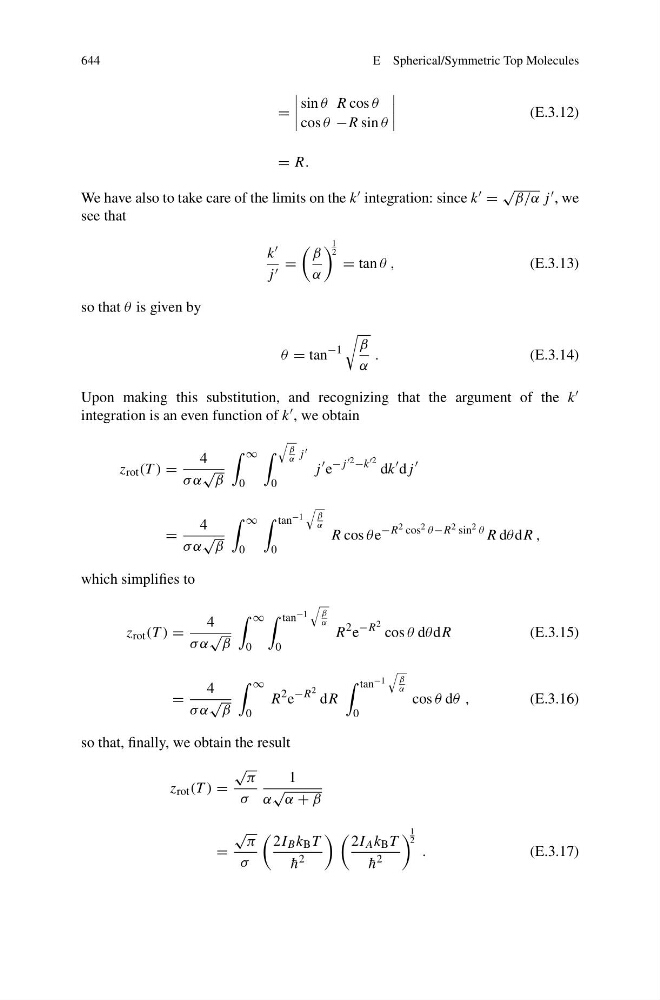
We have also to take care of the limits on the k integration: since k =
√
β/α j , we
see that
k
j =
β
α
1
2 = tan θ ,
(E.3.13)
so that θ is given by
θ = tan
−1
β
α
.
(E.3.14)
Upon making this substitution, and recognizing that the argument of the k
integration is an even function of k , we obtain
z rot (T ) =
4
σ α
√
β
∞
0
β
α j
0
j
e
−j 2 −k 2 dk
dj
=
4
σ α
√
β
∞
0
tan −1
β
α
0
R cos θ e
−R 2 cos 2 θ−R 2 sin 2 θ R dθ dR ,
which simplifies to
z rot (T ) =
4
σ α
√
β
∞
0
tan −1
β
α
0
R
2 e
−R 2 cos θ dθ dR
(E.3.15)
=
4
σ α
√
β
∞
0
R
2 e
−R 2 dR
tan −1
β
α
0
cos θ dθ ,
(E.3.16)
so that, finally, we obtain the result
z rot (T ) =
√
π
σ
1
α
√
α + β
=
√
π
σ
2I B k B T
¯
h 2
2I A k B T
¯
h 2
1
2
.
(E.3.17)