

E.3 Symmetric Top Molecules
643
in which
α ≡
¯
h 2
2I B k B T
; β ≡
¯
h 2
2k B T
1
I B
−
1
I A
, ⇒
¯
h 2
2I A k B T
= α +β .
(E.3.6)
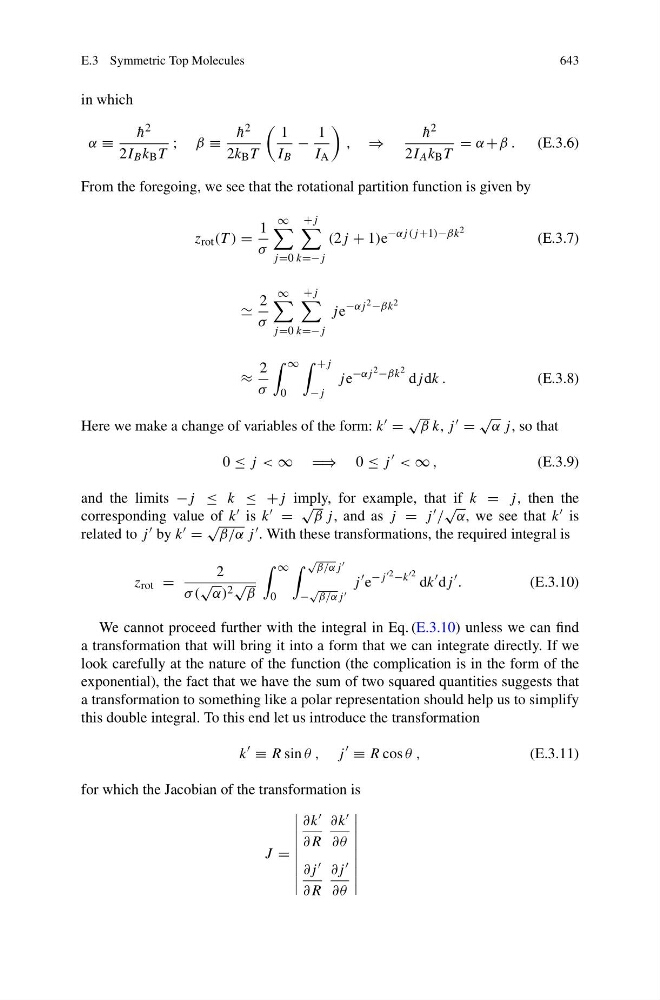
From the foregoing, we see that the rotational partition function is given by
z rot (T ) =
1
σ
∞
j =0
+j
k=−j
(2j + 1)e
−αj (j +1)−βk 2
(E.3.7)
2
σ
∞
j =0
+j
k=−j
j e
−αj 2 −βk 2
≈
2
σ
∞
0
+j
−j
j e
−αj 2 −βk 2 dj dk .
(E.3.8)
Here we make a change of variables of the form: k =
√
β k, j =
√
α j, so that
0 ≤ j < ∞ ∞⇒ 0 ≤ j
< ∞ ,
(E.3.9)
and the limits −j ≤ k ≤ +j imply, for example, that if k = j , then the
corresponding value of k is k =
√
β j, and as j = j /
√
α, we see that k is
related to j by k =
√
β/α j . With these transformations, the required integral is
z rot =
2
σ (
√
α) 2 √
β
∞
0
√
β/αj
−
√
β/αj
j
e
−j 2 −k 2 dk
dj
.
(E.3.10)
We cannot proceed further with the integral in Eq. (E.3.10) unless we can find
a transformation that will bring it into a form that we can integrate directly. If we
look carefully at the nature of the function (the complication is in the form of the
exponential), the fact that we have the sum of two squared quantities suggests that
a transformation to something like a polar representation should help us to simplify
this double integral. To this end let us introduce the transformation
k
≡ R sin θ , j
≡ R cos θ ,
(E.3.11)
for which the Jacobian of the transformation is
J =
∂k
∂R
∂k
∂θ
∂j
∂R
∂j
∂θ