

E.3 Symmetric Top Molecules
641
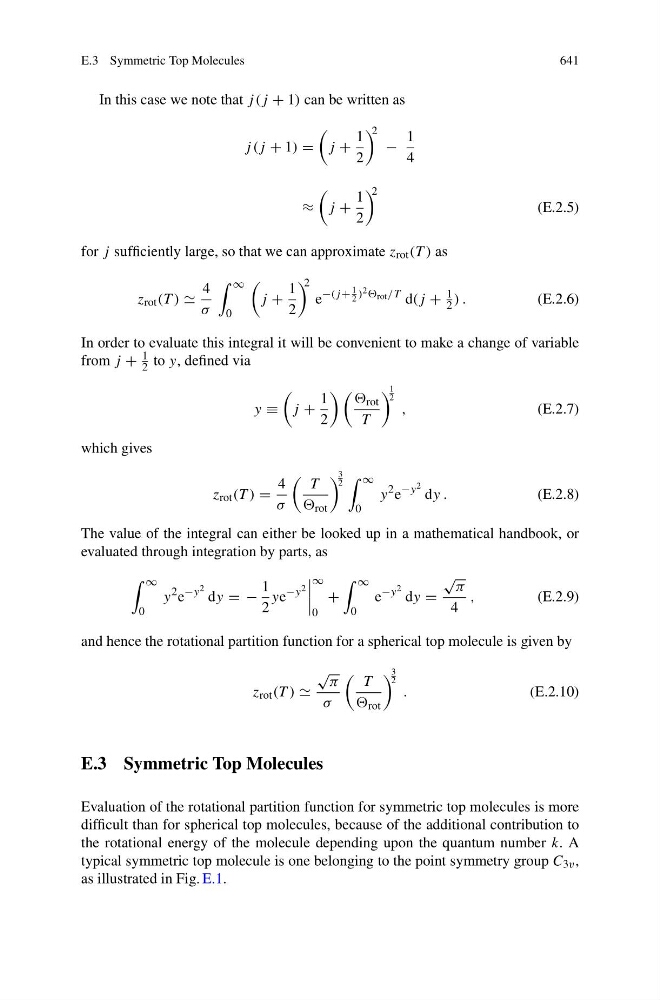
In this case we note that j (j + 1) can be written as
j (j + 1) =
j +
1
2
2
−
1
4
≈
j +
1
2
2
(E.2.5)
for j sufficiently large, so that we can approximate z rot (T ) as
z rot (T )
4
σ
∞
0
j +
1
2
2
e
−(j +
1
2 ) 2 rot /T d(j +
1
2 ) .
(E.2.6)
In order to evaluate this integral it will be convenient to make a change of variable
from j +
1
2 to y, defined via
y ≡
j +
1
2
rot
T
1
2
,
(E.2.7)
which gives
z rot (T ) =
4
σ
T
rot
3
2
∞
0
y
2 e
−y 2 dy .
(E.2.8)
The value of the integral can either be looked up in a mathematical handbook, or
evaluated through integration by parts, as
∞
0
y
2 e
−y 2 dy = −
1
2
ye
−y 2
∞
0
+
∞
0
e
−y 2 dy =
√
π
4
,
(E.2.9)
and hence the rotational partition function for a spherical top molecule is given by
z rot (T )
√
π
σ
T
rot
3
2
.
(E.2.10)
E.3 Symmetric Top Molecules
Evaluation of the rotational partition function for symmetric top molecules is more
difficult than for spherical top molecules, because of the additional contribution to
the rotational energy of the molecule depending upon the quantum number k. A
typical symmetric top molecule is one belonging to the point symmetry group C 3v ,
as illustrated in Fig. E.1.