

640
E Spherical/Symmetric Top Molecules
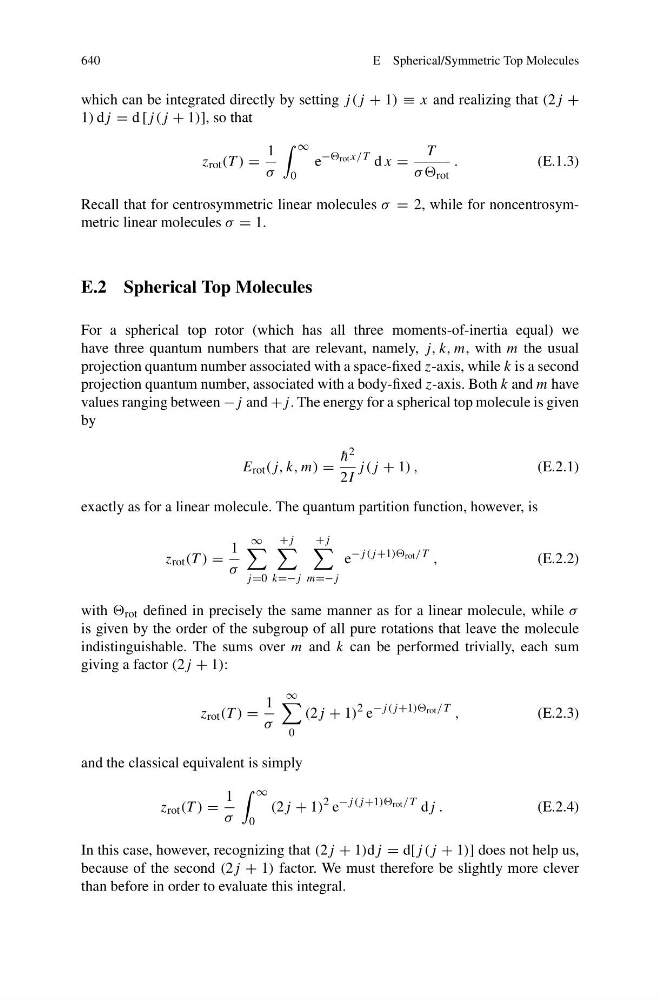
which can be integrated directly by setting j (j + 1) ≡ x and realizing that (2j +
1) dj = d [j (j + 1)], so that
z rot (T ) =
1
σ
∞
0
e
− rot x/T d x =
T
σ σ rot
.
(E.1.3)
Recall that for centrosymmetric linear molecules σ = 2, while for noncentrosymmetric linear molecules σ = 1.
E.2 Spherical Top Molecules
For a spherical top rotor (which has all three moments-of-inertia equal) we
have three quantum numbers that are relevant, namely, j, k, m, with m the usual
projection quantum number associated with a space-fixed z-axis, while k is a second
projection quantum number, associated with a body-fixed z-axis. Both k and m have
values ranging between −j and +j . The energy for a spherical top molecule is given
by
E rot (j, k, m) =
¯
h 2
2I
j (j + 1) ,
(E.2.1)
exactly as for a linear molecule. The quantum partition function, however, is
z rot (T ) =
1
σ
∞
j =0
+j
k=−j
+j
m=−j
e
−j (j+1)) rot /T ,
(E.2.2)
with rot defined in precisely the same manner as for a linear molecule, while σ
is given by the order of the subgroup of all pure rotations that leave the molecule
indistinguishable. The sums over m and k can be performed trivially, each sum
giving a factor (2j + 1):
z rot (T ) =
1
σ
∞
0
(2j + 1)
2 e
−j (j+1)) rot /T ,
(E.2.3)
and the classical equivalent is simply
z rot (T ) =
1
σ
∞
0
(2j + 1)
2 e
−j (j+1)) rot /T dj .
(E.2.4)
In this case, however, recognizing that (2j + 1)dj = d[j (j + 1)] does not help us,
because of the second (2j + 1) factor. We must therefore be slightly more clever
than before in order to evaluate this integral.