

D.2 Extended Example: The He Atom
631
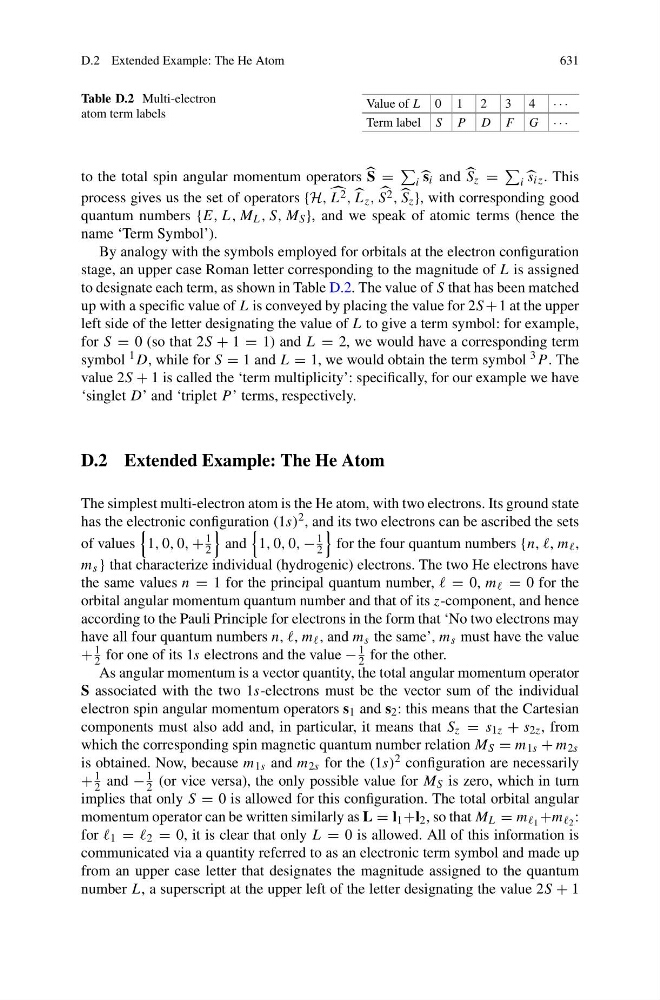
Table D.2 Multi-electron
atom term labels
Value of L 0 1 2 3 4 · · ·
Term label S P D F G · · ·
to the total spin angular momentum operators S =
i s i and S z =
i s iz . This
process gives us the set of operators {H,
L 2 ,
L z ,
S 2 , S z }, with corresponding good
quantum numbers {E, L, M L , S, M S }, and we speak of atomic terms (hence the
name ‘Term Symbol’).
By analogy with the symbols employed for orbitals at the electron configuration
stage, an upper case Roman letter corresponding to the magnitude of L is assigned
to designate each term, as shown in Table D.2. The value of S that has been matched
up with a specific value of L is conveyed by placing the value for 2S +1 at the upper
left side of the letter designating the value of L to give a term symbol: for example,
for S = 0 (so that 2S + 1 = 1) and L = 2, we would have a corresponding term
symbol 1 D, while for S = 1 and L = 1, we would obtain the term symbol 3 P . The
value 2S + 1 is called the ‘term multiplicity’: specifically, for our example we have
‘singlet D’ and ‘triplet P ’ terms, respectively.
D.2 Extended Example: The He Atom
The simplest multi-electron atom is the He atom, with two electrons. Its ground state
has the electronic configuration (1s) 2 , and its two electrons can be ascribed the sets
of values
1, 0, 0, +
1
2
and
1, 0, 0, −
1
2
for the four quantum numbers {n, , m ,
m s } that characterize individual (hydrogenic) electrons. The two He electrons have
the same values n = 1 for the principal quantum number, = 0, m = 0 for the
orbital angular momentum quantum number and that of its z-component, and hence
according to the Pauli Principle for electrons in the form that ‘No two electrons may
have all four quantum numbers n, , m , and m s the same’, m s must have the value
+
1
2 for one of its 1s electrons and the value −
1
2 for the other.
As angular momentum is a vector quantity, the total angular momentum operator
S associated with the two 1s-electrons must be the vector sum of the individual
electron spin angular momentum operators s 1 and s 2 : this means that the Cartesian
components must also add and, in particular, it means that S z = s 1z + s 2z , from
which the corresponding spin magnetic quantum number relation M S = m 1s + m 2s
is obtained. Now, because m 1s and m 2s for the (1s) 2 configuration are necessarily
+
1
2 and −
1
2 (or vice versa), the only possible value for M S is zero, which in turn
implies that only S = 0 is allowed for this configuration. The total orbital angular
momentum operator can be written similarly as L = l 1 +l 2 , so that M L = m 1 +m 2 :
for 1 = 2 = 0, it is clear that only L = 0 is allowed. All of this information is
communicated via a quantity referred to as an electronic term symbol and made up
from an upper case letter that designates the magnitude assigned to the quantum
number L, a superscript at the upper left of the letter designating the value 2S + 1