

630
D Atomic and Molecular Term Symbols
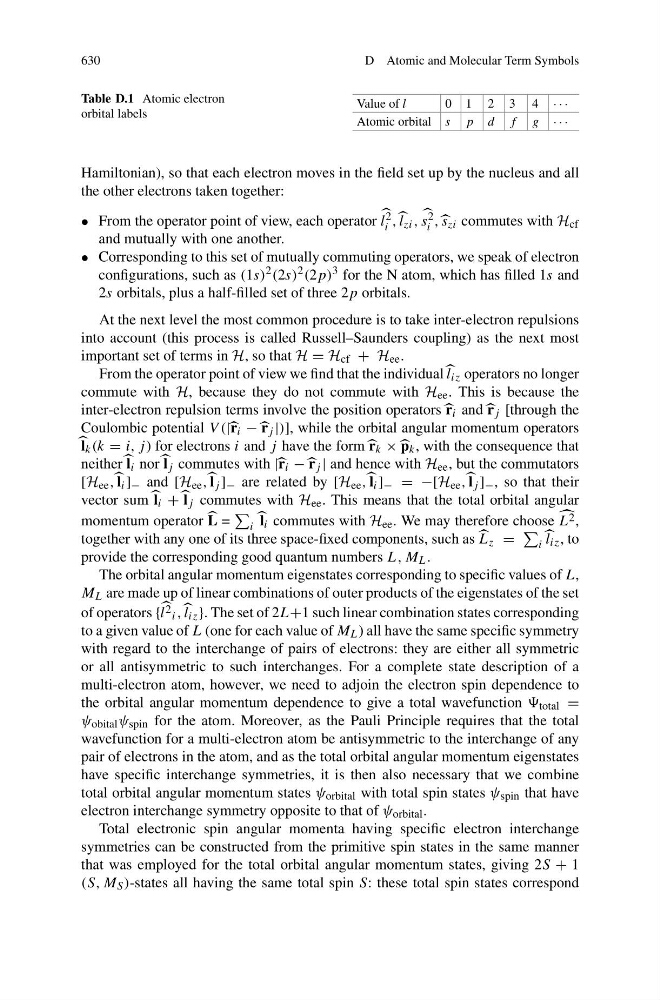
Table D.1 Atomic electron
orbital labels
Value of l
0 1 2 3 4 · · ·
Atomic orbital s p d f g · · ·
Hamiltonian), so that each electron moves in the field set up by the nucleus and all
the other electrons taken together:
• From the operator point of view, each operator
l 2
i , l zi ,
s 2
i , s zi commutes with H cf
and mutually with one another.
• Corresponding to this set of mutually commuting operators, we speak of electron
configurations, such as (1s) 2 (2s) 2 (2p) 3 for the N atom, which has filled 1s and
2s orbitals, plus a half-filled set of three 2p orbitals.
At the next level the most common procedure is to take inter-electron repulsions
into account (this process is called Russell–Saunders coupling) as the next most
important set of terms in H, so that H = H cf + H ee .
From the operator point of view we find that the individual l iz operators no longer
commute with H, because they do not commute with H ee . This is because the
inter-electron repulsion terms involve the position operators r i and r j [through the
Coulombic potential V (| r i − r j |)], while the orbital angular momentum operators
l k (k = i, j ) for electrons i and j have the form r k × p k , with the consequence that
neither l i nor l j commutes with | r i − r j | and hence with H ee , but the commutators
[H ee , l i ] − and [H ee , l j ] − are related by [H ee , l i ] − = −[H ee , l j ] − , so that their
vector sum l i + l j commutes with H ee . This means that the total orbital angular
momentum operator L =
i
l i commutes with H ee . We may therefore choose
L 2 ,
together with any one of its three space-fixed components, such as
L z =
i
l iz , to
provide the corresponding good quantum numbers L, M L .
The orbital angular momentum eigenstates corresponding to specific values of L,
M L are made up of linear combinations of outer products of the eigenstates of the set
of operators {
l 2 i , l iz }. The set of 2L+1 such linear combination states corresponding
to a given value of L (one for each value of M L ) all have the same specific symmetry
with regard to the interchange of pairs of electrons: they are either all symmetric
or all antisymmetric to such interchanges. For a complete state description of a
multi-electron atom, however, we need to adjoin the electron spin dependence to
the orbital angular momentum dependence to give a total wavefunction total =
ψ obital ψ spin for the atom. Moreover, as the Pauli Principle requires that the total
wavefunction for a multi-electron atom be antisymmetric to the interchange of any
pair of electrons in the atom, and as the total orbital angular momentum eigenstates
have specific interchange symmetries, it is then also necessary that we combine
total orbital angular momentum states ψ orbital with total spin states ψ spin that have
electron interchange symmetry opposite to that of ψ orbital .
Total electronic spin angular momenta having specific electron interchange
symmetries can be constructed from the primitive spin states in the same manner
that was employed for the total orbital angular momentum states, giving 2S + 1
(S, M S )-states all having the same total spin S: these total spin states correspond