

620
B Review of Traditional Calculus
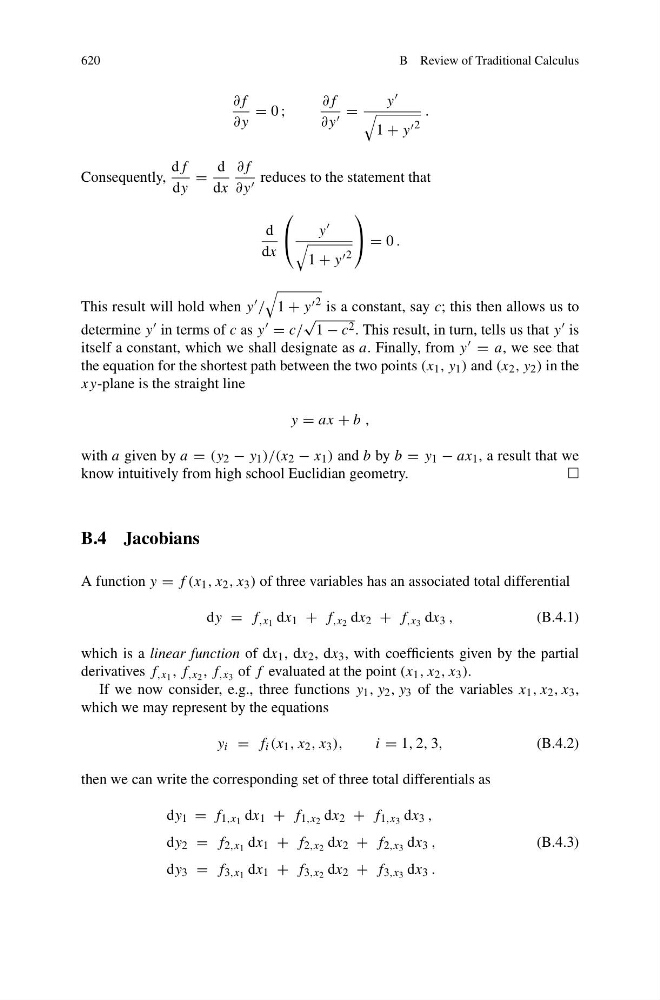
∂f
∂y
= 0 ;
∂f
∂y =
y
1 + y 2
.
Consequently,
df
dy
=
d
dx
∂f
∂y reduces to the statement that
d
dx
⎛
⎝
y
1 + y 2
⎞
⎠ = 0 .
This result will hold when y /
1 + y 2 is a constant, say c; this then allows us to
determine y in terms of c as y = c/
√
1 − c 2 . This result, in turn, tells us that y is
itself a constant, which we shall designate as a. Finally, from y = a, we see that
the equation for the shortest path between the two points (x 1 , y 1 ) and (x 2 , y 2 ) in the
xy-plane is the straight line
y = ax + b ,
with a given by a = (y 2 − y 1 )/(x 2 − x 1 ) and b by b = y 1 − ax 1 , a result that we
know intuitively from high school Euclidian geometry.
B.4 Jacobians
A function y = f (x 1 , x 2 , x 3 ) of three variables has an associated total differential
dy = f ,x 1 dx 1 + f ,x 2 dx 2 + f ,x 3 dx 3 ,
(B.4.1)
which is a linear function of dx 1 , dx 2 , dx 3 , with coefficients given by the partial
derivatives f ,x 1 , f ,x 2 , f ,x 3 of f evaluated at the point (x 1 , x 2 , x 3 ).
If we now consider, e.g., three functions y 1 , y 2 , y 3 of the variables x 1 , x 2 , x 3 ,
which we may represent by the equations
y i = f i (x 1 , x 2 , x 3 ),
i = 1, 2, 3,
(B.4.2)
then we can write the corresponding set of three total differentials as
dy 1 = f 1,x 1 dx 1 + f 1,x 2 dx 2 + f 1,x 3 dx 3 ,
dy 2 = f 2,x 1 dx 1 + f 2,x 2 dx 2 + f 2,x 3 dx 3 ,
(B.4.3)
dy 3 = f 3,x 1 dx 1 + f 3,x 2 dx 2 + f 3,x 3 dx 3 .