

604
B Review of Traditional Calculus
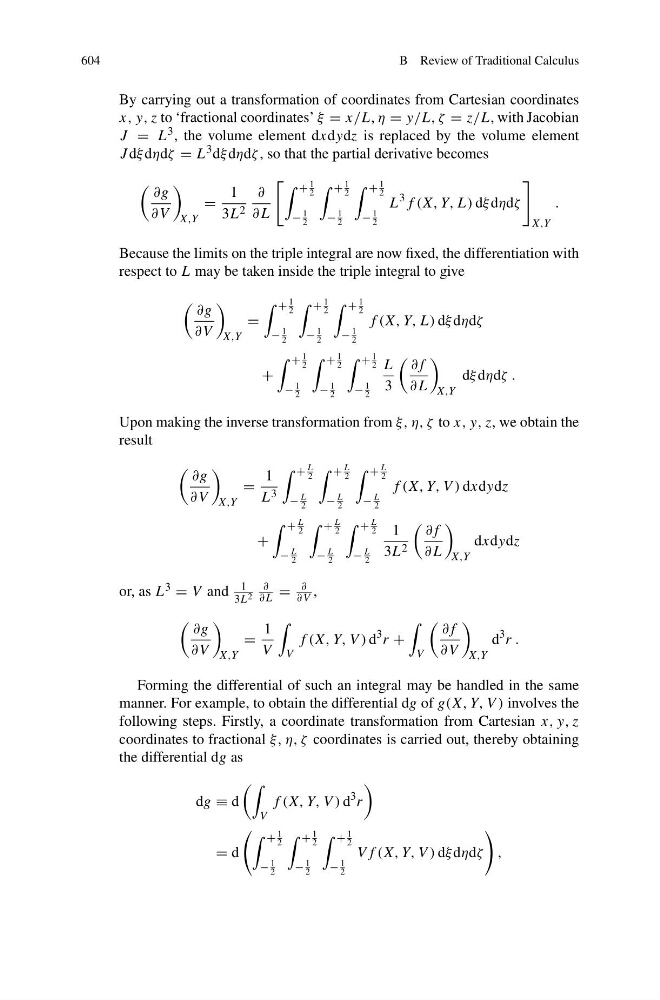
By carrying out a transformation of coordinates from Cartesian coordinates
x, y, z to ‘fractional coordinates’ ξ = x/L, η = y/L, ζ = z/L, with Jacobian
J = L 3 , the volume element dxdydz is replaced by the volume element
J dξ dηdζ = L 3 dξ dηdζ , so that the partial derivative becomes
∂g
∂V
X,Y
=
1
3L 2
∂
∂L
+
1
2
−
1
2
+
1
2
−
1
2
+
1
2
−
1
2
L
3 f (X, Y, L) dξ dηdζ
X,Y
.
Because the limits on the triple integral are now fixed, the differentiation with
respect to L may be taken inside the triple integral to give
∂g
∂V
X,Y
=
+
1
2
−
1
2
+
1
2
−
1
2
+
1
2
−
1
2
f (X, Y, L) dξ dηdζ
+
+
1
2
−
1
2
+
1
2
−
1
2
+
1
2
−
1
2
L
3
∂f
∂L
X,Y
dξ dηdζ .
Upon making the inverse transformation from ξ, η, ζ to x, y, z, we obtain the
result
∂g
∂V
X,Y
=
1
L 3
+
L
2
−
L
2
+
L
2
−
L
2
+
L
2
−
L
2
f (X, Y, V ) dxdydz
+
+
L
2
−
L
2
+
L
2
−
L
2
+
L
2
−
L
2
1
3L 2
∂f
∂L
X,Y
dxdydz
or, as L 3 = V and
1
3L 2
∂
∂L =
∂
∂V ,
∂g
∂V
X,Y
=
1
V
V
f (X, Y, V ) d
3 r +
V
∂f
∂V
X,Y
d
3 r .
Forming the differential of such an integral may be handled in the same
manner. For example, to obtain the differential dg of g(X, Y, V ) involves the
following steps. Firstly, a coordinate transformation from Cartesian x, y, z
coordinates to fractional ξ, η, ζ coordinates is carried out, thereby obtaining
the differential dg as
dg ≡ d
V
f (X, Y, V ) d
3 r
= d
+
1
2
−
1
2
+
1
2
−
1
2
+
1
2
−
1
2
Vf (X, Y, V ) dξ dηdζ
,