

B.1 Derivatives
603
or
f (x, y, z) =
∂f
∂x
dx
dλ
+
∂f
∂y
dy
dλ
+
∂f
∂z
dz
dλ
= x
∂f
∂x
+ y
∂f
∂y
+ z
∂f
∂z
,
which is what we set out to establish.
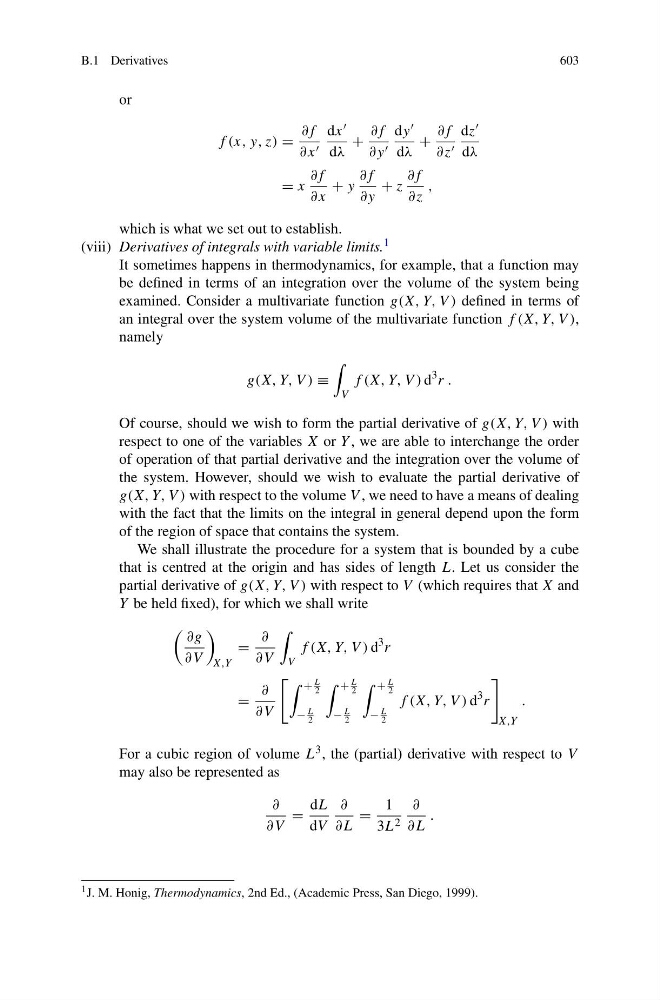
(viii) Derivatives of integrals with variable limits. 1
It sometimes happens in thermodynamics, for example, that a function may
be defined in terms of an integration over the volume of the system being
examined. Consider a multivariate function g(X, Y, V ) defined in terms of
an integral over the system volume of the multivariate function f (X, Y, V ),
namely
g(X, Y, V ) ≡
V
f (X, Y, V ) d
3 r .
Of course, should we wish to form the partial derivative of g(X, Y, V ) with
respect to one of the variables X or Y , we are able to interchange the order
of operation of that partial derivative and the integration over the volume of
the system. However, should we wish to evaluate the partial derivative of
g(X, Y, V ) with respect to the volume V , we need to have a means of dealing
with the fact that the limits on the integral in general depend upon the form
of the region of space that contains the system.
We shall illustrate the procedure for a system that is bounded by a cube
that is centred at the origin and has sides of length L. Let us consider the
partial derivative of g(X, Y, V ) with respect to V (which requires that X and
Y be held fixed), for which we shall write
∂g
∂V
X,Y
=
∂
∂V
V
f (X, Y, V ) d
3 r
=
∂
∂V
+
L
2
−
L
2
+
L
2
−
L
2
+
L
2
−
L
2
f (X, Y, V ) d
3 r
X,Y
.
For a cubic region of volume L 3 , the (partial) derivative with respect to V
may also be represented as
∂
∂V
=
dL
dV
∂
∂L
=
1
3L 2
∂
∂L
.
1 J. M. Honig, Thermodynamics, 2nd Ed., (Academic Press, San Diego, 1999).