

574
10 Quantum Statistics
another astounding result. Why is it so? A number of explanations can be given, but
they all reduce to the fundamental reason being that photons, unlike most other
particles, can be created (emitted) and destroyed (absorbed) by matter, so that
their number is not conserved. Recall that we introduced the chemical potential
μ (through γ = −βμ) in the grand ensemble as a constraint on the total number
of particles [characterizing material contact between our system of interest and the
‘reservoir’]. If the total number of particles is not conserved, then there is no need
for μ to be assigned a specific value, leaving it arbitrary, so that we may set it to
zero.
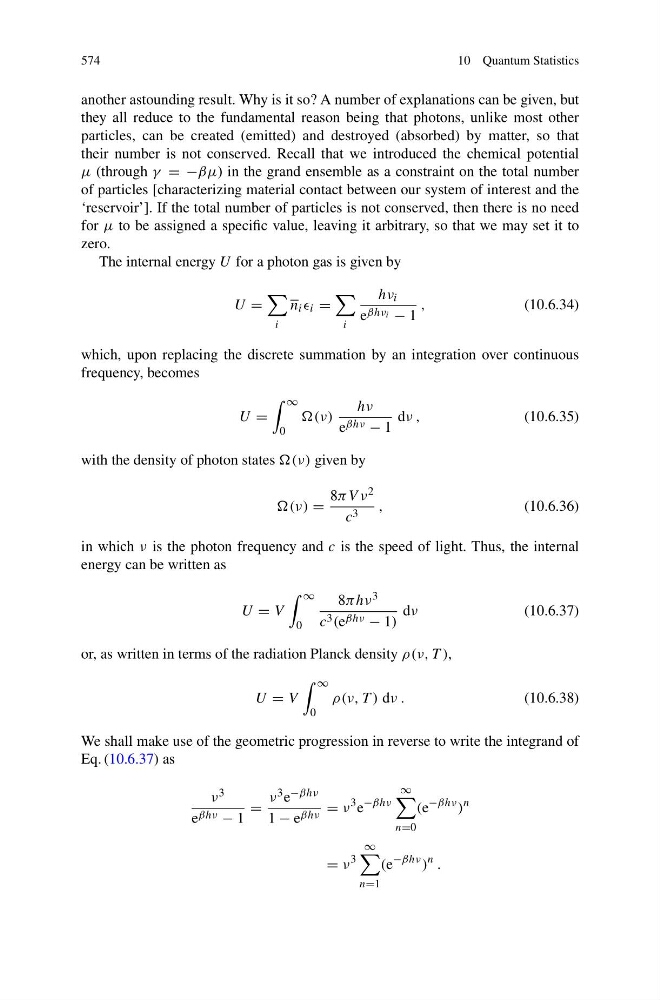
The internal energy U for a photon gas is given by
U =
i
n i i =
i
hν i
e βhν i − 1
,
(10.6.34)
which, upon replacing the discrete summation by an integration over continuous
frequency, becomes
U =
∞
0
(ν)
hν
e βhν − 1
dν ,
(10.6.35)
with the density of photon states given by
=
8πV ν 2
c 3 ,
(10.6.36)
in which ν is the photon frequency and c is the speed of light. Thus, the internal
energy can be written as
U = V
∞
0
8πhν 3
c 3 (e βhν − 1)
dν
(10.6.37)
or, as written in terms of the radiation Planck density ρ(ν, T ),
U = V
∞
0
ρ(ν, T ) dν .
(10.6.38)
We shall make use of the geometric progression in reverse to write the integrand of
Eq. (10.6.37) as
ν 3
e βhν − 1
=
ν 3 e −βhν
1 − e βhν = ν
3 e
−βhν
∞
n=0
(e
−βhν )
n
= ν
3
∞
n=1
(e
−βhν )
n .
10 Quantum Statistics
another astounding result. Why is it so? A number of explanations can be given, but
they all reduce to the fundamental reason being that photons, unlike most other
particles, can be created (emitted) and destroyed (absorbed) by matter, so that
their number is not conserved. Recall that we introduced the chemical potential
μ (through γ = −βμ) in the grand ensemble as a constraint on the total number
of particles [characterizing material contact between our system of interest and the
‘reservoir’]. If the total number of particles is not conserved, then there is no need
for μ to be assigned a specific value, leaving it arbitrary, so that we may set it to
zero.
The internal energy U for a photon gas is given by
U =
i
n i i =
i
hν i
e βhν i − 1
,
(10.6.34)
which, upon replacing the discrete summation by an integration over continuous
frequency, becomes
U =
∞
0
(ν)
hν
e βhν − 1
dν ,
(10.6.35)
with the density of photon states given by
=
8πV ν 2
c 3 ,
(10.6.36)
in which ν is the photon frequency and c is the speed of light. Thus, the internal
energy can be written as
U = V
∞
0
8πhν 3
c 3 (e βhν − 1)
dν
(10.6.37)
or, as written in terms of the radiation Planck density ρ(ν, T ),
U = V
∞
0
ρ(ν, T ) dν .
(10.6.38)
We shall make use of the geometric progression in reverse to write the integrand of
Eq. (10.6.37) as
ν 3
e βhν − 1
=
ν 3 e −βhν
1 − e βhν = ν
3 e
−βhν
∞
n=0
(e
−βhν )
n
= ν
3
∞
n=1
(e
−βhν )
n .