

10.6 Bose–Einstein Statistics
573
C V (T ) =
⎧
⎪ ⎪ ⎪ ⎪ ⎪ ⎨
⎪ ⎪ ⎪ ⎪ ⎪ ⎩
15g
−
5
2
(λ)
4g
−
3
2
(λ)
−
9g
−
3
2
(λ)
4g
−
1
2
(λ)
, for T > T c
15V
4NN 3 g
−
5
2
(1) ,
for T < T c
.
(10.6.31)
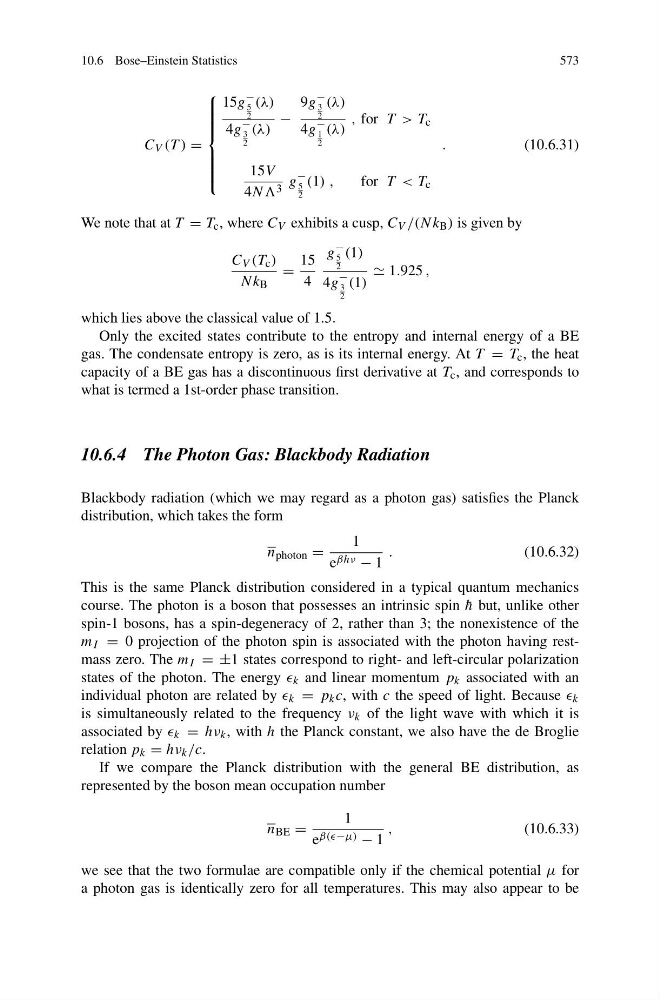
We note that at T = T c , where C V exhibits a cusp, C V /(N k B ) is given by
C V (T c )
Nk B
=
15
4
g
−
5
2
(1)
4g
−
3
2
(1)
1.925 ,
which lies above the classical value of 1.5.
Only the excited states contribute to the entropy and internal energy of a BE
gas. The condensate entropy is zero, as is its internal energy. At T = T c , the heat
capacity of a BE gas has a discontinuous first derivative at T c , and corresponds to
what is termed a 1st-order phase transition.
10.6.4 The Photon Gas: Blackbody Radiation
Blackbody radiation (which we may regard as a photon gas) satisfies the Planck
distribution, which takes the form
n photon =
1
e βhν − 1
.
(10.6.32)
This is the same Planck distribution considered in a typical quantum mechanics
course. The photon is a boson that possesses an intrinsic spin ¯
h but, unlike other
spin-1 bosons, has a spin-degeneracy of 2, rather than 3; the nonexistence of the
m I = 0 projection of the photon spin is associated with the photon having restmass zero. The m I = ±1 states correspond to right- and left-circular polarization
states of the photon. The energy k and linear momentum p k associated with an
individual photon are related by k = p k c, with c the speed of light. Because k
is simultaneously related to the frequency ν k of the light wave with which it is
associated by k = hν k , with h the Planck constant, we also have the de Broglie
relation p k = hν k /c.
If we compare the Planck distribution with the general BE distribution, as
represented by the boson mean occupation number
n BE =
1
e β((−μ) − 1
,
(10.6.33)
we see that the two formulae are compatible only if the chemical potential μ for
a photon gas is identically zero for all temperatures. This may also appear to be
573
C V (T ) =
⎧
⎪ ⎪ ⎪ ⎪ ⎪ ⎨
⎪ ⎪ ⎪ ⎪ ⎪ ⎩
15g
−
5
2
(λ)
4g
−
3
2
(λ)
−
9g
−
3
2
(λ)
4g
−
1
2
(λ)
, for T > T c
15V
4NN 3 g
−
5
2
(1) ,
for T < T c
.
(10.6.31)
We note that at T = T c , where C V exhibits a cusp, C V /(N k B ) is given by
C V (T c )
Nk B
=
15
4
g
−
5
2
(1)
4g
−
3
2
(1)
1.925 ,
which lies above the classical value of 1.5.
Only the excited states contribute to the entropy and internal energy of a BE
gas. The condensate entropy is zero, as is its internal energy. At T = T c , the heat
capacity of a BE gas has a discontinuous first derivative at T c , and corresponds to
what is termed a 1st-order phase transition.
10.6.4 The Photon Gas: Blackbody Radiation
Blackbody radiation (which we may regard as a photon gas) satisfies the Planck
distribution, which takes the form
n photon =
1
e βhν − 1
.
(10.6.32)
This is the same Planck distribution considered in a typical quantum mechanics
course. The photon is a boson that possesses an intrinsic spin ¯
h but, unlike other
spin-1 bosons, has a spin-degeneracy of 2, rather than 3; the nonexistence of the
m I = 0 projection of the photon spin is associated with the photon having restmass zero. The m I = ±1 states correspond to right- and left-circular polarization
states of the photon. The energy k and linear momentum p k associated with an
individual photon are related by k = p k c, with c the speed of light. Because k
is simultaneously related to the frequency ν k of the light wave with which it is
associated by k = hν k , with h the Planck constant, we also have the de Broglie
relation p k = hν k /c.
If we compare the Planck distribution with the general BE distribution, as
represented by the boson mean occupation number
n BE =
1
e β((−μ) − 1
,
(10.6.33)
we see that the two formulae are compatible only if the chemical potential μ for
a photon gas is identically zero for all temperatures. This may also appear to be