

10.6 Bose–Einstein Statistics
563
and
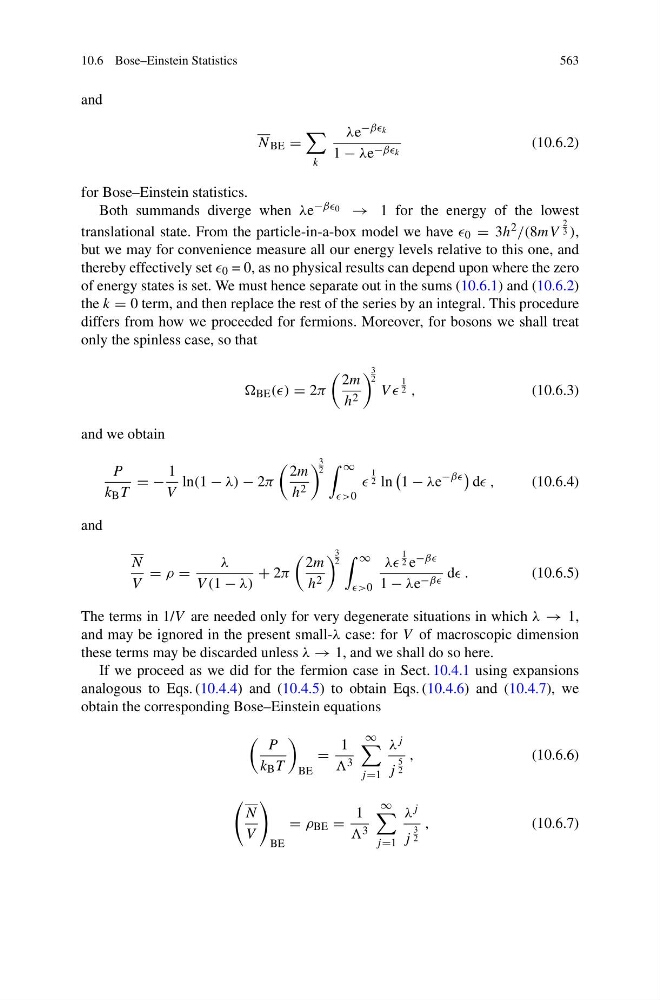
N BE =
k
λe −ββ k
1 − λe −ββ k
(10.6.2)
for Bose–Einstein statistics.
Both summands diverge when λe −ββ 0 → 1 for the energy of the lowest
translational state. From the particle-in-a-box model we have 0 = 3h 2 /(8mV
2
3 ),
but we may for convenience measure all our energy levels relative to this one, and
thereby effectively set 0 = 0, as no physical results can depend upon where the zero
of energy states is set. We must hence separate out in the sums (10.6.1) and (10.6.2)
the k = 0 term, and then replace the rest of the series by an integral. This procedure
differs from how we proceeded for fermions. Moreover, for bosons we shall treat
only the spinless case, so that
BE (() = 2π
2m
h 2
3
2
V V
1
2 ,
(10.6.3)
and we obtain
P
k B T
= −
1
V
ln(1 − λ) − 2π
2m
h 2
3
2
∞
>0
1
2 ln
1 − λe
−ββ
d ,
(10.6.4)
and
N
V
= ρ =
λ
V (1 − λ)
+ 2π
2m
h 2
3
2
∞
>0
λλ
1
2 e −ββ
1 − λe −ββ d .
(10.6.5)
The terms in 1/V are needed only for very degenerate situations in which λ → 1,
and may be ignored in the present small-λ case: for V of macroscopic dimension
these terms may be discarded unless λ → 1, and we shall do so here.
If we proceed as we did for the fermion case in Sect. 10.4.1 using expansions
analogous to Eqs. (10.4.4) and (10.4.5) to obtain Eqs. (10.4.6) and (10.4.7), we
obtain the corresponding Bose–Einstein equations
P
k B T
BE
=
1
3
∞
j =1
λ j
j
5
2
,
(10.6.6)
N
V
BE
= ρ BE =
1
3
∞
j =1
λ j
j
3
2
,
(10.6.7)
563
and
N BE =
k
λe −ββ k
1 − λe −ββ k
(10.6.2)
for Bose–Einstein statistics.
Both summands diverge when λe −ββ 0 → 1 for the energy of the lowest
translational state. From the particle-in-a-box model we have 0 = 3h 2 /(8mV
2
3 ),
but we may for convenience measure all our energy levels relative to this one, and
thereby effectively set 0 = 0, as no physical results can depend upon where the zero
of energy states is set. We must hence separate out in the sums (10.6.1) and (10.6.2)
the k = 0 term, and then replace the rest of the series by an integral. This procedure
differs from how we proceeded for fermions. Moreover, for bosons we shall treat
only the spinless case, so that
BE (() = 2π
2m
h 2
3
2
V V
1
2 ,
(10.6.3)
and we obtain
P
k B T
= −
1
V
ln(1 − λ) − 2π
2m
h 2
3
2
∞
>0
1
2 ln
1 − λe
−ββ
d ,
(10.6.4)
and
N
V
= ρ =
λ
V (1 − λ)
+ 2π
2m
h 2
3
2
∞
>0
λλ
1
2 e −ββ
1 − λe −ββ d .
(10.6.5)
The terms in 1/V are needed only for very degenerate situations in which λ → 1,
and may be ignored in the present small-λ case: for V of macroscopic dimension
these terms may be discarded unless λ → 1, and we shall do so here.
If we proceed as we did for the fermion case in Sect. 10.4.1 using expansions
analogous to Eqs. (10.4.4) and (10.4.5) to obtain Eqs. (10.4.6) and (10.4.7), we
obtain the corresponding Bose–Einstein equations
P
k B T
BE
=
1
3
∞
j =1
λ j
j
5
2
,
(10.6.6)
N
V
BE
= ρ BE =
1
3
∞
j =1
λ j
j
3
2
,
(10.6.7)