

562
10 Quantum Statistics
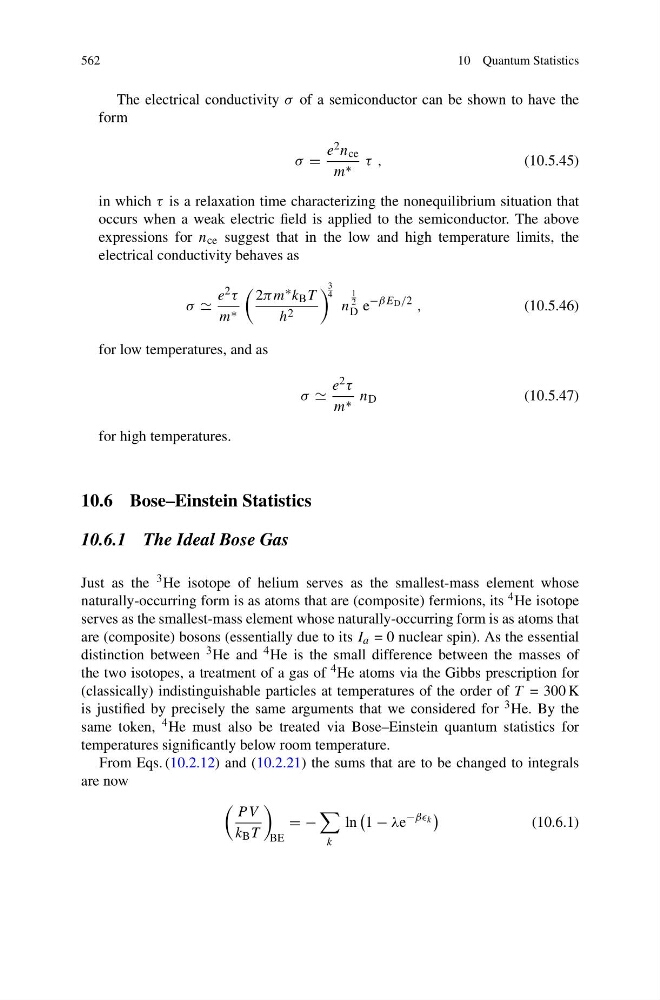
The electrical conductivity σ of a semiconductor can be shown to have the
form
σ =
e 2 n ce
m ∗ τ ,
(10.5.45)
in which τ is a relaxation time characterizing the nonequilibrium situation that
occurs when a weak electric field is applied to the semiconductor. The above
expressions for n ce suggest that in the low and high temperature limits, the
electrical conductivity behaves as
σ
e 2 τ
m ∗
2πm ∗ k B T
h 2
3
4
n
1
2
D e
−βE D /2 ,
(10.5.46)
for low temperatures, and as
σ
e 2 τ
m ∗ n D
(10.5.47)
for high temperatures.
10.6 Bose–Einstein Statistics
10.6.1 The Ideal Bose Gas
Just as the 3 He isotope of helium serves as the smallest-mass element whose
naturally-occurring form is as atoms that are (composite) fermions, its 4 He isotope
serves as the smallest-mass element whose naturally-occurring form is as atoms that
are (composite) bosons (essentially due to its I a = 0 nuclear spin). As the essential
distinction between 3 He and 4 He is the small difference between the masses of
the two isotopes, a treatment of a gas of 4 He atoms via the Gibbs prescription for
(classically) indistinguishable particles at temperatures of the order of T = 300 K
is justified by precisely the same arguments that we considered for 3 He. By the
same token, 4 He must also be treated via Bose–Einstein quantum statistics for
temperatures significantly below room temperature.
From Eqs. (10.2.12) and (10.2.21) the sums that are to be changed to integrals
are now
P V
k B T
BE
= −
k
ln
1 − λe
−ββ k
(10.6.1)
10 Quantum Statistics
The electrical conductivity σ of a semiconductor can be shown to have the
form
σ =
e 2 n ce
m ∗ τ ,
(10.5.45)
in which τ is a relaxation time characterizing the nonequilibrium situation that
occurs when a weak electric field is applied to the semiconductor. The above
expressions for n ce suggest that in the low and high temperature limits, the
electrical conductivity behaves as
σ
e 2 τ
m ∗
2πm ∗ k B T
h 2
3
4
n
1
2
D e
−βE D /2 ,
(10.5.46)
for low temperatures, and as
σ
e 2 τ
m ∗ n D
(10.5.47)
for high temperatures.
10.6 Bose–Einstein Statistics
10.6.1 The Ideal Bose Gas
Just as the 3 He isotope of helium serves as the smallest-mass element whose
naturally-occurring form is as atoms that are (composite) fermions, its 4 He isotope
serves as the smallest-mass element whose naturally-occurring form is as atoms that
are (composite) bosons (essentially due to its I a = 0 nuclear spin). As the essential
distinction between 3 He and 4 He is the small difference between the masses of
the two isotopes, a treatment of a gas of 4 He atoms via the Gibbs prescription for
(classically) indistinguishable particles at temperatures of the order of T = 300 K
is justified by precisely the same arguments that we considered for 3 He. By the
same token, 4 He must also be treated via Bose–Einstein quantum statistics for
temperatures significantly below room temperature.
From Eqs. (10.2.12) and (10.2.21) the sums that are to be changed to integrals
are now
P V
k B T
BE
= −
k
ln
1 − λe
−ββ k
(10.6.1)